Saturday, March 2, 2024

SPACEMAN: This is the Beginning


Without knowing a thing about it, including that it had even been made, I watched Johan Renck's Spaceman last night. Although going in, I had no idea what it was about, it was, nonetheless, 100% not anything I might even have suspected.  I was immediately - as in within seconds - completely caught up in everything this story had to say, the art direction, the acting, the storytelling and . . . well, quite frankly not only moved (several times) to tears, but actually kind of blown away by the inherent sadness and tone of it.  

This is a nearly impossible movie to review without giving it away, so here is a 99.9% spoiler free synopsis. 

Czech cosmonaut, Jakub Procházka is on a solo journey to investigate and collect samples from the heavenly anomaly, Chopra, a beautiful, glowing purple cloud of dust that appeared on Earth's horizon several years prior. For this mission,  Jakub had to leave his beautiful, adored wife and unborn daughter. He fights loneliness, depression, and technical issues on his spacecraft in the form of toilet issues, cameras breaking down, noise and eventually, failing communications with Earth.  Six months into his journey he is awakened by an unwelcome alien creature (although being the universe, he, too, is in reality, an alien). This creature, an enormous spider, wreaks havoc on Jakub's psyche as he struggles wondering if he is hallucinating or if this is his reality.  Eventually, a bond is formed between the two beings, and he names the spider (who is from a race where there are no names) Hanuš, who was once believed to have been the builder of the Prague Astronomical Clock in 1410. In turn, Hanuš addresses Jakub only as Skinny Human.  

As they drift closer to Chopra Hanuš is able to see into the mind of Jakub, understand his crippling loneliness, and the fraying of his marriage directly caused by an inability to face the horrible realities of his childhood, and be completely honest with his beloved Lenka. 
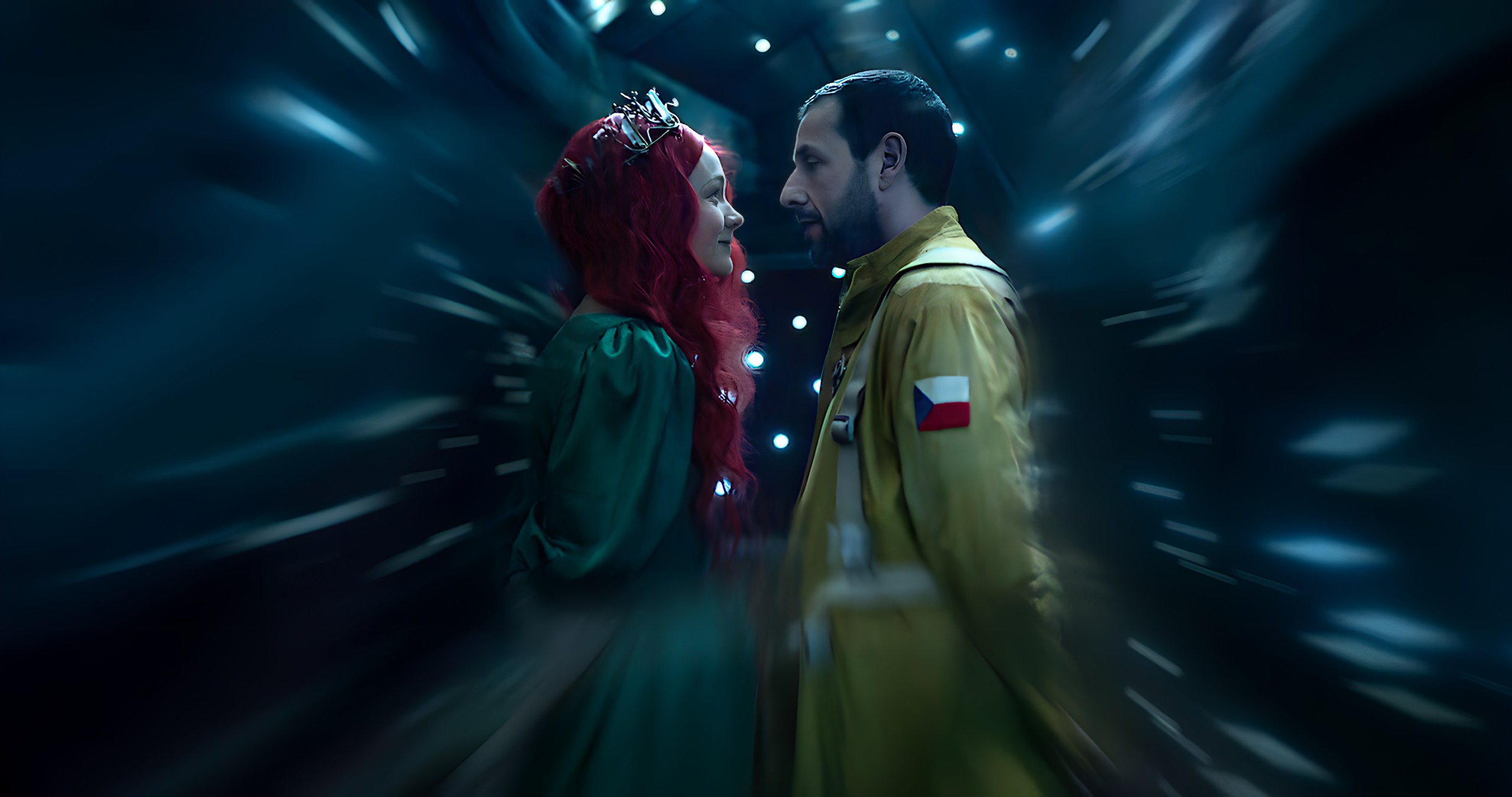

Opera lovers may find it interesting how important a role, musically thematically, and dramatically, Dvořák's Rusalka plays in Spaceman, including Jakub's description of the opera to Hanuš. Renée Fleming's recording with Sir Charles Mackerras' of Měsíčku na nebi hlubokém (Song to the Moon) makes several appearances in Max Richter's hauntingly atmospheric soundtrack.  

Full disclosure: I have never been much of an Adam Sandler fan, but here, the fellow bares naked the tortured soul of Jakub, a man who will fearlessly face anything but the realities of his sad and lonely life. Sandler's performance is magnificent. Frustrating. Heartbreaking. Paul Dano supplies the gentle voice of his wise new companion, Hanuš.


Although the bulk of the film is carried on the spaceship, the earthbound counterparts are of equal importance to the tale, and here, Carrie Mulligan as the heartbroken Lenka struggling to move ahead in life is gripping and moving. (One may ask, when is she never?)  Lena Olin - a face we don't see as often as we should - is excellent in the short role of Lenka's mother.  Isabella Rossellini, as Commissioner Tuma - Jakub's commander  is strong, compassionate, and determined to make certain everything works for Jakub whose shoulders much is carried on in this project.

To tell more than this, would be too much I think.

But you may decide NOT to see this movie as, since watching it, I've read countless reviews and nearly all of them have torn the film to pieces. One of the tropes I find most appalling - and one of the biggest cop outs, come from critics who use variations of the phrase "this movie can't decide what it wants to be. Is it a space movie? A love story? Sci-Fi? A statement on the human conditon?"  Why does a story need to be confined to one thing? Why should a movie about humans on earth and in space be only about earth and space? I could go on, but  . .. nah.  


The film is directed by Johan Renck - whose 2019 Chernobyl was an international hit, not to mention one of the best things seen on television in the last decade. Renck has also garnered praise and awards for pilots and episodes of things like Breaking Bad, Black Mirror, Vikings, and The Walking Dead. He treats this filmic adaptation of  Jaroslav Kalfař's acclaimed novel Spaceman of Bohemia, with love, striking perfect balances between what is real and what may not be real, and in so doing, creates a universe, both on earth and in heaven, that is frequently breathtaking in its beauty. 

In the end, all I can say is this: I fell in love with this strange, and strangely beautiful film and plan to journey with it again soon.      

Labels: , , , , , , , , , , , , ,

Thursday, December 21, 2023

Maestro: A Love Letter to Lenny

I just finished watching Bradley Cooper's film on Leonard Bernstein. It was not at all what I was expecting, and, in fact, I went in with a lot of hesitation. For one thing I was not expecting a love story, and I'm one who fairly loathes and avoids love stories, generally. Even more unexpectedly, Maestro, went straight to my heart. Having not particularly cared for most of Mr. Cooper's roles or films, I've always felt there was a great actor often miscast in mediocre movies and crude comedies. Every once in a while, however, a role came through that confirmed for me something great was coming.  This was that something.  Cooper's style of filmmaking - at least for this motion picture - is pure, old-fashioned Hollywood. So much so in fact, the entire first half, shot in vivid black and white, with its period costumes, decor and sense of style, made had the feel and look like a classic film. So, seeing him co-write, direct and act in a project with this much care, attention to detail and understanding of the medium was . . . well, rather beautiful.

The transition from black and white to color was almost imperceptible . . . it just happened, no segue, no waking up in Oz, but nonetheless there was a clear delineation which divided the two distinct halves of the film.  

I've heard much made about the falseness of Lenny and Felicia's relationship, the sham marriage, and more. This I find to be nonsense, entirely missing the point of how despite the complexities, the difficulties (and not only sexually) that two people can love each other this deeply, this profoundly.  The chemistry between Cooper and Carrie Mulligan was, at least to these tired old eyes, pure magic. The courtship had me smiling, imagining them both that young, with all manner of hopes and dreams for their respective careers, but really not a clue how all of this would play out in real time and on the world stage. 

There are accusations of the film not going gay enough, which I also find rather a bit of nonsense. One needn't look too far back to see a far different reality for gay life than we are witness to today. And again, the film was essentially about the Bernstein marriage more than it was anything else, including his career, for which we already have recordings, films, and countless books, articles, and essays which, more adquately address that aspect of his life and career than is possible in a theatrically released movie.  My Bernstein Bible will always be the Harvard lecture series The Unanswered Question - over thirteen hours of Lenny sharing with us, probing beneath the surface of nearly every aspect of the why, how, when and more of music.  

Ms. Mulligan gives, hands down, perhaps the finest, most bravura performance of an actress I've seen on-screen this year. I can't think of a performance I've loved as much. Mulligan's Felicia is presented as a beautiful, charming, and gifted, strong willed woman whose smile, voice and style would captivate anyone. Regardless of his sexuality, it was easy to see why Lenny fell for her.  Similarly, regardless of knowing his sexuality, one could just as easily see why she fell for him.  

This is not a movie about Bernstein as a conductor, or composer, or classical superstar - although all of those elements are wed into the story (how could they not be). We don't witness his triumphs in Vienna, Rome, Israel, Munich, Paris or London, but instead the story about the marriage of Lenny and Felicia. Indeed, nearly every scene in the film revolves around their lives, their decisions, their love story, thorns and all.

If the first half felt like a sweet romantic comedy involving two larger-than-life figures, the second, which developed the ongoing difficulties, Felicia's illness, Lenny's insecurities working their way into everything, and even poisoning some things, I often felt as though I was a voyeur, intruding on moments too private and not meant for my eyes.  Of course great art can do that to us . .. it's part of its job. 

The large supporting cast feels handpicked and appropriate to the era, especially Sarah Silverman as Lenny's sister, Shirley.

While Bernstein's music is ever present as (most of) the soundtrack, the music, for the most part, takes a back seat to the story of Lenny and Felicia. But, when the music does drop in, it is in moments that can sweep us away. The dance rehearsal of On The Town, when, through the magic of film, Lenny transforms from smiling observer alongside Felicia, to a sailor showboating for his lady love is absolutely magical.  In a different vein, the Ely Cathedral Mahler 2nd - Resurrection - ends in a triumph that segues us into the most difficult and last leg of this beautiful film.

I'm not ashamed to say that, several times, Maestro hit me like a suckerpunch, and had me in tears, and involuntarily sending my hand to my heart..

Mr. Cooper's effort, as well as those of the cast and production team, reveal this as a labor of love . . . a love letter to a man I've loved and revered since boyhood, and was one of the  people who shaped my own relationship to music. It doesn't get much more personal than that. 

Labels: , , , , , , ,