Tuesday, April 25, 2023

THE WONDER: Sebastian Lelio's Film Is Aptly Named


I always say a movie cannot be compared to the novel it was based on and that is a GOOD thing. Many complain, but the reality is the two things are, and must be, entirely different entities. It is literally impossible for them to be otherwise. It is therefore that rare thing - for me - when novel and film affect me exactly the same, which is what happened for me with Emma Donoghue's novel Room and the film based upon it.  

I've wanted to read Donoghue's The Wonder for some time, but still have not gotten around to it, so when I saw the film was on Netflix I was conflicted if I should wait, or just hit "play."  I opted for the latter, and having just moments ago finished watching it, believe I made the right decision.  

Sebastian Lelio, using the screenplay adapted by Donoghue herself, along with Alice Birch goes directly to the spirit of the movie in a way that is extraordinary and the result is a film that is . . . extraordinary.

Without giving anything away, Lelio uses an ingenious framing device for his movie that transcends what is true and what is not true, that, and that in its way makes irrelevant arguments between what is right and wrong. None of this comes easy, nor is it an easy film to watch.

A decade after the Great Irish Famine, a small village believes they have a saint on their hands in the form of a young girl who has refused to eat for four months, yet seems relatively healthy. "She is a wonder," we are told by one of the many visitors to her home to witness the miracle child themselves. Skeptical, a local committee hires an English nurse to observe young Anna to either prove or disprove the claims the faithful believe to be true.  

As nurse Elizabeth "Lib" Wright, Florence Pugh gives a performance of towering strength, hiding, for as long as she can, Mrs. Wright's insecurities and vulnerabilities as she tries to pit science against the kind of blind faith that helps give religion a bad name.  Treated poorly, and all but shunned by the religious zealotry who are longing for a miracle, she slowly unravels the truths behind the tale of the girl who lives on nothing but "Manna from Heaven."  

In an equally impressive performance, Kila Lord Cassidy imbues in Anna a sense of purity that seems both other wordly wise, yet frustrating in her simplicity and religious fervor. She is constantly praying, speaking of heaven and hell and the precious blood of Jesus. But her earnestness and belief strikes something in the skeptical nurse.  At this I felt there was more than a faint similarity between Donoghue's story and John Pielmeier's  1979 play Agnes of God, though the stories themselves have little in common. 

While the story is centered on the relationship between nurse and patient - observer and observee, this is a large ensemble piece creating Anna's family and community, and without singling any of them out here, there is not a weak performance among them.


Lelio's direction, is always exquisite and often remarkable, in the way his cameras seem to capture lighting, color and halo effects in a scene that seem almost inspired by the paintings of Rembrandt or other of the Dutch Masters.  Everything is perfectly placed, nothing appears to be random or extraneous . . . all essential, visual elements serving to point up the story in a most revealing manner. 

The score by Matthew Herbert is perfect an aural match highlighting everything we see or think we see.  (in 2010 Herbert famously shocked the music world with his "recomposition" of the Mathler 10th for Deutsche Grammophon).  The Wonder serves not only for the title of this film, it's also an apt description of Lelio's work.


Labels: , , , , , , , ,

Monday, December 19, 2022

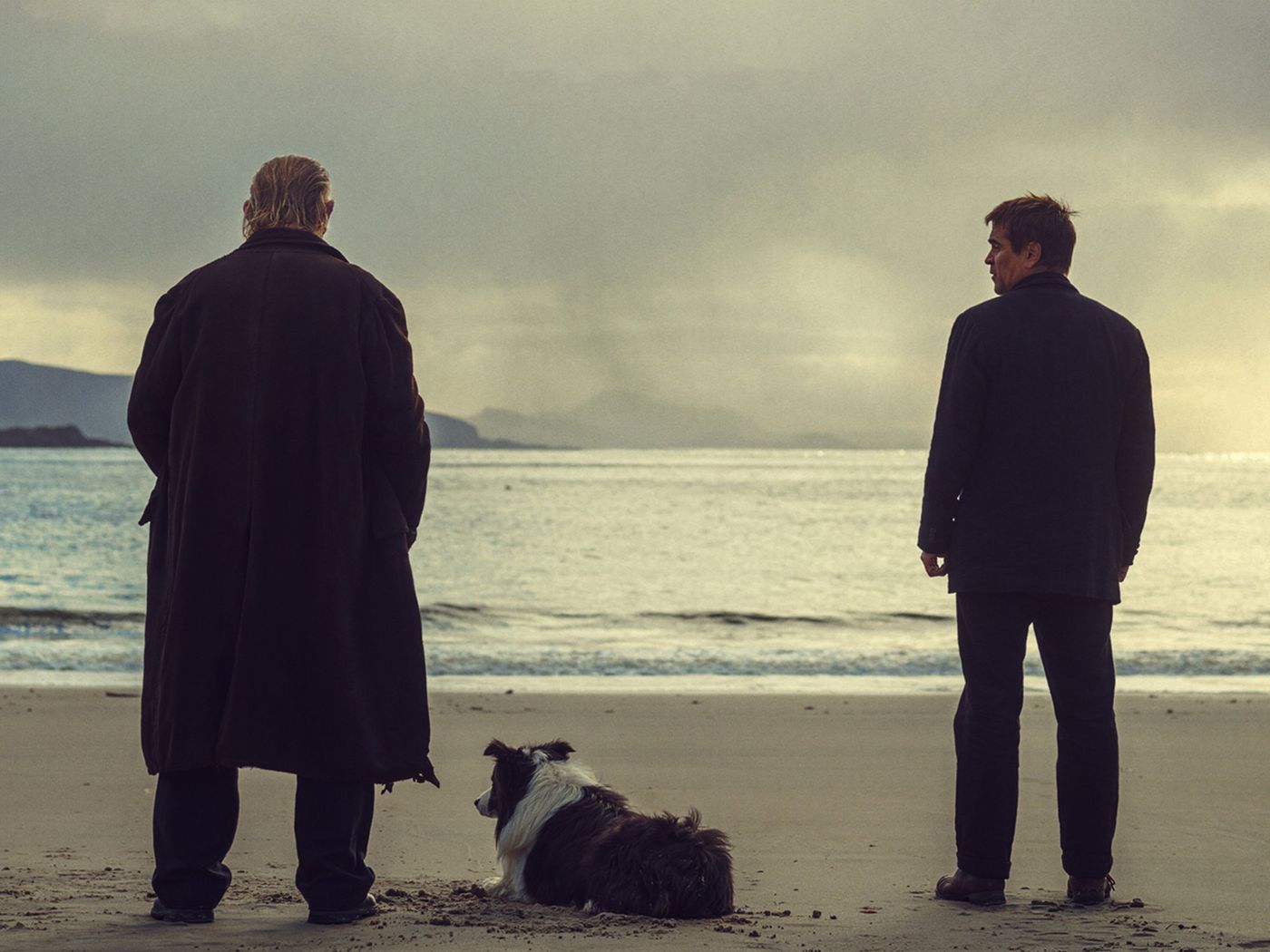
THE BANSHEES OF INISHERIN. Martin McDonough Does It Again

As he did with In Bruges, writer/director Martin McDonough strikes cinematic gold with a pair of actors at the top of their game. Again. 

McDonough's The Banshees of Inisherin is my favorite kind of movie:  a genre busting, black comedy, horror, realistic fantasy, tragic revenge drama with an oversized heart and a cast of characters that are, each and every one of them, as memorable as its two stars.  And what stars McDonough gives us: Colin Farrell and Brendan Gleeson.  Both actors here give some of their most rewarding work ever committed to film.  And they're surrounded by a well of talent so memorable and well written, I pretty much fell in love with every character in this movie, set during the last days of the 1923 Civil War.   

It's hard to describe without giving spoilers, but I don't believe what I have to say here spoils anything, in fact, reading commercial reviews - which I held off reading until after viewing it myself - give away far more, so feel free to press on.  

Banshees is the tale of Pádraic (Farrell) and Colm (Gleeson), a pair of previously inseparable friends on the tiny island of Inisherin. The film begins with Colm essentially declaring he wants Pádraic out of his life - forever, fully intent never to speak or see him ever again. Pádraic is crushed, but also naturally curious as to what the cause of this sudden "divorce" is, but no easy answers are forthcoming.  In his pursuit to understand the reasons behind it his confusion progresses from sadness to despondency, to resentment and revenge. 

Farrell's Pádraic is, from the start, a sort of sweet, good guy, none too bright, but earnest and well loved by all.  Except now by Colm.  The actor gives a sort of wounded bird quality throughout his performance which is endearing and not just a little heartbreaking.

As Colm, Gleeson is a gifted fiddle player and teacher, his modest home on the shore, filled with odd artifacts like ancient puppets and masks.  Admitting to suffering "from despair, there is a sad almost moroseness to Colm from the get go. Wedded to his resolve to shut Pádraic out of his life, I found I myself was perplexed, digging deeper into their friendship, and I realized, like Pádraic, I was searching for reasons to explain this and never fully coming up with one.  At least not a good one.  Then again, I'm not Colm. (Note: a reason is given, but I, at least after a single viewing, am not buying it for a second.)

To show the strength of his conviction that the pair should separate, the gifted fiddler states that should Pádraic ever speak to him again, he will sever a finger.  From here we move into a bit of the genre of horror story, and wonder, along with Pádraic "will hewon't he?"  All of this adds an element of uncomfortable anxiety to the viewer (or at least this viewer). 


Pádraic shares a tiny home (and a single bedroom) with his sister, Siobhán, who receives an absolutely, gloriously understated performance from the wonderful Kerry Condon. All I can say about Condon's Siobhán is, just try not to fall in love with her.  I couldn't not. She's fiercely protective of her brother whose affinity and love for their animals, a horse, some cattle and the miniature donkey, Jenny, who will steal your heart.  This loyalty and protection, however, does not prevent her brother from driving her absolutely crazy at times.

Siobhán, is well read and wise, a woman who holds her own, and yet it is evident from our first glimpse of her, and by every ensuing look, gesture and action, this is someone who clearly feels trapped - a prisoner - serving time on this tiny island.  Through all of this you can quite sense her longing to leave Inisherin.  Forever.  

Other quite remarkable performances come from the drunken police officer (Gary Lydon) and Dominic, his abused, dimwitted, but observant son, brilliantly played by Barry Keoghan, and David Pearse's foul-mouthed priest. And then there is the pipe smoking, ghoulish old Mrs. McCormick of Sheila Flitton, whose presence is enough to give one - everyone - the creeps.  You need only catch a glimpse of her and can feel your skin clamming up.

In addition to the amazing performances from its cast, cinematographer Ben Davis captures the island, and the surrounding waters in an almost mythic fashion; fog and shadow, fire and light and every other element creates an absolutely gorgeous feast for the eyes.

Carter Burwell's score adds yet another dimension, and there are musical insertions that point up every dramatic moment to nearly unbearable levels of beauty and grief. Among these features are operatic/song  offerings from John McCormack, Jessye Norman and Juliane Banse, as well as moments from Carl Orff's opera Der Mond.  

As I watched, I kept feeling as though I knew these characters from somewhere else.  They and the story being told, seemed so thoroughly literary . . . I felt almost certain I'd read this tale in some ancient collection of Irish short stories. Of course, nobody does the tragic trifecta of quiet despondency, loneliness and heartbreak quite like the Irish.   

It really is just about perfect

Labels: , , , , , , , , ,