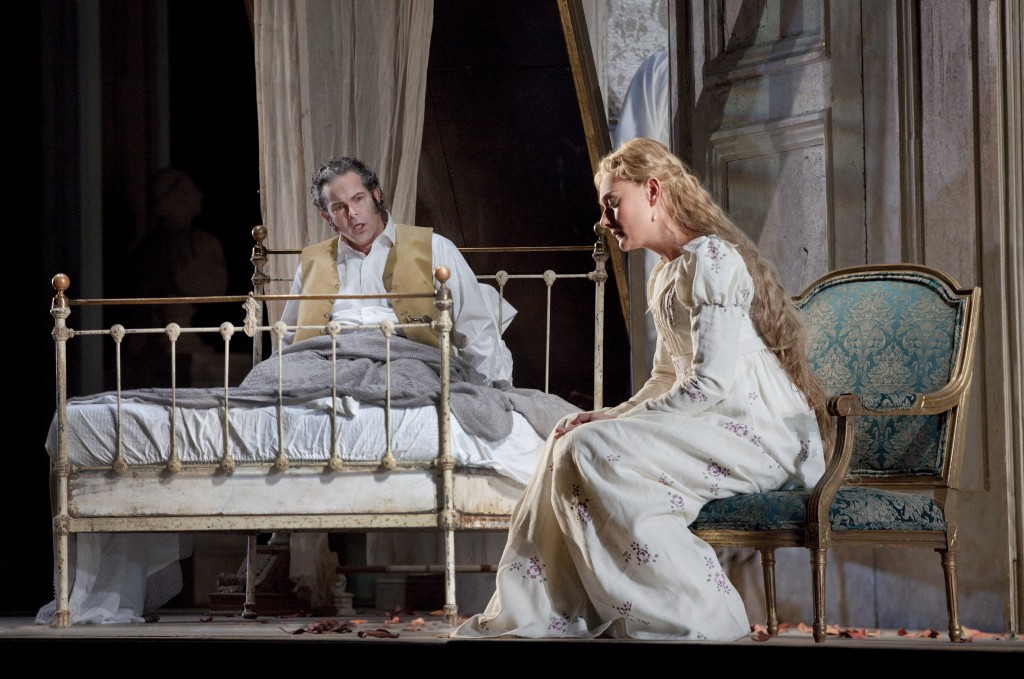
Pelléas et Mélisande : Faith Esham and Jerry Hadley - Wow!

I’ve been listening to a fascinating performance of Pelléas et Mélisande from 1992. Lyric Opera of Chicago with Faith Esham, Jerry Hadley and Victor Braun. Teresa Stratas was taking over the role for Frederica von Stade, but cancelled the first two performances so Faith Esham made her Lyric Opera debut. Pelleas is among my favorite operas, so I’ve heard many pairings over my lifetime (so far) and, fan of both Ms. Esham and Mr. Hadley that I am, was not quite prepared for the performance they presented on opening night. I generally prefer a tenor in the role (Richard Stilwell, Simon Keenlyside, taking top honors for baritones) and Hadley does not disappoint in that regard. He and Esham both had very bright sounding voices which sounds so “right” in French, their diction crisp yet fluid – perfect for Debussy’s “problem” opera. The scenes between Esham and Braun’s Golaud have a depth and bite that could convince even non-fans this is a drama more than about “nothing.”
At the start, Braun seems a tad less gruff than many a Golaud, but he gradually sinks into a sort of cruelty - a violence that ever grows in its intensity until it becomes downright horrifying, even before his ultimate crime.
My favorite tenor Pelleas has, for a time, been Richard Croft and Hadley’s performance here does not take him down from the shelf, but boy, is he terrific in his own way. Croft has an elegance that fits in with Debussy’s soundscape – just about perfectly. Hadley, on the other hand, does not skimp on matters musical – and in certain moments (notably in the Tower scene) brings his own brand of elegance. More often than not, however, there is a slight “roughness” (not the sound itself, but the way he handles the role) that is unusual yet perfectly in tune with his and Esham's take on the lovers.
Esham’s first of several utterances of “Pelleas” in the Tower scene is sparked with an undeniable eroticism that shocks . While many Melisandes retain an aloofness throughout the role, Esham makes her seem almost familiar, yet somehow just as puzzling and troubled. In the middle of a scene she may add a touch of nervousness to her sound emphasizing the girlishness which, along with that brightness and ease of the language (her best roles truly were Manon, Juliette, Leila, Marguerite . . . ) makes this a special performance. Also, like a tenor Pelleas, a soprano (as opposed to mezzo) Melisande really changes the tone of the opera.
The great Act IV love scene drips with passion and Esham and Hadley sound as if they can barely contain themselves – and then when Hadley’s Pelleas reaches, “Et maintenant je t'ai trouvee. . . je ne crois pas qui'il . . . ait sur la terre un femme plus belle!" they – and we – realize they cannot. Breathless passion mounts into a sudden, slow ecstasy, each singer now sounding, somehow, a bit older, as if the realization of this love has aged them. It's almost more like they're playing "grown up,” which makes Golaud’s sudden appearance and slaughter of Pelleas more unbearably than it already is, Melisande's final cry adding an extra punctuation mark of horror.
Yvonne Minton, turns in her customary excellence in the fairly ungrateful role of Genevieve, and Dimitri Kavrakos is touching as Arkel. Soprano, Lucy Tamez Creech has a very boyish voice, though it appears she sang Yniold from the pit while child actor Joel Eng pantomimed onstage.
James Conlon, like every conductor of this opera, has a passion for it that comes out through his masterful reading of it. He brings out the sonic wonderment of the score, while keeping everything and everyone in near perfect balance. I would have liked a bit more “oomph” and drive at the beginning of the love scene, but this approach and gradual build up certainly makes good dramatic sense. The “special effects” of the percussion section – bells, etc., absolutely sparkle and shine. During the first intermission of the broadcast, he is interviewed and offers terrific insights into Debussy’s masterpiece and the characters who populate it. He draws an interesting parallel between Arkel and Pelleas that I’d never really thought about before. I love when someone sheds new light on something that can, at times, seem almost overly familiar. It puts things back into the right perspective and makes me, as here, love that thing all the more.
Since recently moving, and giving away/selling many of my recordings I’m not certain how many of “Pelleas” I still own, but this would have been, according to my estimation, the 32nd in my collection. I think that qualifies me as a Pelleas obsessive, oui?
p.
Labels: 20th century opera, Chicago, Debussy, Dmitri Kavrakos, Faith Esham, French Opera, James Conlon, Jerry Hadley, Lyric Opera, melisande, pelleas, pelleas et melisande, Victor Braun, Yvonne Minton
posted by Sharky at
1:44 PM
2 Comments