Friday, September 23, 2022

John Adams: Still Going Strong With Antony and Cleopatra


After reading Zachary Wolfe’s dismissal of John Adam’s latest opera, Antony and Cleopatra, referring to it as his “dullest” and how its three long hours “slump(s) to a subdued finish,” and ultimately damning it as “a dreary disappointment,” I was uncertain what to expect.  


Insomnia bade me to give it a whirl tonight, and I thought, at worst, it could cure this sleeplessness.  The effect, however, was entirely opposite of that.  While there were several moments in the first act that had me wanting to push the whole thing forward, most of it grabbed me, propelling its way to a rather thrilling conclusion that, orchestrally at least, hinted the Act One finale of  Doctor Atomic.  What I was not prepared for, however, was how its longer second act felt as though it passed before my eyes and ears in a matter of minutes.  


Indeed, through its tautness, sheer theatricality and best of all, magnificent performances by a terrific cast, Adams second act bounced, danced, wriggled and writhed, exploding from strength-to-strength. Indeed, I felt breathless for its first forty-one minutes (hitting pause to get some water, so noticed the time).  While its pace at that point, slowed down, it did so appropriately to the storytelling, all the while ever gaining in intensity up until its tragic, and literal, denouement.  


Antony and Cleopatra frequently finds Adams more traditionally lyrical than in the past, but anyone acquainted with his output is never at a loss as to whose music this is.  There are moments of turgidity, fire, and horror, too, if different than those we experienced in his other operas.  A genius of orchestration, the composer brings in his old friends the cimbalom and hammered dulcimer, which introduce a slight tang that musically highlights the exoticism of the storytelling.  I’d happily pit this score (no pun intended), after a single hearing against any of his others for sheer expressiveness of sound and beauty.  Music Director Eun Sun Kim, leads the San Franciscans in a reading that captures every nuance of the complex score, weaving it and holding it together with marvelous fluidity, nuance and strength.


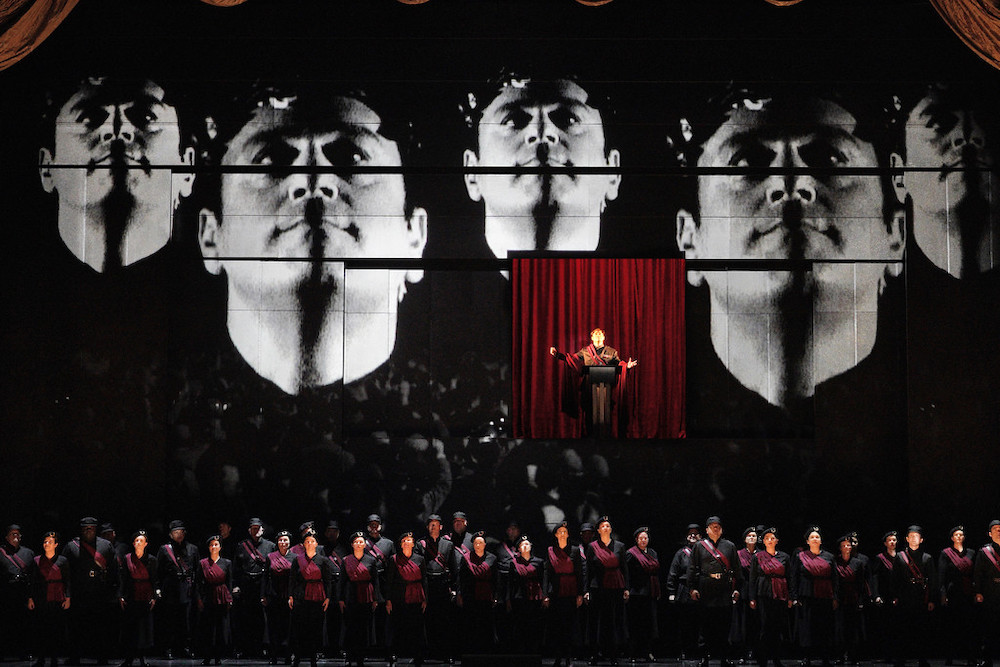
San Francisco Opera clearly pulled out all the stops for this centenary celebratory work, from the powerfully dramatic direction of Elkhanah Pulitzer, to Mimi Lien’s never less than stunning 1930's pseudo-Hollywood design which morphs instantly from minimalistic and intimate to theatrically overpowering with near cinematic seamlessness.  

That commitment extended to the cast which, I cannot imagine being bettered.  Gerald Finley’s voice is one of those that seems ageless, and at 62 remains one of the most beautiful baritones I’ve ever heard, with that unique sense of clarity of sound that allows text to sound as clear as though it were being spoken.  Finley is marvelous as Antony, and captures the complete essence of the heroic romantic warrior from first to last.  Here is every aspect of a complex persona, his hubris, humanity, bitterness, jealousy, fear, rage and despair all worn, as Iago says, “upon his sleeve for daws to peck at.”  


Then there is the Cleopatra of Amina Edris.  Having never heard of the soprano before, and knowing she was a late substitute for Adams’ favorite Julia Bullock, I had reservations. They were dashed about as quickly as she opened her mouth.  Add to the fact she’s a lovely singer in face and figure, her being Egyptian born seemed to add an additional frisson to the proceedings.  Edris’ crystal clear soprano, immaculate diction (in sung Shakespeare, no less) made her Cleo the perfect match to her Antony.  Adams’s writing for the character is of a certain “all over the map” style requiring the singer to wrestle with the language at both the top and bottom of the range, and Edris never – not once – faltered.  Even at the top her diction was flawless, rendering the titles unnecessary.  As to that last statement, this was fairly true of the entire cast.  She fairly owned the second act, and her scenes at Antony’s demise, and at the hands of Caesar’s rubes, and ultimately her suicide found this young soprano clearly making a mark for the big time.  


Paul Appleby’s Caesar offered him in one of the best roles I've seen him in.  His power-grab scene rousing the masses played off brilliantly and horrifically with a sense of showing how little the world has really changed.  Ever.  


Alfred Walker has never disappointed me and here, as Enobarbus, he only makes me wish he’d get more prominent assignments in our houses.  Hired for Masettos and Crowns this is a voice with Wagner and Verdi stamped all over it.  


The balance of the cast, Elizabeth Deshong, Taylor Raven, Brenton Ryan, et al., contribute and help complement the evening into a worthwhile operatic experience.

I’m pleased to learn the opera is a co-production of several companies, including the Metropolitan Opera, which means I may actually get to see this one live.  Until then, I’ll do my best not to fall on Antony’s sword.

Labels: , , , , , , , ,

Sunday, October 19, 2014

The Death of Klinghoffer: More Lies, Anger and Confusion


I continue to find it remarkable that people who don't like John Adams' music (or what they "think" is his message) go on the attack of those who do appreciate his work . . . and there are lots of us who do. I don't give the proverbial rat's ass if someone hates his music, but what I find appalling is the notion being pushed that it should not be performed. This notion comes from many who say they are not arbiters of music, yet they would deny opportunity to others who can and do want to be moved by his music, particularly, as in this instance, "The Death of Klinghoffer."

I read the puff piece in The Wall Street journal and could only shake my head at some of the comments variously describing the composer as a "Jew Hater," with several guessing Adams next work will be an opera about Auschwitz told from the Nazi perspective (with a scene of an old Jewish man singing as he's wheeled into a gas chamber).

Another accuses Adams of being one of a charlatan - unmusical with "little talent and even less artistic taste."

The idiocy abounds with collective outrage demonizing his "celebrating" and "endorsing" the brutal murder of Mr. Klinghoffer, and he thinks it's must be okay to murder a handicapped man "because he is Jewish." Then there are the continued accusations of Adams making the Jews look bad and the terrorists into "sympathetic characters." Have any of them seen this opera? The person who comes off the best is the title character, who courageously confronts the terrorists (let's call them what they are) saying, "somebody's got to tell you the truth . . . We're human, we are the kind of people you want to kill . . . there is so much anger in you, and hate . . . Old men at the Wailing Wall get a knife in the back, you laugh. You pour gasoline over women passengers . . . and burn them alive. You just want to see people die."

Do we ever read these words quoted in the condemnation of this opera? Nope. Not ever. What we read instead are cherry picked like "wherever poor men are gathered they can Find Jews getting fat," always taken out of context and never mentioning these words are sung by Rambo, one of murderers, who also goes on to denigrate not only Jews,but America. By this same logic these people (few if any of whom know anything about this opera) may assert that Adams not only hates Jews, but hates America as well. Gimme a break.

When I reviewed the film version of the opera, several people from Opera-L sent private me e-mails that I could hardly believe, one proclaiming me as "guilty as any Nazi or any other terrorist," another (who I had only pleasant exchanges with previously) inundated my inbox with graphic descriptions of Israelis being raped, tortured and slaughtered by Palestinians telling me since I "got off" watching Klinghoffer murdered I should enjoy these. Then there was the dear lady who suggested I and Mr. Adams begin a defense fund for Abu Abbas so he could get out and kill more Jews. Lovely.

What one also rarely hears is how Adams concludes his opera with the terrorists' arrest, followed by a heart-wrenching aria from Mrs. Klinghoffer, singing of her love for her husband, as anger and grief swell within her, powerfully putting everything into perspective. We never read about this though, because it's an opera about celebrating terrorism and killing Jews.

p.

Labels: , , , , , , ,

Monday, September 15, 2014

CATO and The Metropolitan Opera's Klinghoffer Controversy


I remain amazed (though should not be) by the efforts to shut down the Met's production of "The Death of Klinghoffer."

The sheer audacity, of CATO's statements such as "the opera promoting terrorism, anti-Semitism, and anti-Zionism." Where? Where does the opera do this.are ludicrous and border on the insane. Certainly they are not steeped in a lick of truth.

Then this:

“The Metropolitan Opera, led by its director, Peter Gelb, persists in presenting The Death Of Klinghoffer this fall, despite the fact that incontrovertible evidence exists in the libretto by Alice Goodman, and in remarks made by Gelb and the composer, John Adams, that the opera supports sympathy for terrorists and hatred for Jews and Israel,” CATO said in a statement.

Whenever a statement such as "incontrovertible evidence exists" to describe an agenda against a work of art, someone is misguided or lying, a tactic using its own indefensible reasoning and lacking sound logic. The article accuses Messrs. Gelb and Adams have made remarks the opera supports hatred for Jews and Israel? When did they do this. CATO offers no solid basis in its lies.

CATO's advertisement and call to arms, sinks includes as its sole photograph an image of the burning Twin Towers, accuses the Met of excusing a barbaric act of terrorism and asks, "What's next at the Met? An opera about the beheading of journalists by 'idealistic' Jihadists?" While I still shudder in horror at the treatment and brutal execution of Mr. Klinghoffer, what a rabble rousing manner - using the Twin Towers - CATO has taken.

Art forces us (or can, or should) to look for deeper truths, and while we all will never arrive at the same place, I find it shameful and wrong that one group would deny anyone the privilege of the ability to grow, to learn, to be moved by something. I'm particularly upset when a majority of said group is comprised of folk, who, herded like sheep, have not experienced that work themselves, who have accepted hearsay and are looking only at parts, not the entirety of a work, and judging based on words taken out-of-context of the whole.

During the Klinghoffer controversy when Julliard presented extended excerpts, the School's long-term President, Joseph Polisi, a self-proclaimed friend of Israel who and recipient of the King Solomon Award called the opera "a profoundly perceptive and human commentary on a political/religious problem that continues to find no resolution" and that cultural institutions "have to be responsible for maintaining an environment in which challenging, as well as comforting, works of art are presented to the public."

There have been a number of movies about terrorism, terrorist cells which have attempted (successfully in my opinion) to depict more than one side of the story. While I will never agree with terrorism, I believe the refusal to even look at the misguided reasons for it, is to ignore the bigger picture.

I still believe the most powerful review of the opera I've read, the one that resonated most with me, was of the film of the opera, in Jewish Film

"... the creators were denounced as unabashedly pro-Palestinian for humanizing the terrorists. In actual fact, the libretto gives voice to heartbreaking sufferings by both Israelis and Palestinians. A decade later, in the wake of unrelenting Middle East conflict, many see the opera's passionate exploration of terrorism from all viewpoints as more important than ever in stimulating dialogue about an intractable situation . . . no matter where you fall on the political spectrum, The Death of Klinghoffer will elicit heated discussion - - and quite possibly, tears."

Labels: , , , , , , , , , , , ,

Thursday, February 3, 2011

Review: Adams' Nixon in China Arrives at the Met


I listened – mostly with something approaching rapture – to the Sirius broadcast of the Met’s “Nixon in China” last night and with few exceptions couldn’t have been more thrilled. Even though the evening was not without blemish, I felt this to be a most important night and overall a major success for the Company and one too long overdue.

This morning I repeatedly heard remarks for James Maddalena some assigning him to the dust bin of a singer “past his sell by date” which is completely incorrect. It was clear (especially over the broadcast) this was a singer who had just fallen ill, his coughing and clearing phlegm in the first 20 minutes of the performance were terrifying and I thought the curtain might even come down to bring out his cover. I was completely surprised that no pre-curtain announcement was made, but perhaps, the singer felt he was fine to go on at curtain and once there, it was past the point of no return. Even over the airwaves alone and not at his best, Maddalena's performance was riveting and, most of all, moving. Not an easy assignment on the best of days and one to be heartily applauded.

As Pat Nixon, Janis Kelly began the evening a bit tentatively with a bit of harshness to the sound which was unfortunate. Fully warmed up by Act II, however, her very long (and difficult) scene was buoyed by a luminous sound and a complete identification with the role and by scene’s end, the high, exposed and gentle writing came through with some of the evening’s most beautiful singing, fully revealing the First Lady’s fear, confusion and introspection. She was, in a word, marvelous.

Adams concentrates on the women in Act II and following Kelly’s lovely performance, Kathleen Kim blazed onto the stage with “I am the wife of Mao Tse-tung” in one of the opera’s most bravura scenes nailing it and capping it with a spectacular high note (I believe this added because of who was singing) holding onto it for what seemed like forever – a thrilling end to the powerful scene.

As Mao, Robert Brubaker sang wonderfully sailing through Adams’ heldentenor writing As Kissinger and the lord of The Red Detachment of Women, Richard Paul Fink was the model of creepy clarity, singing beautifully throughout, while providing plenty of evil chill. Wonderful. Russell Braun as Chou en-Lai provided some of the evening’s most thoughtful singing – ending an opera so filled with aural spectacle, softly and great beauty. Adams’ score here strongly recalls Wagner and Strauss, but there were bars where I heard, for the first time, a strong influence of Poulenc in the harmonies that close the work.

I felt the composer did a fine job of holding his difficult score together though some blips along the way marred several ensemble passages, yet seemed quickly to get back on track with (clearly) the orchestra counting through all of those tricky time signatures as if their lives depended upon it – and in a way, they did! None of this concerned me too much, as the orchestra seemed entirely in Adams’ camp and responded with a remarkable sense of cohesion and blend that frequently allowed this very special score to the heights it aims for.

I’m certain the sense of ensemble will only improve throughout the run, and here’s to hoping that whatever was ailing Mr. Maddalena last evening, departs quickly allowing him to return to this role he so brilliantly created and still has much to say about.

Happy Year of the Hare & BRAVO to Maestro Adams and the Met!

Labels: , , , , , , ,

Monday, May 18, 2009

Green Day - 21st Century Breakdown


Here comes that 90’s whining, non-motivated post-punk bank with yet another critically acclaimed work – their second in a row to be termed “an opera.” How did the boys follow up their most critically acclaimed (and surprisingly successful) punk opera, “American Idiot?” By composing and recording an even bigger, punk opera (in three acts, no less!): “21st Century Breakdown.”

“Breakdown” really is that rare masterpiece of pop which the record companies have been hungry for and mourning the loss of, all while simultaneously doing everything in their power to ensure these kind of albums don’t happen at all. That it got made at all is rather amazing – and that it’s “Green Day” who got there – is a rather telling – and WELCOME surprise – and a healthy indication that the music industry is not quite as dead or stagnant as many would like us to believe it is.

As with “American Idiot” the boys have looked to the mess of the world around them for inspiration finding plenty to fuel their cantos of complaint and contemplation. While most rock/pop musicians are drone on endlessly about the banalities of unreciprocated love or busying themselves at press conferences denying their homoerotic locker room entanglements and media-grabbing antics “Green Day” harkens back to the days of social consciousness of the folk strummers – and the angst of 70’s punk. That they’re capable of blending it all into a sort of unifying stew . . . an amalgamation of “pop styles” that existed before they sauntered onto the scene is a welcome sign of hope for an otherwise very tired and often lackluster pop industry.

The songs run a surprising gamut of styles from well scrubbed, no frills post-punk to enormous anthem-like ballads “21 Guns” (which they performed beautifully – and powerfully – on the Saturday Night Live season finale). There’s something inspiring here, too, hearing angry young men sing a call to arms as they do in one of the opera’s most hypnotic numbers, “Do you know you the enemy?

“Bringing on the fury
The choir infantry
Revolt against the honor to obey
Overthrow the effigy
The vast majority
Burning down the foreman of control . . .
. . . Violence is an energy
Silence is the enemy
So gimme gimme revolution”


Yes . . . Gimme revolution, too! It's all awfully inspiring, provocative and infectious. Rather quickly I found myself singing along - each song almost instantly memorable even after but a single hearing. I must say, I find it most interesting (and just a bit amusing) that, for two records in a row now, rock's most unexpected bad boys have chosen to describe their work as opera. They'll get no argument from me.

Despite the praise being heaped upon it, a lot of critics are saying this latest “opera” is “too perfect” (what in insane thing to say) and cannot possibly repeat the success of “American Idiot.” Yet, what’s truly interesting to me is that “Breakdown” (unlike “Idiot”) is in actual preparations for a fully-staged theatrical presentation by the Berkeley Repertory Theater, which opens in September. Can Broadway and London, or even Hollyweird be that far behind? The songs – played back-to-back, last just a touch over 70 minutes – which, with some “breath” between them (and stage business) could make a nice short evening length work. Arjuna also runs at 70 minutes. These two could share a fascinating bill someday!

I’d imagine that neither of these two operas will win much fandom on this list – but each serves to show that opera as a form is very much still alive . . . and a lot more than high notes, bad wigs and dying courtesans.

Labels: , , , , , , , ,

Tuesday, October 21, 2008

Wonders Are Many: The Making of Doctor Atomic


Continuing in my current obsession with John Adams' new opera, "Doctor Atomic" I recently learned of a documentary filmed at the time the opera was being created in San Francisco. Of course, I had to have it. Now I do.

What a fascinating film this is. It comes at you from two interesting perspectives as both historical documentary and a major art project. In easily digestable format director Jon Else combines interviews, rehearsal footage and commentary by the cast and creators of Doctor Atomic - weaving in the story of the development of the atom bomb and the Manhattan Project. All of it is narrated by the mellow voice of Eric Owens, the baritone who has sung (I beleive) every performance of the role of General Groves.

The marriage of these two stories into a cohesive whole works wonders itself, as a perfect balance is struck between following the creation of a new opera and the history of nuclear physics involved in creating the bomb. For those whom this sounds bizarre, to say the least, let me say, I can't think of anyone who's interest would not be held - or even riveted by the manner in which its done.

There is fascinating interview footage with Oppenheimer himself, disturbing shots and clips of bombs testings (not easy to watch) and one truly gets a sense of the project as well as a sense of the bizarre community that occupied Trinity. It was interesting as well to see and hear the singers approaching their music in the first rehearsals, taking suggestions from the composer who was still very much working on the piece, changing things as they went along. Peter Sellars can bother some folk, but his infectiousness and thoughtfulness clearly command the respect of all of his cast members, as well as the composer himself.

Especially moving for me was seeing Finley rehearsing his big first act aria for the first time . . . this piece simply destroying me every time. To hear his own connection with it, how he wishes it had been something he had actually written, speaks volumes about his identification with the piece. It's overwhelming.

It is unnerving watching film clips of bombs 60 years ago - then seeing life- sized props being brought into the War Memorial Opera House (the name of the building really taking an unusually strong symbolism here).

There was some REAL backstage drama which I remembered reading about when it happened, but since forgotten (til now, of course!). Tom Randle - a favorite of many of ours - and portraying Robert Wilson in the opera was let go a little more than a week before opening night, replaced by his understudy, Thomas Glenn. The scene of Randle reading the announcement is one of those horrifying things every performer dreads.

I can't stress enough how unusual a movie this is - very powerful on all accounts. If I've a gripe it's only a wish for some extras, deleted scenes, photo galleries, more bio material, etc. Other than that, it's one amazing movie.

Labels: , , , , , ,

Thursday, October 16, 2008

Dr. Atomic: Trying to Understand Art in the Atomic Age


In my childlike and endless fascination of nearly all things, I TRY always to understand as many different perspectives as there are people to produce them. (And yes, the result usually leaves me more confused than it does anything else). That fascination extends especially to new, little known and/or forgotten works and very likely the culprit of my desires to attend, say Salieri’s Falstaff, or Vivaldi’s L'incoronazione di Dario over a performance of Puccini’s La Boheme, regardless of WHO might be in the cast of either. For me, it tends more to be about the work than the workers (or, as friends tire of hearing me say: more about the opera than the singer).

By varying degrees of difference, few of us are actually alike, no matter how much we may share or how similarly we may see our lives, our plights, or affectations. When I first began listening to opera as a child, I thought of how alone I was in this obsession. As I grew older and began studying music, I thought, “how wonderful” to be able to share this obsession with so many like-minded music lovers.” As I grow older still, I realize, outside of the music itself, how precious little I often have in common with many other opera, symphony, and recital attendees. I understand that we all come to music, to the opera especially, because of our own reasons and these may or may not be shared by others – either many or few.

I was overwhelmed the first time I heard Doctor Atomic several years ago. As soon as a performance became available on pirate DVD, I snatched it up, and played it. And played it. I grew as familiar as I could with the libretto, Adams’ settings of it, the orchestral music and electronic sounds – coming to believe it to be one of this composer’s greatest works. Adams is a composer whose work I liked immediately: everything I heard of early on – Shaker Loops, Grand Pianola Music, etc., got me me thinking, made me smile. None of it, however, left me remotely prepared for the piece which would grab me as almost no other late 20th century work had previously done: the massively constructed “Harmonielehre” (1984) in a recording led by the composer himself. The first time I heard those opening chords I, literally, fell out of my chair and onto my knees. I remember the moment as though it happened an hour ago.

Harmonielehre – this work, alone, made me reevaluate my already positive assessments of contemporary music - especially Adams’, as well as the role it was taking and would play in my life. It soon seemed everything composed was simply the next thing in a logical, natural progression – in his expression, the flow of his creativity - I was finding a composer who seemed to be writing the soundtrack to my own life. Frightening. Beautiful.

I understand and even appreciate how many do not care for Adams’ music. But, as there tends to be whenever personalities are involved (i.e., “always”) there seems also to be some malevolent feelings directed against the composer himself, these bizarrely fixed and fueled fictional agendas perpetuated against him for . . . reasons I never fully comprehend. Sometimes the backlash against his music seems to stem from those who find him “an intellectual” – an almost damnable offense in a 21st century America obsessed with redneck and low-folk inspired humor and sensibilities and one prejudice needing to make a long-overdue retreat.

Still, if one is able to listen to interviews with or read any of many excellent articles on the man one would likely discover a more truthful representation of WHO John Adams is. It is therefore when I see charges like “self-indulgent” – “narcissistic” – “too academic” I can tend to get a bit testy. While this is true generally, it is particularly so with works which speak to me emotionally and which hit, then linger with me my noting the residual impact they leave on my life. We are all well aware of the strength of negative reviews and opinions – and how more fun they are to read than positive ones - with its instant “caught with your pants down” or ‘”gotcha!” quality that provides one with a fleeting instant of superiority to (though rarely sympathy for) the person we're examining under the microscope.

Few of us have the inclination, time, or even desire to understand all of what goes into a composition of ANY sort: painting, opera or a meal of great complexity, seeing only the end result which, of course, is all we’re meant to (if the painter, composer or chef is doing his job). Still, this does not prevent us from attempting to fragment the thing, to – even with incomplete, or worse, incorrect information – try to make more of it than it is – analyzing it using our own spec sheets as to what should have happened when, what disaster could have been averted, improved upon, etc., etc.

Entering as yet another variable into the complexity of the equation is also the eternal question of whether a composer is writing for "us" or is writing for himself. (There is no one correct answer to this . . . and there won’t be a quiz.)

With all of this as preamble, how then do we fairly assess and critique Mr. Adams’ opus three years now before the public? Critics and audiences alike have wrestled with not only the difficult theme of his Manhattan Project project, but the very manner by which it was constructed: with elements of electronic etude, symphonic sturm und drang, ancient and modern philosophies, declassified government documents, dance, ballet, and a libretto about as far away from “standard issue dramaturgy” as Philip Glass’s Bhagavad Gita-inspired “Satyagraha.”
(Adams and Sellars also draw from the Indian epic for “Dr. Atomic”). Poetry – especially in the guise of “sonnets” (the word itself sounding affected to many audiences, particularly American ones), is not what one expects in plays, lyrics, songs – and barely in arias.

We tend to like our opera clear cut and natural yet what could possibly be “less natural” then the very idea of setting speechified text to music in the first place? And yet, by including these ancient texts and sonnets Adams and Sellars have drawn a line – a link between past and future – a distinct connect of language and imagery at once both familiar and foreign. It may be intellectual in its construct, and even its execution, but NOT in its result which is immediate and heartfelt. That is, to me, the essence of art – to take what is not and construct from it an “is.” (If ANYONE is still following me here, bless you!)

I don’t think Adams ever wants his work to be easy on his audience. He is ever probing, inquisitive, suggestive, menacing, thoughtful, arbitrary and indirect. His operas lay open every possibility for exploration of their dramas – usually with an objectivity not easily found in most of the cut-and-dry scenarios most of us tend like in our opera. In almost all of Adams’ work, every character emerges both as hero and monster - we see them completely. Understandably for some such ambiguity of character is disturbing in that they find themselves unable to relate to the characters they’re trying to understand, to feel emotions for. Who is the villain? Who, the hero? All of us.

I’ve heard many confused statements following opening night, people wondering whether Oppenheim and Co. are being portrayed as heroes or villains; whether Adams' opera is glorifying the bomb; even if the subject matter is appropriate for a musical/dramatic treatment in purely “operatic” terms. These questions perplex me for if the answer to any of them is “yes” – or “no” – then we’ve essentially limited ourselves, placed boundaries and cut offs as to what is or isn’t - can or cannot be "art." Adams’ works – not just his operas – constantly and gloriously smash through these boundaries, extending the perimeters of what was and what can be. This is not to say he is alone in this endeavor, but there is no denying the man is at the forefront of it as far as American music is concerned.

The man has devoted his life to studying, discovering and understanding both himself, his species and the world we inhabit. I don’t know how well he’s succeeded or believes he has but, during the process, Adams’ work has shined a light on the best and worst of us offering up a reflection of all which makes us distinctly human and imperfect; creatures capable of creating and destroying, of being our own gods and monsters.

And so, with all of this filling and spilling from my head, I again listened to Doctor Atomic, wrapping myself up in the warm and tight complexities of its magnificent score, feeling it become more and more familiar – and realize I am no closer to understanding or figuring what its about any more than I was several years ago. This is the ultimate beauty and triumph of art – not my ability to grow and understand it, but by how it continually defeats, confuses and evades me no matter how strong my attempt to grasp it is. Little wonder then that it is Donne’s sonnet that has affected me most of all - even more than the detonation of the bomb itself. In the restlessness and confusion of Donne’s words, we see and feel the link Adams creates from it, connecting a modern score to a 400 year old text and in so doing, shows us that no less is our desire for sublation and knowledge, no greater is our understanding, and no less is our urgency - our need to understand.

“Batter my heart, three-person'd God, for you
As yet but knock, breathe, shine, and seek to mend;
That I may rise and stand, o'erthrow me, and bend
Your force to break, blow, burn, and make me new.
I, like an usurp'd town to'another due,
Labor to'admit you, but oh, to no end;
Reason, your viceroy in me, me should defend,
But is captiv'd, and proves weak or untrue.
Yet dearly' I love you, and would be lov'd fain,
But am betroth'd unto your enemy;
Divorce me, 'untie or break that knot again,
Take me to you, imprison me, for I,
Except you' enthrall me, never shall be free,
Nor ever chaste, except you ravish me.”

Amen.

Labels: , , , , , , , , , , ,

Monday, October 13, 2008

John Adams: Doctor Atomic = Wow!


I've held off writing about Dr. Atomic. I've now watched the OpusArte DVD of the original production (mounted at De Nederlandse Opera) for the third time and haven't changed my mind. It's a masterpiece. There's no denying some of the power of the score, but it is in the many more introspective moments that I find its most arresting beauty and power.

Gerald Finley - a singer I went nuts for as Papageno nearly 20 years ago, still has a marvelously appealing boyish handsomeness that suits this role to a tee. This could be the role of his career so far. The voice is in absolutely peak condition, one of the most beautiful baritones singing today (in my opinion) with a winning combination of brightness, mellowness, one of the most even-sounding vibratos of any singer today and a light rich quality that simply gleams. His body was made for the stage, moving with a relaxed athleticism, and knows how to strike a pose that hits you like a spotlight. In many regards, his intensity reminds me of another favorite singer of mine, Lorraine Hunt Lieberson in that his gestures - while highly theatrical, seem germane, perfectly suited to the character - as though they could not be performed any other way. This is star quality that elevates a performance to greatness.

The most powerful moment for me remains the ending of the first act, Oppenheimer's brilliant prayer/aria "Batter my heart, three person'd God." I cannot watch this without tears pouring from first to last. The music itself is remarkable, but combined with Finley's voice, and passionate interpretation, the heightened sense of movement by Peter Sellars and the staging itself, it becomes nearly unbearable in its intensity and beauty. With the bomb behind a curtain, like some templed sacred object behind a veil, Oppenheimer slowly approaches the veil, then turns and falls, and repeats the a series of gestures, each time with increasing intensity rising, falling, beating his heart with fist, hands to his head, then again approaches the veil. Following the final verse, he enters the veiled room, left in silhouhette, his hand raised towards the object itself. It is one of the most beautifully powerful stagings of an aria I've experienced.

Richard Paul Fink is another of my favorite singers and his beautiful bass sound, remarkable diction and fine dramatic instincts make his portrayal of Teller as important as the central role of Oppenheimer, particularly in the first half.

Jessica Rivera is simply amazing as Kitty Oppenheimer, her first aria "Am I in your light," as the couple is in bed, her husband trying to study, offers a stunning contrast to all of the music before it. Oppenheim gives up his reading, and responds to her, climbing over and gently caressing her with stanza from Baudelaire. It is a quiet, intimate and beautiful moment.

Eric Ownes offers a richly detailed, entirely believable performance as General Groves, expressing his frustrations, concerns, detailing his weight issues (complete with calorie counts!) in that gorgeous, sonorous baritone of his.

The remainder of the cast, James Maddalena, Thomas Glenn, Jay Hunter Morris, and particularly the oddly moving performance of Ellen Rabiner as Pasqualita, are all up to the same level as the central roles.

I have some issues with the staging, and could have easily been happier if Lucinda Childs' incessant choreography had but cut - by at least half. Some of it is highly effective, such as the angular, ritualistic movement out in the desert, but much of it appeared as though a rehearsal for the Jets and Sharks were taking place at the rear of the stage while an opera was going on.

The chorus of De Nederlandse Opera sings English about as well as any English speaking chorus, and the musical direction of Lawrence Renes with the Netherlands Philharmonic rises to the level of Adams' remarkable score.

If I've any gripe (outside of the unnecessary choreography) it would be one I've made of many live performance videos: no curtain calls or opportunity to see - and share in - the audience's reaction. This is a bad move in my opinion. I understand by the end of viewing this how emotionally drained a viewer can be - I was exhausted - but there were several thousand people cheering this and, apparently, an enormous ovation for the performers. I find it a bit rude as well not to allow these people who'd offered these intense, blazing performances for three hours of a difficult score, the opportunity to take a bow in our respective living rooms.

There are a bunch of extra features, mini documentaries, and interviews that make this an exceptional DVD purchase for anyone interested in the future of opera. A truly overwhelming operatic experience. For anyone interested or wanting a glimpse, Oppenheimer's great aria "Batter my heart" is available on youtube at the following link.


It's simply amazing, and I cannot recommend this set highly enough.

Labels: , , , , , , , ,