Saturday, October 26, 2024

Met Soars with Grounded


I'm in a minority amongst my opera friends. I like and love a lot of works, especially newer operas, that routinely get bad press in the opera groups, criticized by the press.   I often call my own t aste into question, but the older I get the more I realize, I really don't care what anybody else thinks.  It's fun to read their opinions, their criticisms, and (less frequently) their praise, but the bottom line always has to be: what did the piece do for me? Did it touch and move me?  I never - well hardly ever - approach anything with any expectation. Of course I WANT it to be a successful evening, but other than that hope, I go in blind. It's why I'm rarely disappointed and probably why I have more fun at the opera than anyone I know, even if, owing to my present circumstances, the bulk of that enjoyment comes from experiencing those things online, a practice many find abhorrent, but you take what you can get. 

SO, after that preamble, I spent World Opera Day doing something I love best of all: experiencing a new opera:  Jeanine Tesori and George Brant's Grounded.  I listened on radio to the prima, but there were distractions (lots of them) and while I very much liked what I heard and praised the broadcast, I had no idea of the full impact the work would make by seeing it and listening to the score with a dedicated pair of ears.  I was simply blown away by the thing.  Dramatically, musically, theatrically, from the opening moment to the final, chilling silence (destroyed, as usual, by an over enthusiastic Met audience who can't wait to break a  half second of silence with their screaming), I was riveted.

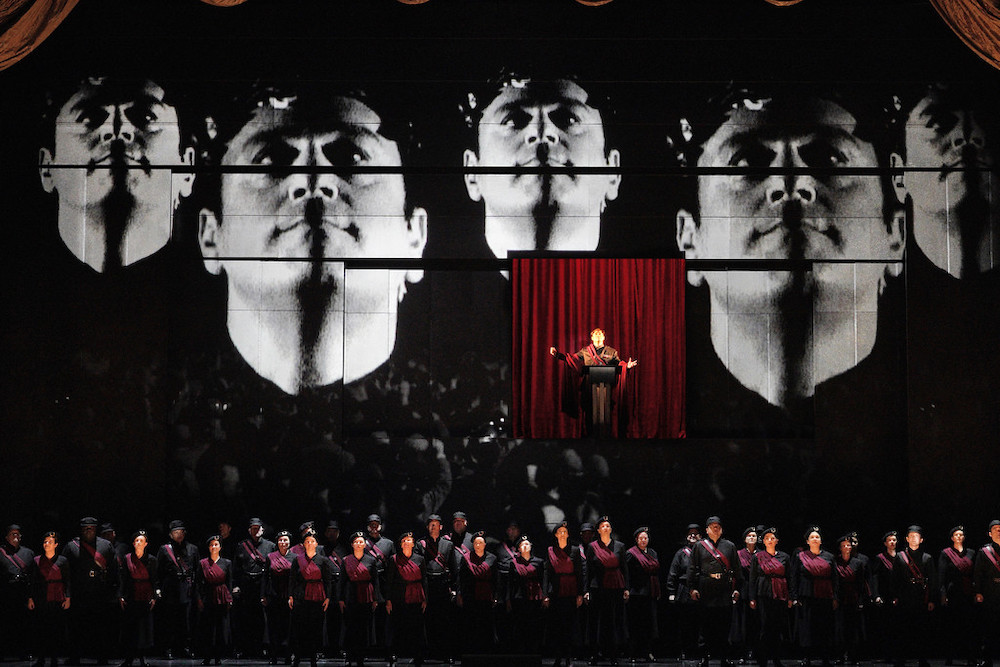
The staging, which I'd read was "bland" . . . "safe" . . . "uninspired," etc.  I found to be none of those things. Kind of electrifying and cinematic actually.  The flow of scenes from one to the next, the use of a multi-tiered set, the projections, the lighting, the excellent  choreographed chorus . . . all of it worked for me.

None of that, however, guarantees a good show, so Tesori's and Brant's work, while given an excellent production - had to show it was worthy of it.  It was.  Tesori's theatrical background shows, and while "too Broadway" was leveled at it by more than one critic, I found very little "Broadway" about it - in the same sense Menotti, Gershwin or Weill wrote music dramas for the non-traditional operatic venues.  Tesori is a gifted composer and her melodies worm their way into the heart, perhaps none so much as the character of Eric's little wordless hum that repeats itself through the opera. Brant's powerful text in the word settings given them by Tesori were better than one often encounters in English language operas. Everything was weighted properly, naturally generally, yet she is unafraid (fearless really) in also allowing words to be elongated for dramatic effect.

As the title character, Jess - we were treated to a never less than stunning achievement from a voice I was mostly unfamiliar with, but who turned me into an instant fanboy: mezzo soprano, Emily D'Angelo. D'Angelo combines a lean almost muscular sound with a gorgeous warmth and refulgence that is unusual.  At times I felt the ghosts of Lorraine Hunt Lieberson and Tatiana Troyanos - and I can't pay a higher compliment than that to any young singer.  D'Angelo, as it happens to turn out, is a formidable, strong actor as well, which the role of Jess not only requires - it demands. The beauty of HD is that we see the faces so well, and every emotion, even the thoughts of Jess, registered on the mezzo's face in a performance that, was Tony Award calibre.

As husband and father of Sam, Ben Bliss turned in one of his best performances to date .  Quite simply Bliss went from being the greatest Don Ottavio I've heard or seen into a loving  practical cowboy card dealer, and one of the sweetest, nicest characters to be written into an opera in . . . . I can't remember when. His aforementioned "tune" and his aria, as well as his scenes with Jess and Sam, the lovely Lucy LoBue, were a tonic, and the perfect counterpoint to the intensity of the war games at hand.

Another discovery for me was the young baritone, Kyle Miller, who, as the Sensor quite frankly, startled the life out of me. A gorgeous baritone sound and terrific comedic timing and acting chops poured out of what Jess described as a "12 year old," added punch to their scenes together.

I've always loved Greer Grimsley, and 30 years since his Met debut (what?) the voice seems to get growlier by the season, and sometimes I must admit I wish I could be hearing someone else in some of his roles, but  his Commander here seemed tailor made for his current voice and, while not a large role, it's an important one and it worked.  Perfectly.

Ellie Dehn as Jess' conscience, Also Jess, worked, brilliantly, even if at first I thought it was just a device to give notes to the central character that were too high for a mezzo.  My bad. This was not overused and actually intensified the "real" Jess' emotions, freeing her up even for other dramatic purposes.

Yannick Nézet-Séguin (who I thought, for a moment was Roberto Alagna when he entered the pit) really did marvelous things with Tesori's score, keeping everything flowing and tightly reigned in, never letting a moment sag. Tesori's orchestration is a huge, gleaming, lyrical thing of beauty, and her sense of groupings for effect was as masterful as any of the greats.  

I loved the dramatic structure of Grounded . . . it felt real at every turn, and it was,a beautiful thing to see something as ugly as war, drone attacks measured out with reason and emotion. Some of the criticisms I read had to do with making it a "gender" thing, how if the role were written for a man it would've been a different and probably less sensitive opera. Why? Stereotype much?  

Throughout the FB Opera groups I've read: "It was horrible"  . . . "An atrocity" ".Death of opera" . . . "what a disgrace" . . . "All the talents of singers, directors, staging crew, lighting. . .wasted on dreary, ugly, silly stuff . . . tragic. . . . laughable . . . Somebody needs to take a giant step back and consider what opera is supposed to do and be" . . . "they opened the season with this crap?" " How the mighty have fallen" . . .

One lady in Met Opera in HD's page was so angered by my opening night positive remarks, she BANNED me from seeing not only her remarks but ANY remarks in her thread (I didn't know that kind of censorship was possible on FB).

I didn't mean to end negatively - but wanted to relate my entire experience with this new work, so that included the bad with the good. 

I disagree with all of the naysayers, and while new works don't often get revived - or even second performances - I hope with some of the operas we've seen lately, and particularly Grounded- that trend comes to an end. If not, there's always La Boheme.

Labels: , , , , , , , , , ,

Wednesday, July 10, 2024

The Last Day of a Condemned Man: Hugo's Novel Becomes an Opera


 As often happens a discussion in another group caused me to think about a new opera I was blown away by a few years ago, but the absence of any subsequent performances of has, I'm embarrassed to admit, allowed me to forget it.  I'm wicked grateful for that discussion to let me revisit the work.  What is it, you ask (okay, probably nobody asked)?  The Alagna Brothers treatment of Victor Hugo's 1829 anti-death penalty novel Le Dernier Jour D'un Condamne - The Last Day of a Condemned Man.  The intense, dramatic libretto was written by all three of the Alagna boys - Roberto, David, and Frédérico - while the powerful, haunting, and frequently beautiful score, is by David.  


The 2014 production for Avignon, was filmed and released on DVD by Deutsche Grammophon but only in Europe and not the U.S. I have never (and will never) understand this idiotic practice. (and don't - you-know-who - come at me with your "reasons" . . . they're still idiotic).  

Fortunately, that tremendous Avignon production is available for view on YouTube - albeit sans any English subtitles. That should not hinder anyone from viewing this (but it of course will).  I've only read the novel in English translation, but even if you only read the synopsis and even if, like me, your French is terrible, this opera packs an emotional punch, going straight to the gut - but also the brain.  

While the libretto changes Hugo's story to reflect both the 18th AND 21st centuries, it is keeping in line with the author's own words of how he wanted his story to be relevant and speaking out against the death penalty and a reform of punishment in his time and for future generations.  This is achieved by taking the unnamed protagonist who in the novel is merely The Condemned Man  in 1829,and creating a counterpart - The Condemned Woman - in 2014.  For those fearful of this kind of adaptation, there is neither time travel nor any interaction between the Man and the Woman - except symbolically and horrifically in the final scene - which I will not reveal here.  
Nadine Duffaut's direction is brutal, meaningful and unfussy in the bleak but brilliant set by Emmanuelle Favre.  Favre has divided the stage in two on a turntable which brings us into both the 1829 prison cell, and the 2014 prison cell which are seen both separately and together, The juxtaposition or the scenes shows us how little has changed over the centuries.  

Roberto's counterpart in this performance is the outstanding American soprano Adina Aaron (who I've been lucky to see several times throughout her career) . . . and the two of them, despite never meeting - make a riveting, heartbreaking pair.  

Reviews were, as one would expect, mixed.  Many critics found the work absorbing, powerful, the score passionate, and darkly melodic . . . lush, while others - who I call the "anti-melodists" , predictably, didn't think it sounded 21st century or harsh enough.  Give me a fucking break people. But listen, watch, and judge it for yourself. If you're like me, you'll be cheering along with the house at Avignon.
As The Condemned Man, Alagna is not only in splendid voice, but reveals again why he has been one of the best actors on the lyric stage for the last 30 years. Adina Aaron is a worthy partner and the two of them, at the curtain, each acknowledge the outstanding work of the other.
The two centuries of costumes are by Katia Duflot and the incredible lighting design of Philippe Grosperrin add to the grand and grim nature of this piece.

Balàzs Kocsàr conducts, bringing masterful performances from the rest of the cast, and the Avignon-Provence Opera Choruses and Orchestra. 


DGG did release an excellent audio recording on CD (with notes by the the Alagnas and others) with Michel Plasson leading Alagna, and Indra Thomas, along with the forces of the French National Orchestra.  

Labels: , , , , , , , , , , ,

Friday, September 23, 2022

John Adams: Still Going Strong With Antony and Cleopatra


After reading Zachary Wolfe’s dismissal of John Adam’s latest opera, Antony and Cleopatra, referring to it as his “dullest” and how its three long hours “slump(s) to a subdued finish,” and ultimately damning it as “a dreary disappointment,” I was uncertain what to expect.  


Insomnia bade me to give it a whirl tonight, and I thought, at worst, it could cure this sleeplessness.  The effect, however, was entirely opposite of that.  While there were several moments in the first act that had me wanting to push the whole thing forward, most of it grabbed me, propelling its way to a rather thrilling conclusion that, orchestrally at least, hinted the Act One finale of  Doctor Atomic.  What I was not prepared for, however, was how its longer second act felt as though it passed before my eyes and ears in a matter of minutes.  


Indeed, through its tautness, sheer theatricality and best of all, magnificent performances by a terrific cast, Adams second act bounced, danced, wriggled and writhed, exploding from strength-to-strength. Indeed, I felt breathless for its first forty-one minutes (hitting pause to get some water, so noticed the time).  While its pace at that point, slowed down, it did so appropriately to the storytelling, all the while ever gaining in intensity up until its tragic, and literal, denouement.  


Antony and Cleopatra frequently finds Adams more traditionally lyrical than in the past, but anyone acquainted with his output is never at a loss as to whose music this is.  There are moments of turgidity, fire, and horror, too, if different than those we experienced in his other operas.  A genius of orchestration, the composer brings in his old friends the cimbalom and hammered dulcimer, which introduce a slight tang that musically highlights the exoticism of the storytelling.  I’d happily pit this score (no pun intended), after a single hearing against any of his others for sheer expressiveness of sound and beauty.  Music Director Eun Sun Kim, leads the San Franciscans in a reading that captures every nuance of the complex score, weaving it and holding it together with marvelous fluidity, nuance and strength.


San Francisco Opera clearly pulled out all the stops for this centenary celebratory work, from the powerfully dramatic direction of Elkhanah Pulitzer, to Mimi Lien’s never less than stunning 1930's pseudo-Hollywood design which morphs instantly from minimalistic and intimate to theatrically overpowering with near cinematic seamlessness.  

That commitment extended to the cast which, I cannot imagine being bettered.  Gerald Finley’s voice is one of those that seems ageless, and at 62 remains one of the most beautiful baritones I’ve ever heard, with that unique sense of clarity of sound that allows text to sound as clear as though it were being spoken.  Finley is marvelous as Antony, and captures the complete essence of the heroic romantic warrior from first to last.  Here is every aspect of a complex persona, his hubris, humanity, bitterness, jealousy, fear, rage and despair all worn, as Iago says, “upon his sleeve for daws to peck at.”  


Then there is the Cleopatra of Amina Edris.  Having never heard of the soprano before, and knowing she was a late substitute for Adams’ favorite Julia Bullock, I had reservations. They were dashed about as quickly as she opened her mouth.  Add to the fact she’s a lovely singer in face and figure, her being Egyptian born seemed to add an additional frisson to the proceedings.  Edris’ crystal clear soprano, immaculate diction (in sung Shakespeare, no less) made her Cleo the perfect match to her Antony.  Adams’s writing for the character is of a certain “all over the map” style requiring the singer to wrestle with the language at both the top and bottom of the range, and Edris never – not once – faltered.  Even at the top her diction was flawless, rendering the titles unnecessary.  As to that last statement, this was fairly true of the entire cast.  She fairly owned the second act, and her scenes at Antony’s demise, and at the hands of Caesar’s rubes, and ultimately her suicide found this young soprano clearly making a mark for the big time.  


Paul Appleby’s Caesar offered him in one of the best roles I've seen him in.  His power-grab scene rousing the masses played off brilliantly and horrifically with a sense of showing how little the world has really changed.  Ever.  


Alfred Walker has never disappointed me and here, as Enobarbus, he only makes me wish he’d get more prominent assignments in our houses.  Hired for Masettos and Crowns this is a voice with Wagner and Verdi stamped all over it.  


The balance of the cast, Elizabeth Deshong, Taylor Raven, Brenton Ryan, et al., contribute and help complement the evening into a worthwhile operatic experience.

I’m pleased to learn the opera is a co-production of several companies, including the Metropolitan Opera, which means I may actually get to see this one live.  Until then, I’ll do my best not to fall on Antony’s sword.

Labels: , , , , , , , ,

Saturday, January 26, 2019

Minnesota Opera's Great Doubt


I was starteled - in the best possible way - to turn on the TV tonight in time to see Great Performances was offering Minnesota Opera's premiere production of Douglas Cuomo's opera Doubt with John Patrick Shanley serving as librettist, having adapating his well known play, and screenplay, for the operatic stage. I'd missed any pre-publicity of this, and found it a return to the good old days with Maine PBS presenting two Friday nights in a row with opera! I somehow also missed ever hearing anything at all about this opera and initially thought it a brand new work, filmed perhaps this past season. Wrong again; Doubt the opera premiered in 2013 meaning it went unaired nearly six years until tonight's presentation. It was well worth the wait.

One of the first things I noticed is the Ordway Theatre must have the largest orchestra pit I've ever seen, or perhaps just a trick of the cameras? From that pit, Christopher Franklin conducted Cuomo's enormous score which, even through home speakers, thundered, cajoled, wove and hypnotized in a most impressive way, particularly for a first time operatic composer.

There were some standard New American Opera issues, the composer seemingly grabbing everything from that particular aisle at the musical supermarket with cans of Adams, Barber, Bernstein and Copland and mixing it with Glass. Even Menotti seemed to show up if only libretto-wise, Shanley turning some awkward phrases and purple prose into the mix.

While I had to supress the occasional groan at a Bernstein, clarinet "jazz" riff, or muted trumpet, Cuomo proved he was capable of creating something original, and when "borrowing" invoked more than just the Americans ; there was, for instance an almost Brittenesque quality to his use of percussion and equally impressive. There were also full-on blasts of sound and structure evoking the symphonies of Shostakovich. Despite all of this, I would hope that both librettist and composer will (if they've not already done so in the ensuing six years since) find some kindly editor and prune a bit of the unnecessary wordy text to remove some music more earthbound than inspired.


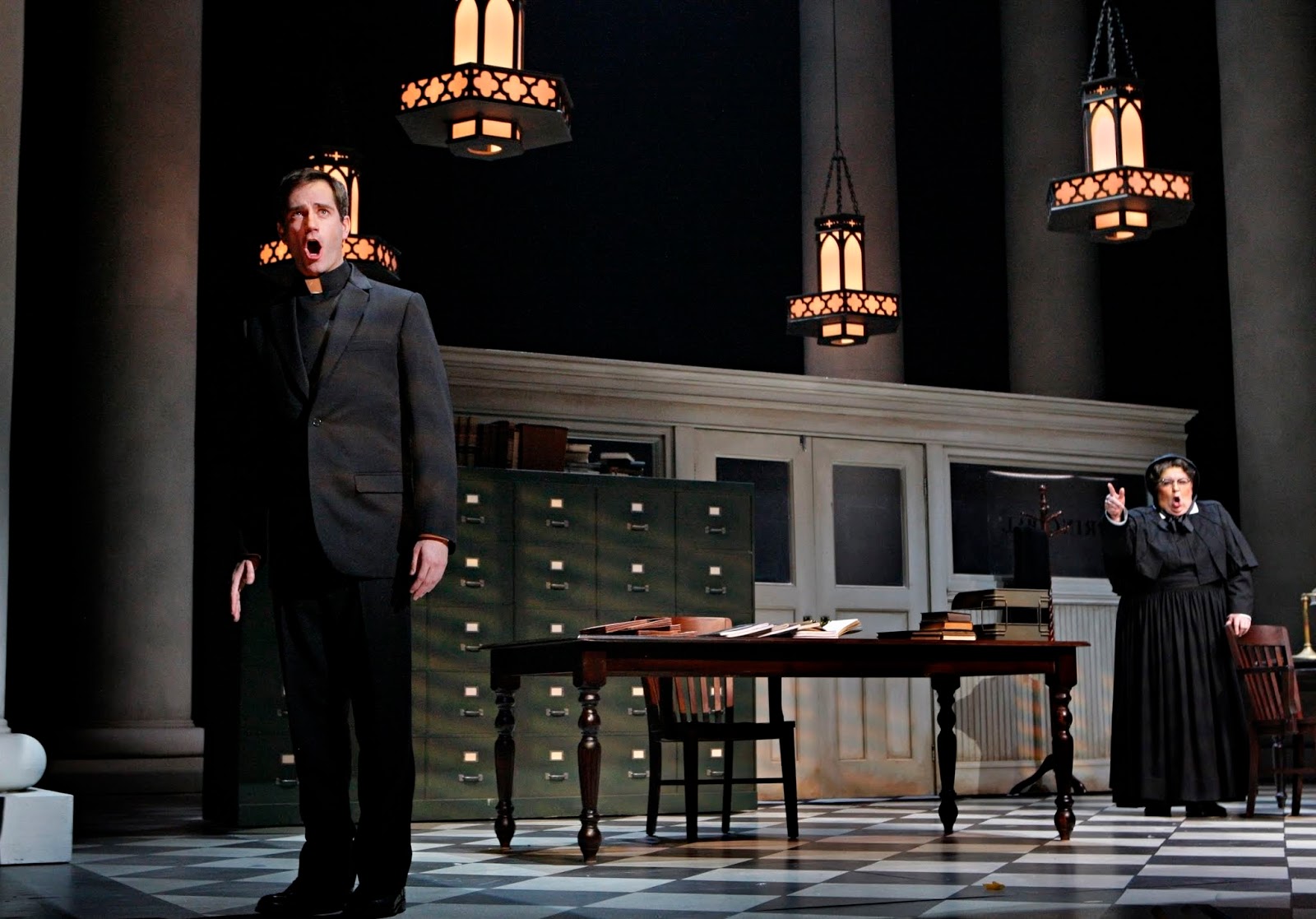
Vocally, it would have been difficult to assemble a finer cast, Christine Brewer showing her Wagnerian chops in decidedly un-Wagner-like music, and digging deep into the surpressed emotions of the troubled Sister Aloysius. Baritone Matthew Worth was boyishly handsome and a fine physical actor which worked to his interpretation of Father Flynn. Vocally, Worth is in command of a truly beautiful, almost sensuous baritone, and sang with great authority and commanding presence which contrasted brilliantly with his darker side almost completely hidden. Adriana Zabala struck all the right notes as the innocent young Sister James, naive yet knowing, and soaring, when appropriately, as both balance and catalyst between her superiors. Denyce Graves, as the troubled mother of the boy at the center of the tale, was given the least interesting music of the score, yet sank her formidable chops into it and presented a portrait of a conflicted mother just trying to keep her young, gay son alive to see another day.

At his best, Cuomo knows how to make magic and Father Flynn's sermons and church scenes are among them, one in particularly a true coup de théâtre. As Father Flynn shares a parable to the congregation, the enormous crucifix and the altar disappear as the parable comes to life before our eyes in a stunning moment both musically and emotionally profound.

The work from the Minnesota Opera Chorus, and the children in the cast were all, likewise, first rate, adding complexity and occasional humor to the proceedings.

Robert Brill's sets moved with cinematic sweep, literally allowing scenes sometimes no longer than a minute to flow seamlessly from one to the next, moving the story swiftly through the classroom, locker room, , board room, garden, darkened corridors, offices, church, each believable and with a sense of the elaborate found in Catholic schools of the era. Director Kevin Newbury moved everyone with that same cinematic ease, drawing direct, emotional performances from his exceptional cast.


I look forward to revisiting this work again, and while it may not have the immediate appeal of some of the new American operas that have grabbed the heart, such as Kevin Puts' "Silent Night," it certainly deserves that chance. For that, I'm grateful PBS dared take this chance and make it an opportunity . . . . or should I say, "opera-tune-ity?"

Labels: , , , , , , , , , , , ,

Wednesday, January 9, 2019

Shalimar the Clown or Two Birds, One Stone: How Not To Sell A New Opera or Its Only Recording


Critics are an important part in selling a work, and despite the decline of printed media these days, many still retain the power to "make or break" a work. In fact, with most people struggling in an economy critics are often the central selling point for getting people on board with a work, or steering them clear and saving their hard-earned dollars for something that's a more sure bet.

So, it was with interst, I read Joe Cadigan's review of the recording of Jack Perla and Rajiv Joseph's bew opera "Shalimar the Clown," based on Salman Rushdie's acclaimed novel of the same name, in February's Issue of Opera News. Unfortunately, I was left both confused and a little angry, that this was, the first, and only, negative review of this exciting new opera I've yet encountered. Oddly, the only negative in the same publication's review by Henry Stewart's after the premiere (both marvelous in detail, and punctuated by some humor), was how the opera should have been longer and developed over three instead of two acts. Stewart ended his writing, "Shalimar the Clown felt topical and thus urgent in a way that other very good recent American operas, such as Cold Mountain or JFK, have not. Contemporary relevance gives good music-drama an edge."

By contrast, Cadagin's review opens comparing the new opera unfavorably to the well loved, classic and repertory staple Pagliacci," complaining how Leoncavallo was able to sell his clown story in 70 minutes, while Perla unsuccessfully pads his out at over two hours and "over-ambitiuous."

Cadigan repeatedly complains how sprawling and overreaching the libretto is and how it "isn't able to strike that Verdian balance between the personal and the poltical . . . " going on again to compare it to Pagliacci and how Shalimar "is undermined by campy song and dance numbers . . . and how Joseph "doesn't treat (the subject matter) very seriously . . .complex social issues are oversimplified and rendered cartoonish . . ."


Of that same libretto, The Chicago Tribune's John von Rhein praised it writing "Joseph's taut libretto — 31 scenes, including a prologue and epilogue — to invest Rushdie's heartbreaking lament with the dramatic resonance of modern Shakespearean tragedy. If touches of Broadway kitsch inform Shalimar's love song, this is, on the whole, a most accomplished piece of music theater."

Mr. Cadagin calls Perla's music "reminiscent of other successful American composers who are regularly commissioned by larger opera houses; like Jake Heggie, Ricky Ian Gordon and Mark Adamo" all of who one can't help getting at least a whiff of disdain for when he writes how Shalimar's composer at least "sets himself apart from his colleagues by integrating a tinta of South Asian music."

Of the title role, Stewart writes, "Sean Panikkar continued to position himself as one of the stars of his generation. And, as far as I can imagine, this is his ideal role. Panikkar naturally possesses the requisite boyish charm, the goofy naïveté, for the young Noman, as well as the acting skill to darken it as he transforms into the killer Shalimar. His voice is unassailable—firm, sturdy and clear, and he employs it with maximum dramatic versatility."


Mr.Cadigan writes only how while Panikkar "displays a powerfu, Pavarotti-like tenor, his voice isn't suited to the role."

Almost every review I recall reading about this important new culture-crossing opera, has been positive. The aforementioned Mr. von Rhein opened his with: "Giuseppe Verdi knew a thing or two about creating powerful operas around credibly human characters thrown into violent conflict. So, as it turns out, does the creative team responsible for adapting Salman Rushdie's "Shalimar the Clown" for the Opera Theatre of St. Louis."

I don't blame Mr. Cadigan for finding fault with the work and with the performance, we all see and hear things with our own eyes, ears and in our own skins, and every highly praised work should have at least negative, or at least differing opinion of it, for an attempt to at least "balance" our views. Should it, however, be "the one" used to try to sell the recording of a highly praised work, particularly in an economy and industry where commercial audio recordings are ever diminishing? Maybe, I'm incorrect, but I don't think so.

Labels: , , , , , , , , , ,

Monday, May 25, 2015

Wuorinen's Brokeback Mountain


When it first appeared on DVD I'd read an in depth review of Charles Wuorinen's new opera, its critic asking if a composer known primarily for writing "dense, angular, and discordant music," could adapt his style to fit this story. His answer was a resounding, "no," citing a complete lack of tenderness or any sense of warmth between its two central characters. I finally was able to find the time to watch it and found the question to be, at least from my perspective, entirely irrelevant as I don't believe it was necessary for the composer to adapt his style for any reason whatsoever; this is the musical language in which he speaks, and he speaks it very well.

Despite the romance at its heart, I don't see Brokeback Mountain as simply a gay romance, and while I admired Mr. Lee's film, feel Proulx's story to be more of a period piece tragedy, set in a time not so long ago where simply being queer could (and obviously did) get people killed.

These two men, particularly Ennis, live in perpetual fear of being discovered which results in a chilling denial of who they are. They inhabit a world that more frequently than not, terrifies the hell out of them. Wuorinen captures this world, as well as these boys and their myriad emotions, with chilling conviction and an almost painful expressiveness.

Where Jack (a marvelous portrayal from Tom Randle) imagines the pair starting a life and owning a ranch together, Ennis is almost completely paralyzed by his fear, to the point of inaction, as he watches his life dissolve before his eyes, impotent, angered and rendered incapable of doing a goddamn thing about it. Again, Wuorinen's score conveys all of this as it cuts, brilliantly, to the bone with an appropriate, tragic gravitas.


More than one critic has asserted the opera's creators never allow any tenderness between the two men, either musically or dramatically. I disagree. To cite one example; their last night on the mountain opens with Jack standing alone, Ennis coming up from behind him, enveloping him in his arms, singing tenderly (including part of his wordless vocalise heard earlier). Here, he expresses his disappointment at having to leave Jack for the mountaintop, before finally being convinced to spend one last night together. The staging here makes for great theatre and is filled with symbolic implications for all. The tenderness is interrupted as we watch as the tent lifted off of them and witness the stage transform into the disjointed jumble that will be their lives for the next four years (and much of the rest of the opera).


While the score is in his typically angular and frequently dense style, Wuorinen does provide beautiful moments which break up the harshness. While some feel such moments are too few, they serve precisely what the composer and Ms. Proulx saw as their project; creating a different beast entirely than that of Mr. Lee's touching film, much closer to the original short story. This works against the opera for those who prefer the film's sentimentality. One such moment is Jack and Ennis' final meeting. Infinitely touching, we witness their frustration, growing into anger, before transforming into an ultimate sense of accepted foreboding; a realization that grief and loneliness shall be the only future they will share. Here, orchestra, singers, staging and libretto join together so masterfully I confess I was, as Ennis later admits, "choked with love." It's what (for me) opera is all about.


The remaining cast, are fully committed to their (often) minor roles, with Heather Buck standing out as Ennis' young, frustrated wife, who over the course of their marriage reaches the point of no return. It's a tough sing with a lot of high notes and almost from the beginning, a fever pitch intensity. As Lureen Hannah Esther Minutillo, has a sometimes oddly accented English, but convey's her characters coolness and ambition convincingly. With probably the least amount of stage time, Jane Henschel turns in a touching portrayal of Jack's mother, her cameo feeling like a genuine star turn.


The final scene finds Ennis, alone at the mountain, caressing their two shirts, Jack having secretly held onto them for 20 years. Pouring out his grief, Ennis admits his great love in as shattering an emotional climax as any Greek tragedy. One senses this man will be alone for whatever days he has left, this sentiment confirmed by his closing line, as those two shirts, along with any dreams or hopes that may have been, float away, upwards towards the peaks of that mountain. "It was only you in my life, and it will always be only you. Only you . . . Jack, I swear." Here, after listening to all the density of orchestral layers building on top of one another, Wuorinen wisely ends the opera, with Jack holding one final note, unaccompanied, ending the opera in silence. The effect is heartbreaking storytelling of the highest order.

Towards the end of one review its author wrote:

"Thus, we are left with the message that love between men is no different from an encounter in a rough-n-ready porn flick, where grunts, slaps and lots of gritty sounds take the place of warmth, tenderness, and open-hearted embrace."

I felt no "porn" sensibility of any stripe at play here, the gentleness expressed between the dual protagonists felt throughout, a shocking counterpoint against the brutality of their realities. That warmth extended, too, through the final curtain as Mr. Okulitch, basking in a sea of applause, awaits his partner to join him, the two sharing a big embrace (how often do we see artists hugging during bows?) and a warm ovation.

I can see how Wuorinen's score, led here by Titus Engel, might be tough for some audiences to warm up to, but it is, in its often brutal way, beautiful, with the sense of the mountain felt strongly throughout the entire opera.

I'd like to believe this score, and this fascinating production by Ivo van Hove, will be seen again on other stages, but whether that happens or not, am grateful for the commitment of Mr. Mortier the Teatro Real for producing it and the resultant DVD.

Hours later, I'm still a bit rattled by the experience, something I find the best of art always does to me.

Labels: , , , , , , , , , , ,

Saturday, November 2, 2013

Moby Dick: Great American Novel Becomes a Worthy Opera


Having done well in a handful of productions since its world premiere, last night's offering on Great Performances will hopefully prove Jake Heggie's new opera, Moby Dick to be an instant American operatic classic.

Robert Brill's physical production, filmed live from the San Francisco Opera, features state-of-the-art technology (lighting, projections, etc.) to seamlessly move the opera's scenes deftly and, not infrequently, adding a little "awe" power for the audience. But the show is not about effects, but rather about epic storytelling through music and the effects and stage designs are simply the very elaborate platform for an overwhelming operatic treatment of one of our great, classic tales.

Heggie's score has moments that recall Britten (strongly) as well as other composers, yet, having heard most of his music to date, stands on its own offering a stamp of recognizable individuality. There were snippets and melodies of things that I "thought" I knew, but were (much like Humperdinck with his Hansel und Gretel) wholly original - yet undeniably familiar. That's a nice gift.

The individual performances are, to a one, exemplary and the commitment each singer brings to his or her role is commendable and clear. Jay Hunter Morris stepped into some big shoes (Ben Heppner was the celebrated, original Ahab) and does so admirably. With a brighter, more pointed sound and less sweetness of tone than Heppner, Morris presents a different Ahab, no less formidable and his madness is, at times, appropriately unnerving, though this seems to come more from seeing than hearing him.

Each of Ahab's crew members are immediately likable, each earning our sympathies, none, so much (for this viewer) as Stephen Costello's Greenhorn. Costello's attractive, tightly wound vibrato imbues Greenhorn with the innocent melancholy of an orphan . . . an outsider, his growing attachment to the "savage" Queequeg, and the friendship that ensues between this pair of loners is infinitely touching.
Greenhorn's "realization" aria following the rescue of Pip elevates this simple soul into another realm. His duet with Queequeg which opens Act 2, is one of the opera's emotional and musical highlights. As Queequeg, Jonathan Lemalus is non plus ultra and will surely be a tough act to follow for future singers of the role. Possessed of a Samoan/Polynesian island physicality, and elaborately tattooed from the face down, Lemalu's savage is truly noble, in many ways, the most thoughtful and honest of the Pequod's shipmates.

Talise Trevigne's clear, high flying soprano and impish size make her perfect as Pip the cabin boy (and she gets to fly) Morgan Smith's Starbuck is, likewise, just about perfect, his great aria closing Act 1 revealing his torturous moral dilemma of how to save his shipmates from Ahab the Mad. The "home" duet for Starbuck and Ahab is a grand one pulling each man in several directions, before driving the opera to its mighty conclusion. Heggie pulls out all the stops here, the music swaying between the sentimentality and the madness of Ahab's pursuit of the Great White.

Patrick Summers leads the San Francisco forces with assurance, driving the music furiously through its dramatic, stormy scenes while allowing his singers plenty of room for lyrical expansion - which Heggie, thankfully offers the men and boys of the Pequod, aplenty.

The DVD/BluRay set finds the opera - a bit more than was captured for PBS (including a curtain call, albeit abbreviated and rushed clumsily), onto a single disc, with a second, hour long DVD featuring interviews with the cast, Messrs Heggie, Summers and Scheer. It also has a breathtaking (literally), fascinating time-lapse video condensing a roughly 24 hour period of the War Memorial Stage as it transforms from Lohengrin, to Moby Dick, Lohengrin again, then Tosca.

I was happy to learn that after 5 or 6 productions so far, "Moby Dick" will be playing at even more companies in the upcoming years - a promising sign.

Labels: , , , , , , , , , , , , , , , , ,

Wednesday, March 13, 2013

New Opera Discovery (Parody)

17 September 2008
United Press International
Mozambique

A previously unknown manuscript by the American composer John Cage was discovered Tuesday morning at the Biblioteca Nacional de Mocambique. During a routine maintenance check in the facility’s basement, a shelf was discovered to have broken spilling the contents of a small box onto the floor. The contents were picked up by Biblioteca employee Xavier Jamis a custodian at the main facility. Mr. Jamis gathered the papers together and brought them to the attention of Biblioteca Nacional de Mocambique’s General Director, Cabo Delagado, the country’s most respected scholar of late 20th century American serialism. Although no name was initially found with the manuscript, Director Delagado recognized immediately the handwriting as that of Mr. Cage and alerted the press as to the remarkable findings by the library’s janitor.

A quick perusal of the manuscript revealed the work to be in a genre rarely approached by Mr. Cage: an opera. Titled “The Bee” it is based on an unpublished screenplay of the same name by little known science fiction/horror author, Ahdam Baum a one-time resident of Mozambique of unknown extraction.

The Bee is set in the 1950’s and centers on the relationship between the beautiful young mystery writer, Armonia Mundi and her paramour, scientist and genius, Barry Bumble - youngest recipient of the Prix du Einstein. In a coincidence eerily relevant to one occurring today, Bumble foresees the major – and unexplained – world wide disappearance of communities of honey bees in the 21st century the results of which are both far reaching and disastrous.

Questioned by his lover as how he could possibly predict such an event with such certainty, Bumble reveals his long hidden secret project: a time traveling beehive. To convince her, of the future’s horros, Bumble tricks Mundi into ingesting the very special honey from the bees of this particular hive. The effect of the honey causes the couple to shink – painfully and slowly, their bodies contract and ooze until they “evolve” into bees themselves. The first act ends as the couple – borne on a prism from a window hanging crystal, enter Vall-Hiva.

The ensuing two acts find the couple time traveling between the mid 20th early 21st centuries in a desperate attempt to discover the cause of the nature bee disappearances. Is it borne of nature? Of man? During one of their time travels Bumble becomes stuck in the honey and unable to morph into his human body, becoming, in essence, an enormous bee. Neither entirely man, nor entirely insect, he dubs his new self: “Bumblebee.”

The work shows Cage in an unusually lyrical mode, his expansive orchestration calling for, in addition to a normal-sized symphonic orchestra, a battery of 16 prepared pianos, eight tape recording machines, a high school marching band,
boy choir and two ondes martinots and Theramin.

In an unprecedented move Mozambique’s national opera company, Opera l’Mozambique Nacionale, will be presenting the world premiere of The Bee in a season devoted entirely to operas about wildlife; Janacek’s The Cunning Little
Vixen; Tobias Picker’s “Fantastic Mr. Fox”; Stravinsky’s delightful “Le Rossignol” provides the meat to a sandwich of one acts, bookended by Jorge Martin’s “Tobermory” and “Sredni Vashtar.” The season ends with a controversial new staging of Puccini’s Madama Butterfly by famed zoologist Joan Embrey of the San Diego Zoo, making her directorial debut.

Noticeably missing from the announced repertoire is the recent opera “The Fly” by Howard Shore. Hearing about this season of unusually themed operas in a venue far removed from the operatic centres of the world, Mr. Shore and the
director of the world premiere of his opera, David Cronenberg offered to bring the production to Mozambique at no cost to the company. When asked why he declined, Opera l’Mozambique’s Artistic Director, Mbuzini Maccccccccccccaco responded“Both as a nation – and as a budding artistic venture, we are poor, struggling and still learning. Even so, we are neither that desperate nor are we idiots.”

Labels: , , , , , , ,

Tuesday, May 19, 2009

Arjuna's Dilemma


Having owned this on CD for a good while now, I only recently sat down and studied the whole thing, listening from start to finish (mulltiple times) in order to get the intended effect the composer was looking to lay on us (at least musically). The work has definitely grown on me . . . so much so that I truly regret not having taken the opportunity to catch it in New York this past season.

Cuomo's score is a curious thing - alternately whimsical (in a good way) and profound. Its middle-Eastern/Indian flavor notwithstanding, the opera seems (to me) primarily to be jazz based. Arjuna's music strongly reminded me of the work of some of the great avant garde and progressive jazz ensembles from the 70's and 80's. One hears definite (and definitive) influences, particularly John Zorn and those familiar with Anthony Braxton and the Rova Quartet will swear at least several moments were inspired from some of his complex pieces. I also happen to think there’s some Carla Bley hiding in there, too!

Labeled a chamber opera, I'm certain a lot of Arjuna's charms were meant to be seen as well as heard, meaning some of those qualities simply cannot come through in an audio only format. I say this not to be dismissive of the composition, as clearly its original intent was to be seen AND heard and this is reflected in the score.

Cuomo skillfully weaves a fascinating sound palette blending various styles with one another, and at times INTO one another. Thus, we move from Indian raga, through more formal minimalistic stylings, to jazz riffs, and (for my money) some gorgeous polyphonic writing reminiscent of the likes of William Byrd and Thomas Tallis and, more recently, Arvo Paart. There was at least one moment where both Philip Glass's "Songs from Liquid Days" and the Boubil/Schoenberg musical "Les Miserables" came to the very forefront of my mind. This is not a bad thing (in my opinion). Though considered an opera – implying “sung” – I think the majority of the score is actually instrumental, and decidedly more jazz than "modern classical" music. Only one "legitimate" solo voice appears, Arjuna himself, here sung by tenor Tony Boutté, who's free, open sound blossoms beautifully in several of the scores biggest bursts of melodic invention.

In several bits of purely instrumental music, I heard an almost identical "riff" familiar to me from John Adams' "Vishnu" chorus from Doctor Atomic (written about the same time). Considering the subject matter at that precise moment, any number of parallels seem to come into into play, adding layers of richness both ironic and theatrical.

All in all, this is a noteable addition to the ever expanding genre that is "modern opera" - and a most welcome one, to boot!

Labels: , , , , , ,