Minnesota Opera's Great Doubt

I was starteled - in the best possible way - to turn on the TV tonight in time to see Great Performances was offering Minnesota Opera's premiere production of Douglas Cuomo's opera Doubt with John Patrick Shanley serving as librettist, having adapating his well known play, and screenplay, for the operatic stage. I'd missed any pre-publicity of this, and found it a return to the good old days with Maine PBS presenting two Friday nights in a row with opera! I somehow also missed ever hearing anything at all about this opera and initially thought it a brand new work, filmed perhaps this past season. Wrong again; Doubt the opera premiered in 2013 meaning it went unaired nearly six years until tonight's presentation. It was well worth the wait.
One of the first things I noticed is the Ordway Theatre must have the largest orchestra pit I've ever seen, or perhaps just a trick of the cameras? From that pit, Christopher Franklin conducted Cuomo's enormous score which, even through home speakers, thundered, cajoled, wove and hypnotized in a most impressive way, particularly for a first time operatic composer.
There were some standard New American Opera issues, the composer seemingly grabbing everything from that particular aisle at the musical supermarket with cans of Adams, Barber, Bernstein and Copland and mixing it with Glass. Even Menotti seemed to show up if only libretto-wise, Shanley turning some awkward phrases and purple prose into the mix.
While I had to supress the occasional groan at a Bernstein, clarinet "jazz" riff, or muted trumpet, Cuomo proved he was capable of creating something original, and when "borrowing" invoked more than just the Americans ; there was, for instance an almost Brittenesque quality to his use of percussion and equally impressive. There were also full-on blasts of sound and structure evoking the symphonies of Shostakovich. Despite all of this, I would hope that both librettist and composer will (if they've not already done so in the ensuing six years since) find some kindly editor and prune a bit of the unnecessary wordy text to remove some music more earthbound than inspired.

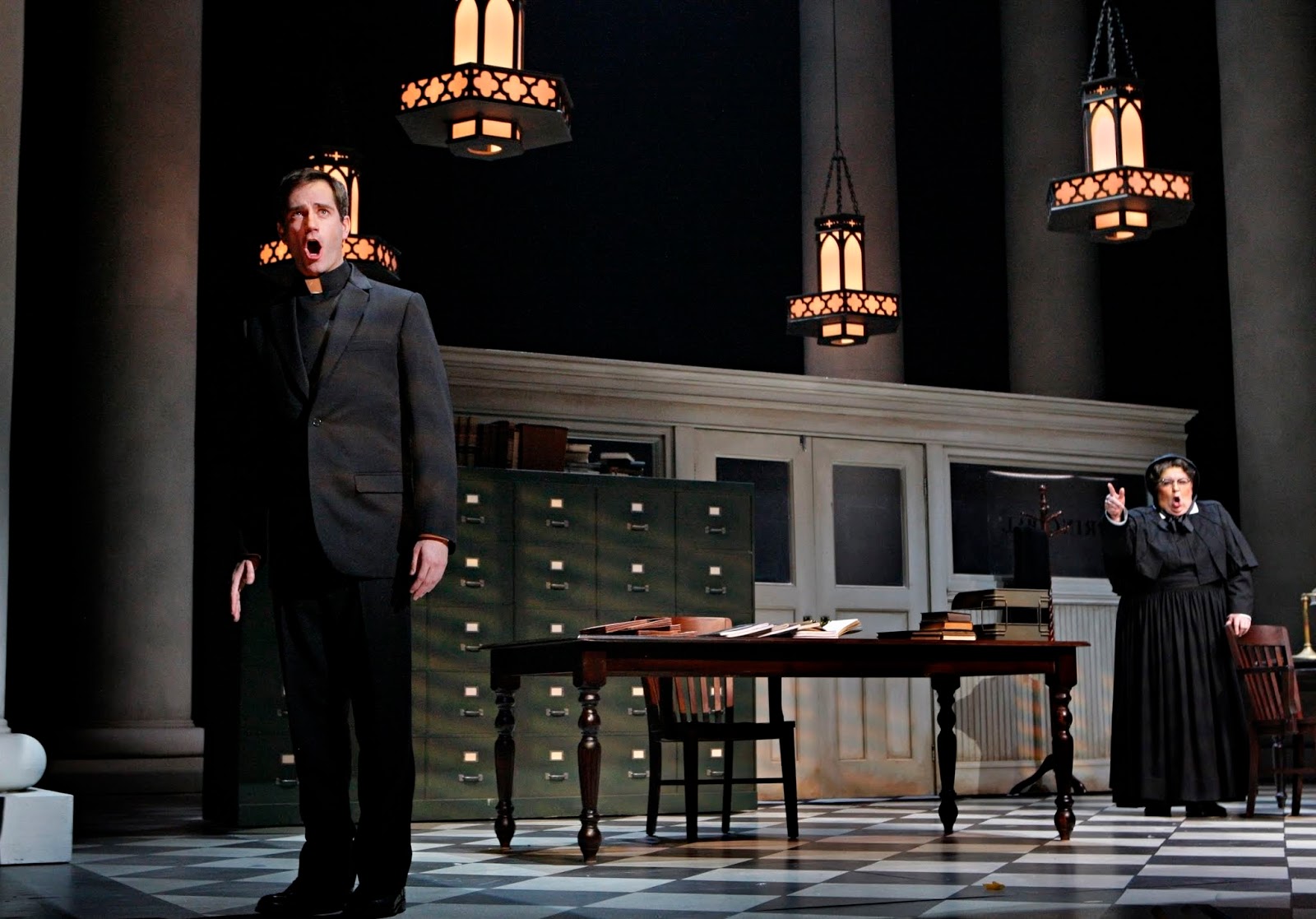
Vocally, it would have been difficult to assemble a finer cast, Christine Brewer showing her Wagnerian chops in decidedly un-Wagner-like music, and digging deep into the surpressed emotions of the troubled Sister Aloysius. Baritone Matthew Worth was boyishly handsome and a fine physical actor which worked to his interpretation of Father Flynn. Vocally, Worth is in command of a truly beautiful, almost sensuous baritone, and sang with great authority and commanding presence which contrasted brilliantly with his darker side almost completely hidden. Adriana Zabala struck all the right notes as the innocent young Sister James, naive yet knowing, and soaring, when appropriately, as both balance and catalyst between her superiors. Denyce Graves, as the troubled mother of the boy at the center of the tale, was given the least interesting music of the score, yet sank her formidable chops into it and presented a portrait of a conflicted mother just trying to keep her young, gay son alive to see another day.

At his best, Cuomo knows how to make magic and Father Flynn's sermons and church scenes are among them, one in particularly a true coup de théâtre. As Father Flynn shares a parable to the congregation, the enormous crucifix and the altar disappear as the parable comes to life before our eyes in a stunning moment both musically and emotionally profound.


The work from the Minnesota Opera Chorus, and the children in the cast were all, likewise, first rate, adding complexity and occasional humor to the proceedings.
Robert Brill's sets moved with cinematic sweep, literally allowing scenes sometimes no longer than a minute to flow seamlessly from one to the next, moving the story swiftly through the classroom, locker room, , board room, garden, darkened corridors, offices, church, each believable and with a sense of the elaborate found in Catholic schools of the era. Director Kevin Newbury moved everyone with that same cinematic ease, drawing direct, emotional performances from his exceptional cast.

I look forward to revisiting this work again, and while it may not have the immediate appeal of some of the new American operas that have grabbed the heart, such as Kevin Puts' "Silent Night," it certainly deserves that chance. For that, I'm grateful PBS dared take this chance and make it an opportunity . . . . or should I say, "opera-tune-ity?"
Labels: 21st century Opera, Adriana Zabala, Brill, Christine Brewer, Christopher Franklin, Doubt, Douglas Cuomo, Great Performances, John Patrick Shanley, Kevin Newbury, Matthew Worth, Minnesota Opera, PBS
posted by Sharky at
2:12 AM
2 Comments


.jpg)


