Monday, April 18, 2022

Radiant "Song of the Lark" from PBS American Collection


"I reluctantly watched this last evening and am glad to report I was more than than just pleasantly surprised. It had that good old-fashioned Masterpiece Theatre feel to it which I remember from when I watched more PBS in my youth. In fact watching this, in a very big way, returned me to my youth, reminding me of my own innocent passions. I can picture other kids living in "nowhereville" watching this and sense their growing youthful aspirations of achieving greatness and leaving those stifling towns for Great Things.

As a highschool fan of Willa Cather - after being forced to read "My Antonia" - it was nice to see such a fine treatment of this moving novel. 

Allison Elliot's Thea is a strong young woman, as she would have to be in the world which the film shows - mostly dominated by men. In fact the film has its own late romantic operatic touch in that Thea, a Swedish minister's daughter, is the only central female character, and she fits into this "men's world" quite easily.

It is no small irony that the men in Moonstone with whom she identifies live somewhat unhappy lives and dream of something more: her suitor, Ray who sees that Thea is bound for great things which he cannot begin to understand and who's death provides the opportunity for her to leave and begin her studies in earnest; her piano teacher, Professor Wunsch, the once "almost famous" musician who drowns his tortured failings in the bottle; and most of all Dr. Archie, who, hopelessly trapped in a loveless marriage with a "sour" wife see's Thea as the possible vicarious escape in which dreams can be achieved.

There is also Mexican Johnny who teaches her the folk songs from his homeland, which neighbors and even her own family find some disgrace in. Though the film does not delve into race relations - in more than one scene we are shown that those involved in the arts have the opportunity (if not always the inclination) to rise above racism and sexism. 

Though Thea faces some hardships they are given that nice Masterpiece Theatre glow which doesn't necessarily diminish their importance, but rather provides an opportunity to show growth and strength of character.

Director Karen Arthur had a few good tricks up her sleeve - our first image of Thea is in work clothes on a hill, dusty, unkempt - an image she will see herself in at the start of her new life when she visits the Art Institute of Chicago and out of all the treasures there is drawn to Jules Breton's painting "The Song of the Lark." I don't know if it's my bad eyes or if a certain technique was being used, but at key moments - the turn of a head, a look out the window, a glance towards the audience - the film speed seemed to alter, slowing down almost to the quality of a nickelodeon picture, which given the time period of the story was another perfect touch.

Lori Stinson provides the voice of the character and we hear the raw beauty of it in some old Swedish hymns, some Mexican folk songs as it blossoms into youthful maturity in Che faro senza Euridice, Let the Bright Seraphim, a Queen of the Night aria, among other things. Marilyn Horne is credited as the vocal coach.

While I found all of the actors uniformly top quality, the performance that moved me the most was Arliss Howard as Dr. Archie. As played by Howard, here is a man who could easily be tortured by his life's circumstances, but remains a gentleman, through strength of purpose is able to maintain both his dignity perspective. Howard's range of confined respectable emotions vasilate between what must remain a secret tortured love for Thea, a parental tenderness, and the true love and respect of a friend. At her debut in Chicago, it is Dr. Archie that leads the ovation - the years of joy and pain now register in his face through pride. It is not just Thea's debut, it is, in a way, his triumph. 

The film's penultimate scene is his his most moving, as.bidding Thea farewell, for what he realizes will be forever, he fights back his tears and with voice choked tells her "You were three, the first time I saw that little blonde head of yours ... I couldn't imagine all the wonder, all the wonders it contained. There is so little that is truly fine in this world ... Life would have been a pretty bleak stretch for me, if you were left out."

Bravo to Masterpiece Theatre on this fine innaugaral effort of its American Collection.

Labels: , , , , , , , ,

Saturday, January 26, 2019

Minnesota Opera's Great Doubt


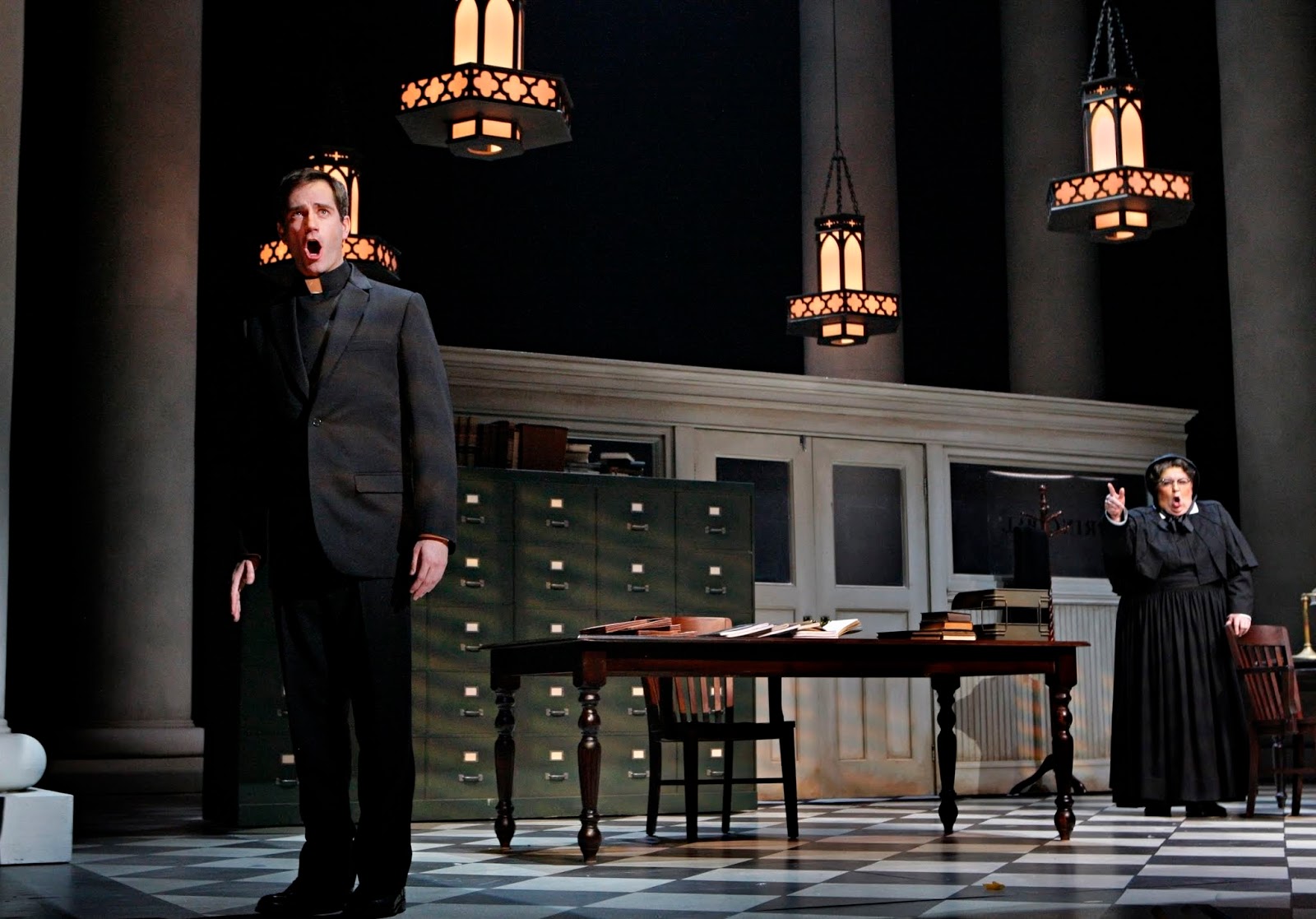
I was starteled - in the best possible way - to turn on the TV tonight in time to see Great Performances was offering Minnesota Opera's premiere production of Douglas Cuomo's opera Doubt with John Patrick Shanley serving as librettist, having adapating his well known play, and screenplay, for the operatic stage. I'd missed any pre-publicity of this, and found it a return to the good old days with Maine PBS presenting two Friday nights in a row with opera! I somehow also missed ever hearing anything at all about this opera and initially thought it a brand new work, filmed perhaps this past season. Wrong again; Doubt the opera premiered in 2013 meaning it went unaired nearly six years until tonight's presentation. It was well worth the wait.

One of the first things I noticed is the Ordway Theatre must have the largest orchestra pit I've ever seen, or perhaps just a trick of the cameras? From that pit, Christopher Franklin conducted Cuomo's enormous score which, even through home speakers, thundered, cajoled, wove and hypnotized in a most impressive way, particularly for a first time operatic composer.

There were some standard New American Opera issues, the composer seemingly grabbing everything from that particular aisle at the musical supermarket with cans of Adams, Barber, Bernstein and Copland and mixing it with Glass. Even Menotti seemed to show up if only libretto-wise, Shanley turning some awkward phrases and purple prose into the mix.

While I had to supress the occasional groan at a Bernstein, clarinet "jazz" riff, or muted trumpet, Cuomo proved he was capable of creating something original, and when "borrowing" invoked more than just the Americans ; there was, for instance an almost Brittenesque quality to his use of percussion and equally impressive. There were also full-on blasts of sound and structure evoking the symphonies of Shostakovich. Despite all of this, I would hope that both librettist and composer will (if they've not already done so in the ensuing six years since) find some kindly editor and prune a bit of the unnecessary wordy text to remove some music more earthbound than inspired.


Vocally, it would have been difficult to assemble a finer cast, Christine Brewer showing her Wagnerian chops in decidedly un-Wagner-like music, and digging deep into the surpressed emotions of the troubled Sister Aloysius. Baritone Matthew Worth was boyishly handsome and a fine physical actor which worked to his interpretation of Father Flynn. Vocally, Worth is in command of a truly beautiful, almost sensuous baritone, and sang with great authority and commanding presence which contrasted brilliantly with his darker side almost completely hidden. Adriana Zabala struck all the right notes as the innocent young Sister James, naive yet knowing, and soaring, when appropriately, as both balance and catalyst between her superiors. Denyce Graves, as the troubled mother of the boy at the center of the tale, was given the least interesting music of the score, yet sank her formidable chops into it and presented a portrait of a conflicted mother just trying to keep her young, gay son alive to see another day.

At his best, Cuomo knows how to make magic and Father Flynn's sermons and church scenes are among them, one in particularly a true coup de théâtre. As Father Flynn shares a parable to the congregation, the enormous crucifix and the altar disappear as the parable comes to life before our eyes in a stunning moment both musically and emotionally profound.

The work from the Minnesota Opera Chorus, and the children in the cast were all, likewise, first rate, adding complexity and occasional humor to the proceedings.

Robert Brill's sets moved with cinematic sweep, literally allowing scenes sometimes no longer than a minute to flow seamlessly from one to the next, moving the story swiftly through the classroom, locker room, , board room, garden, darkened corridors, offices, church, each believable and with a sense of the elaborate found in Catholic schools of the era. Director Kevin Newbury moved everyone with that same cinematic ease, drawing direct, emotional performances from his exceptional cast.


I look forward to revisiting this work again, and while it may not have the immediate appeal of some of the new American operas that have grabbed the heart, such as Kevin Puts' "Silent Night," it certainly deserves that chance. For that, I'm grateful PBS dared take this chance and make it an opportunity . . . . or should I say, "opera-tune-ity?"

Labels: , , , , , , , , , , , ,

Saturday, November 2, 2013

Moby Dick: Great American Novel Becomes a Worthy Opera


Having done well in a handful of productions since its world premiere, last night's offering on Great Performances will hopefully prove Jake Heggie's new opera, Moby Dick to be an instant American operatic classic.

Robert Brill's physical production, filmed live from the San Francisco Opera, features state-of-the-art technology (lighting, projections, etc.) to seamlessly move the opera's scenes deftly and, not infrequently, adding a little "awe" power for the audience. But the show is not about effects, but rather about epic storytelling through music and the effects and stage designs are simply the very elaborate platform for an overwhelming operatic treatment of one of our great, classic tales.

Heggie's score has moments that recall Britten (strongly) as well as other composers, yet, having heard most of his music to date, stands on its own offering a stamp of recognizable individuality. There were snippets and melodies of things that I "thought" I knew, but were (much like Humperdinck with his Hansel und Gretel) wholly original - yet undeniably familiar. That's a nice gift.

The individual performances are, to a one, exemplary and the commitment each singer brings to his or her role is commendable and clear. Jay Hunter Morris stepped into some big shoes (Ben Heppner was the celebrated, original Ahab) and does so admirably. With a brighter, more pointed sound and less sweetness of tone than Heppner, Morris presents a different Ahab, no less formidable and his madness is, at times, appropriately unnerving, though this seems to come more from seeing than hearing him.

Each of Ahab's crew members are immediately likable, each earning our sympathies, none, so much (for this viewer) as Stephen Costello's Greenhorn. Costello's attractive, tightly wound vibrato imbues Greenhorn with the innocent melancholy of an orphan . . . an outsider, his growing attachment to the "savage" Queequeg, and the friendship that ensues between this pair of loners is infinitely touching.
Greenhorn's "realization" aria following the rescue of Pip elevates this simple soul into another realm. His duet with Queequeg which opens Act 2, is one of the opera's emotional and musical highlights. As Queequeg, Jonathan Lemalus is non plus ultra and will surely be a tough act to follow for future singers of the role. Possessed of a Samoan/Polynesian island physicality, and elaborately tattooed from the face down, Lemalu's savage is truly noble, in many ways, the most thoughtful and honest of the Pequod's shipmates.

Talise Trevigne's clear, high flying soprano and impish size make her perfect as Pip the cabin boy (and she gets to fly) Morgan Smith's Starbuck is, likewise, just about perfect, his great aria closing Act 1 revealing his torturous moral dilemma of how to save his shipmates from Ahab the Mad. The "home" duet for Starbuck and Ahab is a grand one pulling each man in several directions, before driving the opera to its mighty conclusion. Heggie pulls out all the stops here, the music swaying between the sentimentality and the madness of Ahab's pursuit of the Great White.

Patrick Summers leads the San Francisco forces with assurance, driving the music furiously through its dramatic, stormy scenes while allowing his singers plenty of room for lyrical expansion - which Heggie, thankfully offers the men and boys of the Pequod, aplenty.

The DVD/BluRay set finds the opera - a bit more than was captured for PBS (including a curtain call, albeit abbreviated and rushed clumsily), onto a single disc, with a second, hour long DVD featuring interviews with the cast, Messrs Heggie, Summers and Scheer. It also has a breathtaking (literally), fascinating time-lapse video condensing a roughly 24 hour period of the War Memorial Stage as it transforms from Lohengrin, to Moby Dick, Lohengrin again, then Tosca.

I was happy to learn that after 5 or 6 productions so far, "Moby Dick" will be playing at even more companies in the upcoming years - a promising sign.

Labels: , , , , , , , , , , , , , , , , ,