Thursday, July 28, 2016

Holy Smoke: It's Carmen!


PORTopera opened its new production of Bizet's time-honored Carmen in a modest, but effective production, the emphasis appropriately placed where it should be; on music, and drama. I always cringe a a little when a company chooses the Guiraud version instead of Bizet's original, feeling it robs a good deal of the bite and spice the dialogue can add. That being said, most of the music making was strong. Maestro Stephen Lord started things off with a briskly paced overture setting the tone for all that followed. There were a few moments of loss of coordination between stage and pit, most notably the middle of the Smugglers quintet, which found its way back on track and finished with sizzle. Lord is a singers' conductor who strikes the right balance between singers and band, never overpowering, but letting the big orchestral moments pop. In this regard, he's also an audiences' conductor, and that's always a good thing.

Judy Gailen's unit set of a large, curved stucco wall served for all four acts with slight variances (dangerous steps, an enormous table for Carmen to dance and seduce Don Jose on at Lillas Pastia, etc.) for each.

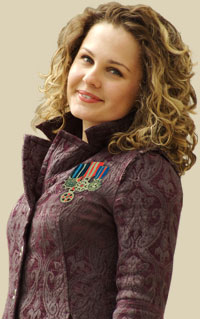
Dona D. Vaughn led a generally excellent cast, starting with the leading lady, Israeli mezzo soprano, Maya Lahyani. With striking good looks, physique and a physical force Lahyani's a natural Carmen, comfortable with her body and unafraid to use it to seduce, or as a weapon. The voice is rich, with an old-fashioned lushness that projected throughout the house beautifully. Wonderful in her early arias and the first two acts' lighter moments, Lahyani truly came into her own in the card scene, reaching into the story's darker side and taking us along Carmen's grizzly ride to Doomsville.

Adam Diegel took a bit of warming up, but earned the first real ovation of the night with the Flower aria, the sweetness of his voice blooming beautifully for the finish. He was at his best in Jose's deadly showdown with his ex where things got good and ugly. He's an agile singer and moved like a dancer, though at other times stiff, which is not, I suppose, against character. One got a small sense of this character's dangerous, but not all (Carmen isn't his first kill). He and Lahyani were appropriately passionate, right up until, well, you know.

Conversely, I was not quite convinced by Edward Parks' turn as Escamillo, With a rich, beautiful mid range, upper notes widened a bit, while the lowest notes (particularly in the Toreador aria) nearly disappeared. His third act appearance reminded me more of Ross Martin's Artemus Gordon from The Wild, Wild West, than a dangerous bullfighter. In the final act he became the victim of an unfortunate costuming decision.

Amanda Woodbury took on, Micaëla, the only decent person in sordid story, and did so marvelously, nowhere more so than in her Act Three aria that, when beautifully sung (as it frequently is, since its Micaëla's only big moment) steals the show. It happened again last night.

Comprimario roles were, to a one, as good as it gets, and the choruses, both children and adult, were magnificent. Once again, When it comes to crowd scenes, Ms. Vaughn once again shows her had as one of the best in the business. Her endless, silhouetted parade of gypsies climbing the mountain pass, then down steep, dangerous steps was stage magic. Vaughn did away with the parade at the bull ring, while the choristers made me believe (vividly) they were seeing it, so much so that I occasionally looked across the balcony expecting to see an army of banderilleros, picadors and matadors. Nice touch.

Getting older, and a touch jaded, I sometimes resist attending operas I've seen countless times, but when I give in, I'm reminded why I fell in love with them in the first place, and so it was this evening. I wasn't alone, the audience, young and old, loved it, and a friend, attending his first opera, can't wait to start going to more. Carmen can do that.

(Photo Credit: John Ewing for mainetoday.com)

Labels: , , , , , , , , , , ,

Sunday, August 2, 2015

PORTopera's Tosca: One Sing-ular Sensation


On paper at least, Puccini’s Tosca seemed like an odd choice for an opera company to make its debut in the arena of “semi-staging” However, with imaginative use of space, intelligent (and detailed) direction, good costumes, a first rate orchestra, choruses and a cast of singers, the possibility exists of the experience being greater than the sum of its parts. Such was the case with PORTopera’s second go at Puccini’s classic potboiler.

With a 60+ piece orchestra taking pride of place on stage, only a narrow corridor of space toward the apron existed for the action to develop. A large wooden platform with a staircase leading to its top served, in the first act as the painter Mario Cavaradossi’s galley in Church of Sant’Andrea della Valle, (an enormous blank picture frame atop it), and in the second, as the parapet of the Castel St. Angelo for a changing of the guard, and the denouement of Tosca leaping to her death.

Challenged by the limited playing space, director, Dona D. Vaughn created an intimate Tosca that did not skimp on her customary excellence, her supernumeraries (scrub maid,, monk, Scarpia’s henchmen, et al.) enlivening and providing richly detailed action.

Vaughn wisely embraced, and enhanced, the comedic elements of the first act which came off with the lighthearted naturalness of musical comedy, particularly the marvelous work from Thomas Hammons' genuinely funny (and warmly curmudgeonly) Sacristan, the romantic interplay between Tosca and Mario, and the children’s entrance. The children's chorus was a delight and one could not help but smile as as the kids circled and danced around the old man. All of this worked, of course, to heighten the contrasting, darker, more chilling aspects of the tale and make them more deeply felt without the use of maudlin manipulation to which this opera frequently falls prey.

Adam Diegel, PORT’s excellent Pinkerton from several seasons ago, returned as an exuberant young Cavaradossi, his bright, enormously pingy tenor ringing out with amazing clarity over the orchestra. Despite Maestro Lord’s moving the score along, both of Mario’s arias elicited applause, particularly the tragic “E lucevan le stele,” which earned hearty cheers and bravos from the house, and his "Vittoria!" has rarely been more thrillingly sung in my lifetime.


Alexandra LoBianco made for a lovely, winning Tosca presenting a softer, more coquettish heroine than the sometimes jealous, woman-on-the-verge as she's so frequently presented. LoBianco offered a softer, more coquettish Tosca, a deliciously coy flirtatiousness tempering her jealous outbursts, making her vulnerable and her eventual harrowing predicament all the more wrenching. The first act duet with Mario garnered enough applause to nearly stop the action, and, I can state without hesitation, it's been many years since I've felt a certain "tingle" at the end of that scene.

Luxury casting was found in the Scarpia of James Morris, whose voice, while showing signs of age, has Scarpia imprinted all over it. I wasn't the only one who wondered why he, alone, was in a modern tuxedo (I'm imagining a minor costume controversy may have been involved here) but the fact is he could've been donned in overalls or pajamas and one still was going to believe THIS was Scarpia. The self-important piety with which he entered, literally stopped the show in St. Andrea's. Alternating between subtlety and villainy Morris created a Scarpia who one sensed always got his way, his man . . . and his woman. Until Tosca.

Mario's execution was made all the more gruesome by the addition of a coup de grâce, stopped at the last minute, the effect of which made the moment all the more chilling and, perhaps for the first time, made me wonder if the boy might actually get up and flee with Tosca. The ensuing moments of chaos worked beautifully (how nice to hear the vocal parts here, almost always eliminated by the Met and other companies) as Tosca is hunted and chased down before taking opera's most famous leap (LoBianco's "O Scarpia avanti a Dio" by the way, was positively thrilling).

Over thirty years after I (a then a chorister) sang a tour of Boheme with him, it was an absolute joy to see and hear Thomas Hammons as the Sacristan, still potent of voice and ever the actor. Robert Mellon (Angelotti), Lucas Levy (Spoletta), Josh Quinn (Sciarrone) and Carina Di Gianfilippo (The Shepherd) all offered splendid contributions to the evening's proceedings.

Maestro Stephen Lord's work with the PORT orchestra and choruses was exemplary, presenting Puccini's score as full-throttled and rousing as one could hope for, leading principals for whom he rarely hold to hold back or do much adjusting of volume for.

On paper, this may have read as a "semi-staged" production, but for a packed house at Merrill Auditorium, it was a Tosca for the ages.

Labels: , , , , , , , , , ,

Wednesday, April 2, 2014

PORTopera: Maine's Divas Come Home!


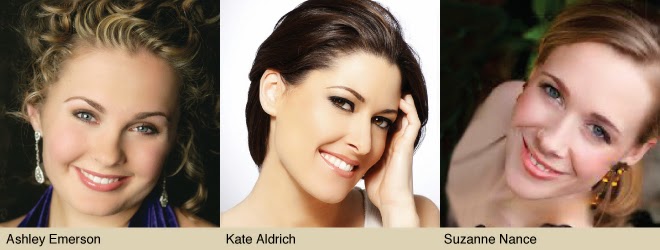
Last evening, PORTopera kicked off its 20th season with a concert titled: Maine’s Divas Come Home! at University of Maine’s Hannaford Hall. The Maine Divas were: Mezzo, Kate Aldrich and sopranos, Ashley Emerson and Suzanne Nance, accompanied by the excellent pianist Martin Perry.

The concert opened with an energetic four hand arrangement (I did not catch the name of the second pianist) of the overture to Gilbert and Sullivan’s The Mikado, which led into the ladies’ (all looking senational) Three Little Maids From School, establishing a tone of camaraderie and playful humor between singers and audience, and (as much as allowed) semi-staging. Ms. Aldrich and Ms. Emerson danced barefoot as Hansel and Gretel in Humperdinck's best-known duets, including the touching Evening Prayer, ending by picking up their shoes and quietly exiting the stage during the postlude.

Ms. Nance followed nicely with I Have Dreamt from Bernard Herrmann’s Wuthering Heights, later (after a dramatic costume change) camping it up brilliantly in a marvelously sung Meine Lippen, sie küssen so heiß from Lehàr’s Giuditta.

The first real "Diva at the Opera” moment arrived when Ms. Aldrich, fresh from recent performances of Donizetti’s La Favorite in Toulouse, began Leonor’s O mon Fernand, the audience cheering as Ms. Aldrich held “the pose,” then launched into the cabaletta, tearing through Mon arrêt descend du ciel, filling the hall with dramatic tension, powerful sound and causing the audience to erupt into a genuine ovation. Later, Aldrich topped even that performance with a beautiful rendition of Sesto’s Parto, Parto ma tu ben mio from La Clemenza di Tito, her performance reminding me of Agnes Balsta’s some years ago. Awesomeness ensued in a terrific sense of line, perfect trills and remarkable, clear agility through Mozart’s difficult, rapid fire coloratura passages.

The program noted it was subject to “inspired whims of our divas” and Ashley Emerson wisely switched out Gilda’s Caro nome for Susanna’s De vieni non tardar - a much nicer given the mostly light mood of the evening, her clean, light lyric voice, even and radiant throughout the range. Later, appearing in a white party dress and roller skates, she literally rolled onto the stage, working limbs and skates into a musically excellent and hilarious Les oiseaux dans la charmille from Offenbach’s Les Contes d’Hoffmann. The audience ate it up, skates, high notes and all.

Duets included two of the most popular, the Flower Duet from Delibe’s Lakmé and the Barcarolle from Hoffmann. Both beautifully sung.

The evening ended with more comedy, 3 divas having difficulty trying to “share”" I Could Have Danced All Night, the mezzo predictably getting the short end of the stick before exerting a little mezzo vendetta stealing the limelight, before all three concluded it harmoniously. The single encore was a reprise of Three Little Maid's, each maid wearing an iconic Maine image (Emerson in a lobster bib, Aldrich in wool gloves and Nance in a parka), with cleverly reworked lyrics and inventive rhymes such as "lobstah" with "PORTopera." The evening could not possibly have been more fun. Well, okay, the final trio from Der Rosenkavalier would've been a nice touch, but I'm not going to complain!

Labels: , , , , , , , , , ,

Friday, July 29, 2011

Fille-Nominal Fille du Regiment


Last night when the curtain came down on PORTopera’s new production of La Fille du Regiment it was with a roar more typically heard at a rock concert. The entire cast and charming production certainly deserved it, but it was clear whose fan club was in attendance as Maine native soprano made her big girl role debut with the company as Marie.

After a frothy account of Donizetti’s faux military orchestra (sans some horn issues) the curtain rose on an enormous barricade built of furniture – chairs and other household items. Flanking it, atop and on all sides, the Tyrolean villagers, ready for combat armed with rakes and other garden tools, and standing guard against the invading French army. Frequently first act stage pictures, (particularly the military camp), evoked the feel of a Bertrand Tavernier film (that is if he made comedies). Shannon Zura's moveable platforms adjusted quickly, instantly becoming whatever space the staging required. The second act set with its mile high drawing room (and gorgeous parquet flooring) was raked horizontally creating a physically off-kilter look which added to the onstage hijinks created by the awkwardness of plot situations. Jamie Grant's lighting design emphasized the natural brightness of the tale, and with restrained subtlety, added the perfect atmosphere in more gentle and introspective moments.

Fresh from a run of Fille in St. Louis, Ashley Emerson offered perfect comic chops, an instantly adorable stage personality and a face that expressed perfectly young Marie’s wide range of emotions. The voice, like its owner, is on the petite size, but as a critic once told me “some singers you really have to lean in to hear, but they are oh so worth leaning in for.” Emerson is clearly in that camp; the voice has a pure quality that positively gleams and as secure a technique as I’ve heard from a young singer. Her attacks were spot on - no adjustments, just there every time. She showed off a brilliant upper extension with no loss of vibrancy and zero strain and a renarkable evenness throughout the range. For such a clear, bright sound, Emerson is also able to summon up a remarkable warmth for moments such as "Il faut Partir" which was limpid and properly heartbreaking, bringing down the house. Throughout the evening I kept thinking “future Zerbinetta." I can also imagine a Semele, Cleopatra and a number of other Handel operas that would seem to be a natural fit.

PORTopera lucked out in nabbing tenor Andrew Bidlack as Tonio. A beautiful, italianate sound built for bel canto, Bidlack sailed through his assignment with aplomb, verve and boyish good looks - a perfect match for his Marie. Overall, while the voice is bright there is a slight tendency towards covering high notes - not all of them. Such was certainly not the case with those those famous nine high C's in "Ah mes amis" which he tossed off with an almost uncanny ease.

Jan Opalach has become a Portland favorite and last night his beautifully sung and hilarious Sulpice showed exactly why, nowhere more so then when joined by Emerson and Bidlack in the infectious trio "Tous les trois réunis" - (perhaps my favorite moment of this entire opera). The staging - and Donizetti's effervescent music - could not help but produce the broadest of smiles.

It's always a joy to see Judith Christin and as The Marquise of Birkenfeld, her speaking voice frequently dipped into the bass-baritone range adding an extra measure of fun. Her work in the Lesson Scene, was a masterclass in operatic comic acting. Teamed up with Jeffrey Tucker as Hortensius, they made quite the pair.

In a scene re-tooled for the Duchess of Krakenthorp, Ellen Chickering, in a matter of minutes, managed to practically steal the show with an interpolated (and ridiculous) aria about her character's bloated ego and the difficulties of being so beautiful and admired. A great and awful song done to perfection.

The PORTopera Orchestra and Chorus were ably led in grand bel canto style by Stephen Lord. At times balances (but never tempi) between stage and pit were a bit off, the orchestra covering the voices - though most of the time things sounded just right.

As ever, Dona D. Vaughn's direction was sharp, clear, uncluttered pointing every moment to its comic zenith without ever going over the top. It's clear to see why singers love working with her: the end result is a satisfied audience happily going along for the three hour tour. Honestly, I can't imagine a better way to spend a beautiful summer evening.

Labels: , , , , , , ,

Monday, August 2, 2010

PORTOpera's Glorious Hansel & Gretel


In the world of opera Humperdinck’s “Hansel und Gretel” stands pretty much by itself as a tale that can reach, teach, inspire and be understood by everyone from innocent children to grown ups who have seen it all. Sadly, most opera companies relegate it to the Christmas holiday season promoting it chiefly as a family event, so when PORTOpera announced its production - to take place in smack dab in the middle of summer - it was news worthy of rejoicing.

Humperdinck’s score was in the capable hands of Israel Gursky who got things off to a glorious beginning with a gleaming reading of the overture that had Wagnerian breadth and allowed the music to soar and, well, do it’s job. Throughout the evening Gursky struck an ideal balance never allowing the orchestra to cover the singers at any point, yet permitting the house to swell with sound at every climax. The band has rarely sounded better than they have here.

The curtain rose on Charles S. Kading’s s fanciful set, placing us deep in the forest, with a vista of stone mountains rising high in the background, two stairways “carved” into the stone and surrounding the stage. A center stage turntable handled most of the locale changes from humble peasant cottage, to the restful oasis in the woods, to the fanciful gingerbread where the children’s fate takes its turn.

General Director Dona D. Vaughn’s production earned major points in presenting the story not only as fairytale but as a timeless allegorical tale hitting on uncomfortable issues like alcohol abuse, desperation, hunger, homelessness, child abuse, heroism and the restorative power of love and family. While the story was indeed told sweetly, this was also theatre of a powerful and positive nature.

Vaughn provided plenty of coupes d’theatre that provoked laughter, tears and spontaneous applause, such as when the Witch flies high above the stage on her broom, disappearing into the clouds or the genuinely creepy tree roots that slid in from either side of the forest. The Prayer and Dream Pantomime has, in my experience, rarely been more breathtakingly staged. Our duo now fast asleep, dancers from the Portland School of Ballet, attired in jewel toned costumes with transparent “wings” appeared atop the mountains and, en pointe, descend to the forest floor, surrounding the children in a moving ballet. As they spun around the transparent wings revealed a beautiful butterfly pattern as their fluttering arms protected the children. The effect was one of breathtaking beauty and brought down the house.

Similarly, upon the children’s rescue, Vaughn created a moment that made one smile through tears. Once transformed back to life, the Gingerbread Children were revealed to be a choir of local immigrant children, each attired in his or her native costume. This could have been merely a nice gimmick, but combined with the stunning sound of their vocalism it brought the evening to a hauntingly beautiful and profoundly moving conclusion.

As Hansel, mezzo soprano Heather Johnson had the “boyishness” business down to a tee as he clumsily attempted to match his graceful sister in dance steps. Johnson’s Hansel seemed a bit harder, tougher and less trustful than his sister, which leant an air of darkness about him. A quick glance of the forest as he gives up his coat to cover and protect his sleeping sister was just one of those perfect little touches that help elevate every moment of a special production.

Angela Mortellaro created a simply delicious and adorable Gretel, revealing a soprano of sweetness, but that could open up thrillingly and dominate the ensembles with clarity and precision as well as beauty.

Peter (the father) was Weston Hurt, whose house filling baritone and slightly tipsy demeanor leant a heartiness to his performance that made it impossible not to like him instantly.

In my opinion, simply adding the name Maria Zifchack to a production increases its value tenfold. One of the most glorious voices of our time it was a case of welcome luxury casting to have Zifchack as Gertrude (The Mother). While Gertrude’s actions are what sets off the darkness of the story, one couldn’t help but feel her hopeless desperation as well as her horror and regret. Zifchack and Hurt each helped ground the story with a bit of realism that truly benefited the telling of this tale.

Luxury casting, too was Robert Brubaker as The (green faced) Witch. Allowing the camp factor to kick in, Brubaker’s “old lady voice” would, at key moments, give way to his powerful tenor that made the creepy crone both a bit more comical as well as more menacing than usual. He also earned points by climbing aboard that broom and actually flying high above the stage!

In their brief roles as Sandman and Dew Fairy, Rachel Hauge and Emily Murdock made the most of their assignments each earning major audience approval with their depictions.

Sung in English, the projected titles proved unnecessary (and sometimes a distraction from the stage) as I do not believe I have ever heard an entire cast deliver English in such crisp and immediately understandable English. Every word was clear and sure (this was a much discussed intermission topic as I roamed the lobbies). While I’m an “original language” kinda guy, a strong case can be made for having your audience understand every word, and such a case was here indeed, strongly made.

Who would have thought so innocuous a work as Hansel and Gretel could give us the perfect example of Wagner’s ideal gesamtkunstwerk? Dona D. Vaughn and PORTOpera, that’s who! A remarkable evening capped off what had to be one of the most prolonged ovations in the company’s history. After last season’s cancelled production (replaced by a wonderful gala concert) it was heartening to see the Company bounce back on such sure footing and grand scale. Bravo a tutti!

Labels: , , , , , ,

Friday, July 31, 2009

PORTopera's Sparkling 15th Anniversary Gala


Maine’s only professional opera company, PORTopera, celebrated its 15th anniversary last night in a festive gala at Merrill Auditorium that bubbled like the champagne that seemed to be flowing all night.

Guest Maestro Robert Moody, Music Director for the Portland Symphony, made his company debut leading the orchestra in a sparkling reading of the Overture to Rossini’s Il Barbiere di Siviglia, and having the band onstage allowed opportunities for this terrific “pit band” to shine in the evening's orchestral numbers. This was most notable during the Intermezzo from Cavelleria Rusticana, where the high strings achieved a breathtaking, magical quality that hadn’t quite been captured earlier in their reading of the Act III Prelude from La Traviata. The oft-played Intermezzo has been featured in countless movies and employed in television advertisements selling everything from spaghetti sauce to Kleenex, yet when played so beautifully never fails to move an audience and did so last night.

The gala featured singers from past productions in familiar arias and scenes from opera’s greatest hits (or at least some of them). First up was our Mercutio from last season, Michael Maye. He began “Largo al factotum” from offstage, dashing out, hopping on one leg as though he’d just been “caught in the act” and had found himself in front of an audience. It was a fun "bit." Maye's voice is very comfortable sounding in the top – which seemed to grow in size, and his spirited manner, dashing about the stage, brought Figaro vividly to life. A bit of rushing on the singer's part caused a few timing blips between singer and band, but Moody showed himself to be an excellent “accompanist” paying as much attention and communicating to the singers behind his back, as to his merry band.

Next was the sylphlike Lauren McNeese the delightful lyric mezzo who appeared as Stephano in Romeo et Juliette and made her debut as a wily Rosina in “Barbiere.” Her “Una voce poca fa” was predictably delightful, the coloratura effortless and showing off a damned fine trill. Ms McNeese (as did all the ladies on this night) looked as good as she sounded . . . in a word: sensational.

Staying with Beaumarchais characters, and particularly Rosina was our Mimi, Pamela Armstrong now as the Countess from Nozze di Figaro in what was, for me, the most perfect moment of the evening. Armstrong gave a performance that was extraordinary – it was exactly as Mozart should be and the result was exquisite. Here was purity of sound wed to a lushness of timbre, amazing control of the line and remarkable attention to the wide dynamic of the aria. Halfway through I realized I’d never heard this aria sung better and today have been replaying this moment in my head. (Microphones above the stage had me daring to hope the evening will be released as a fundraiser for the company. Cross your fingers!)

Jan Opalach (Leporello) had fun with Figaro’s Se vuol ballare” and later his “Ah un foco insolito” teased us with what might have been had not the season’s production of “Don Pasquale” been cancelled. He was (as usual) a delight.

Ms, McNeese went from Rosina to Cherubino in a delightful “Voi, che sapete.”

The first half closed with most of Act III of La Boheme, Ms. Armstrong recreating her affecting Mimi, and our Romeo from last season, Gaston Rivero (looking like a pop star in non-standard issue trousers) as her Rodolfo. He was just as terrific, both voices soaring thrillingly out over the orchestra, opening up at the climaxes and taking our collective breath away. Mr. Mayes returned as Marcello joined by Sandra Lopez (Marguerite, Micaela and Nedda) to round out the act, each contributing their considerable all, particularly Mayes in his powerful exchange with Mimi. Though attired in concert gear (white dinner jackets and diva gowns) each number had been staged by company director Dona D. Vaughn, helping bring each work to life and particularly effective in Boheme and the Scenes from Carmen that closed the evening.

Following intermission Mr. Mayes returned with the Prologue from Pagliacci – getting things off to a nice start (and making me want to hear his complete Tonio), followed by Sandra Lopez in a rapturous Qual fiamma . . . Stridono lassu.”

Carmen dominated the balance of the gala and brought back Jeniece Golbourne, graduating from a smokin’ Lola into a smoldering, sizzling, Carmen. Statuesque and swathed in deep aqua, Golbourne moved barely a muscle during the Habanera, making the old chestnut positively sizzle. With a deep, richly fruity sound in the lower voice, all were unprepared for a top that was positively volcanic – and soared mightily through all of Carmen’s music. Joined by four singers from the Emerging Artist program, we were treated to a Smugglers’ Quartet that snapped, crackled and popped with life – Maestro Moody's bouncing on the podium adding a fun visual counterpoint to the proceedings.

Mr. Rivero returned to deliver Jose’s Flower Song (La fleur que tu m’avais jete) and, as good as he was in the Boheme, hearing him here confirmed my thoughts after his Romeo appearance: this is a voice meant for the French repertoire. An attractive reediness that perfectly fits the music, along with a real sense of line and the ability to darken, lighten and sweeten the tone, the sound opening up thrillingly the higher he went.

Mr. Mayes as Escamillo, returned to join them in the final scene (with cameos by Ms. Lopez & Ms. McNeese as Frasquita and Mercedes). Despite the jewel-toned gowns and white dinner jackets (Rivero eschewing his for a black opened shirt with rolled up sleeves – adding to Jose’s dementia) one almost forgot completely this wasn’t a fully staged performance, and our Jose and Carmen raised the ante up to a fever pitch finale that thrilled the entire house.

Self AdmissionTime: I groaned just a bit seeing the final number of the program would be that perennial gala closer “Make Our Garden Grow” from Bernstein’s “Candide.” I should have been (and properly was) ashamed of myself once the number began. Each singer emerged, from the wings, ambling onto the stage adding one more voice to a performance that grew measure-by-measure to its life affirming climax. The resulting effect was one of those spine-tingling moments that only great music can produce, and while standing ovations have become something of a routine these days, there was nothing for us to do but rise and cheer, and so we did.

Bravo, bravissimo to Dona D. Vaughn and PORTopera – and here’s to another wonderful 15 years!

Labels: , , , , , , , ,