Monday, November 7, 2016

A Chilling Bluebeard's Castle from the PSO


The Portland Symphony celebrated All Saints Day/Dia de los Muertos with two works seemingly at odds, the Bach Concerto for Two Violins in d minor, and Bartok's short, powerful opera, Bluebeard's Castle.

With a paired down chamber ensemble playing period style, the Bach glittered sparkled and reminded one of this composer's enormous genius never feeling academic but instead almost dance like. Maestro Moody gave the outer movements a brisk, almost breathlessly athletic pace, while in its gooey center movement he revealed Bach's genius at writing long, exquisite melodies, as the two violins wrapped around each other's lines in an embrace that makes it one of Bach's most beloved works.

Keeping it within the family, the soloists were PSO violinists Amy Sims and Sasha Callahan, each playing with beautiful baroque style and stunning virtuosity. They were rewarded with a glowing ovation from their hometown audience . . . all of us feeling the love.

Following intermission came the Bartok. I've loved this difficult (in many ways) opera since my teens, have enjoyed several live performances and most available recordings, but here, in a stripped down concert staging, it worked in a way few staged performances are capable of. Having Bartok's massive orchestra onstage allowed it to become an even greater part of the drama than from a recessed pit.

Once Moody took the podium, the house and stage lights went out, plunging the hall into darkness. Though no lighting designer or stage director was credited, one sensed immediately both lights and "action" would be part of the show. In the dark, a sounding narrator welcomed us with the Prologue of the Bard (spoken in English) as the haunting opening strains began. Dim light allowed us to see Bluebeard, Alan Held and his new bride Judith, Michelle DeYoung, enter his castle. The pair played superbly off of each other, DeYoung's Judith an enchanted young bride, reassuring her dark-souled husband of her love, while Held's Bluebeard tested her loyalty, offering her opportunities to return to her former life. Both singers were in superb voice, deftly projecting over Bartok’s dense, lush scoring even when Moody had the orchestra pulling out all the stops, including those of the mighty Kotzschmar Organ

The meat of the opera is comprised of seven closed door, each hiding a secret of Bluebeard is unwilling to reveal, until Judith demands them be opened. Bartok's tonal palette and gift of orchestration gives each of the rooms a unique sound spectrum, beginning with the first, a torture chamber. This production also had a recorded, piped in, most unsettling groan/sigh that chills both Judith and the audience. The theatrical highlight for many, including me, is the opening of the Fifth Door which reveals the vastness of Bluebeard's kingdom the organ and orchestra letting loose at fortissimo as Judith belts out a high C. The effect was heightened as from near darkness, the lights flashed on bathing the entire house in a sea of white as Ms. DeYoung, arms raised in awe, capped everything with as great a high C as I've heard, producing gasps from many in the audience. Brilliant.

At the final door, we meet Bartok's three, still very much alive former wives, representing morning, afternoon and twilight, Judith - who is midnight - must now join, leaving Bluebeard,. as he has been most of his life, alone in the dark.

I'm happy to see and hear Bartok's gem being programmed more than in years past (the nearby Boston Symphony also performed it last week), particularly when so ravishingly played as it was here. It was a highlight of Maestro's tenure so far with this organization, and a night that will not soon be forgotten, or bettered.

Labels: , , , , , , , ,

Wednesday, April 2, 2014

PORTopera: Maine's Divas Come Home!


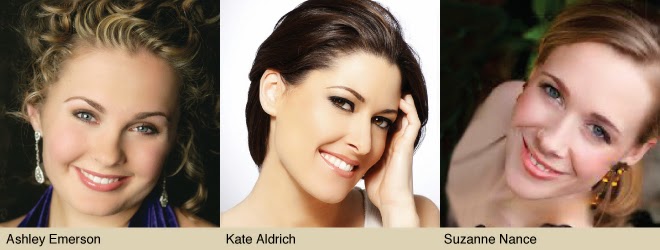
Last evening, PORTopera kicked off its 20th season with a concert titled: Maine’s Divas Come Home! at University of Maine’s Hannaford Hall. The Maine Divas were: Mezzo, Kate Aldrich and sopranos, Ashley Emerson and Suzanne Nance, accompanied by the excellent pianist Martin Perry.

The concert opened with an energetic four hand arrangement (I did not catch the name of the second pianist) of the overture to Gilbert and Sullivan’s The Mikado, which led into the ladies’ (all looking senational) Three Little Maids From School, establishing a tone of camaraderie and playful humor between singers and audience, and (as much as allowed) semi-staging. Ms. Aldrich and Ms. Emerson danced barefoot as Hansel and Gretel in Humperdinck's best-known duets, including the touching Evening Prayer, ending by picking up their shoes and quietly exiting the stage during the postlude.

Ms. Nance followed nicely with I Have Dreamt from Bernard Herrmann’s Wuthering Heights, later (after a dramatic costume change) camping it up brilliantly in a marvelously sung Meine Lippen, sie küssen so heiß from Lehàr’s Giuditta.

The first real "Diva at the Opera” moment arrived when Ms. Aldrich, fresh from recent performances of Donizetti’s La Favorite in Toulouse, began Leonor’s O mon Fernand, the audience cheering as Ms. Aldrich held “the pose,” then launched into the cabaletta, tearing through Mon arrêt descend du ciel, filling the hall with dramatic tension, powerful sound and causing the audience to erupt into a genuine ovation. Later, Aldrich topped even that performance with a beautiful rendition of Sesto’s Parto, Parto ma tu ben mio from La Clemenza di Tito, her performance reminding me of Agnes Balsta’s some years ago. Awesomeness ensued in a terrific sense of line, perfect trills and remarkable, clear agility through Mozart’s difficult, rapid fire coloratura passages.

The program noted it was subject to “inspired whims of our divas” and Ashley Emerson wisely switched out Gilda’s Caro nome for Susanna’s De vieni non tardar - a much nicer given the mostly light mood of the evening, her clean, light lyric voice, even and radiant throughout the range. Later, appearing in a white party dress and roller skates, she literally rolled onto the stage, working limbs and skates into a musically excellent and hilarious Les oiseaux dans la charmille from Offenbach’s Les Contes d’Hoffmann. The audience ate it up, skates, high notes and all.

Duets included two of the most popular, the Flower Duet from Delibe’s Lakmé and the Barcarolle from Hoffmann. Both beautifully sung.

The evening ended with more comedy, 3 divas having difficulty trying to “share”" I Could Have Danced All Night, the mezzo predictably getting the short end of the stick before exerting a little mezzo vendetta stealing the limelight, before all three concluded it harmoniously. The single encore was a reprise of Three Little Maid's, each maid wearing an iconic Maine image (Emerson in a lobster bib, Aldrich in wool gloves and Nance in a parka), with cleverly reworked lyrics and inventive rhymes such as "lobstah" with "PORTopera." The evening could not possibly have been more fun. Well, okay, the final trio from Der Rosenkavalier would've been a nice touch, but I'm not going to complain!

Labels: , , , , , , , , , ,

Sunday, February 27, 2011

Sullivan's Glorious Golden Legend: A Rare Performance


Last night I attended a performance of Sir Arthur Sullivan’s rarely performed dramatic cantata “The Golden Legend”, based on Henry Wadsworth Longfellow’s poem of the same name. The work was performed as part of Longfellow 204th Birthday Choral Festival (an annual event based here in Portland, Maine along with an annual international composition competition in a number of divisions, choral works, cantatas, songs settings, etc.).

Sadly, the unannounced blizzard that arrived Friday, meant two things: the massive work for 5 soloists, orchestra, organ and chorus did not get a dress rehearsal; and (2) people stayed home resulting in a disproportionate ratio of performers (roughly 80) to audience (about 50).

While the performance was not perfect, it was a spirited and winning one that had its small audience cheering, showing there is no good reason this work is not better known, and the powerfully satisfying musical and emotional effect it can have on the listener.

The Longfellow Chorus was fortunate in havingn a handful of young, attractive soloists who, frankly, could not have been better suited to this music and were, in fact superior to those on the impressive Hyperion/Musical Heritage Society recording. So clear was the diction of all five (as well as that of the chorus) it eliminated any necessity of reading the nicely sized (for once) libretto provided in the program.

As Lucifer, Bradford Gleim - even in concert dress - made for a convincing Victorian-era looking devil, and his rich, sonorous voice got the prologue off to a roaring good start, as he attempts to summon his demons. Throughout, Gleim’s devil exhibited perfect amounts of gleeful mischief to make him just evil enough, but also a lot of fun.

Tenor, Brian Arreola (who teaches at UNC Charlotte and a founding member of the ensemble Cantus) was for me the discovery of the night. A clear, nicely sized voice that had the needed Victorian sweetness demanded by this music, but also a cutting heldentenor-ish quality that easily rode over the orchestra , which came nicely into play at the work’s most thrilling moment, (the end of part two) with Henry’s cries of “Angelo! Murderer!” - answered in full cry by the chorus, giving the work a genuine “wow!” factor.

As Ursula, mezzo soprano, Tania Mandzy revealed a absolutely gorgeous-toned voice that at moments reminded me of Dame Janet Baker with its velvety finish and brilliant diction. Unfortunately, at her prayer in the beginning of Part 3, there was a snafu between the orchestra and singer which brought the performance to an unexpected halt. Rather than plugging away and hoping for the best, our intrepid conductor issued a short apology and after a minute to regroup, they began again making the awkward incident worth it as Ms. Mandzy poured her heart out into the prayer, offering phrase after phrase of sheer beauty.

Deborah Selig (who bore an uncanny resemblance to the actress, Jennifer Beals) soared through Elsie’s music with sweetness, but with plenty of sheen to the voice, which opened up beautifully the higher she went. She had the proper amount of earnestness and beauty of tone for “My Redeemer and my Lord” - but truly made her mark with the little coda Sullivan gives Elsie immediately after “My life is little - only a cup of water,” which can only be described as ravishing. Selig’s breathtaking “Christe Elieson” with the chorus at the conclusion of “The night is calm and cloudless” interrupted the performance from the otherwise well mannered audience with several cries of “Brava!”

From the tiny island of Chebeague, (now residing in New York), bass baritone Tyler Putnam offered luxury casting in the small but important role of The Forester. Putnam’s sizeable - almost rattling - voice only made one sorry Sir Arthur hadn’t given him more to sing. Much more.

The Longfellow Chorus sang thrillingly throughout the evening, particularly the women’s voices which were clear and evocative of the best British choruses. The men were slightly underpowered in their chanting of the Hymn of St. Hildebert, and could have used a more “monk’s chant” type of expression in this music, but this is a minor quibble. Most other moments however, such as in first unaccompanied chorus “O blessed light” the sound, would best be described as exquisite, and in the rousing finale, truly glorious.

A nice effect was made with a bit of “staging” with singers shifting positions, actually singing to each other, a prop or two, and a dramatic exit as Lucifer led the then-doomed Elsie down the aisle before appearing in the rear balcony as Prince Henry and his attendants prepare to storm the door for Elsie’s rescue.

Conductor, Charles Kaufman, led all with a sure hand and obvious affection for this remarkable work and, aside from some glitches (most noticeably in the strings), his orchestra (particularly the winds who were marvelous throughout) responded in a performance that made as strong case as I can think of for this work re-entering the repertoire of choral and symphonic organizations.

The small but hearty audience, clearly moved by what we experienced, cheered and applauded lustily, calling back the soloists and Maestro Kaufman for an extended and well deserved bow. It’s a shame the house wasn’t packed . Hopefully a repeat performance today at 3:00 will be better attended.

Labels: , , , , , , , ,

Saturday, February 26, 2011

Walking Home Last Night

Wednesday, January 26, 2011

Portland Symphony: From Russia With Love


Last evening, the Portland Symphony Orchestra's evening began on a high note - and built up from there.

The concert started off with the world premiere of Maine composer Elliott Schwartz's "Diamond Jubilee" commissioned by the PSO in honor of Schwartz's 75th birthday. In three movements, Schwartz recalls 75 years of life on planet earth, displaying humor, pathos, beauty and even a bit of banality (working a ringing phone into the mix!) throughout. As each movement began a video screen presented names, events, products of food and technology, later replaced by images of those same people, places and things. Scored for an enormous orchestra, including five very busy percussionists, offstage chorus and electronics, the work packed a dramatic and satisfying wallop and I look forward to hearing it again. Afterwards, a brief onstage ceremony honored Schwartz with a proclamation from the Maine State Legislature, for all his contributions to the musical life of this great State.

Next up was the Prokofiev Piano Concert No. 3 in C Major. Bold and often daring, Prokofiev's much loved concerto allows its soloist - or demands its soloist - to display an athletic showmanship with sections recalling the complex, rapid passagework in the keyboard works of Bach and Scarlatti. Portland was blessed by having one of today's most exciting pianists, Andrew von Oeyen, on hand to do justice to this most exciting of concerti. von Oeyen played with a unique combination of strength and clarity - delicacy even - revealing at all times a formidable technique that left many (myself included) in awe. Interestingly, there is not a lot of visual showmanship from this young pianist, no bouncing off the bench, flailing arms or other dramatics often associated with virtuoso players, and even more interestingly, none was necessary: von Oeyen trusts and respects the music (and a faultless technique) to create its own excitement and the payoff is enormous. Choosing a brisker tempo than some performances I've heard, Maestro Moody struck both a balance and synchronization between soloist and orchestra that was nearly perfect from the very beginning as the strings begin their moto perpetuoto chugging making von Oeyen's entrance into this happy fray a breathless delight.

Slower passages, including the theme and variations of the concerto's dreamlike central movement, came off marvelously with genuine lyricism allowing Prokofiev's strange and beautiful harmonies to envelop the hall like some aural mist. The handling of the final Allegro-ma non troppo movement - allowed Prokofiev's "argument" to make great sense and the beautiful "violence" to break out as soloist and orchestra seem to perpetually be taking the lead from each other. The final moments of this concerto are as exciting as anything in the concerto repertoire and nothing was skimped over here, the Portland players sawing away energeticaly, von Oeyen dazzling all with the compoer's famous (and eagerly anticipated) glissandi and double handed chromatic passages that end the piece. The reaction from the house was immediate, roars of "bravo!" demanding Mr. von Oeyen return for several curtain calls.

A second great work, Shostakovich's cathartic Symphony No. 5, filled the second half of this Russian-themed program. Again, the Portland Symphony players displayed amazing control and Moody's sense of the piece was almost programmatic in the way the movements held together. The opening movement properly set a tone of melancholy gravitas Shostakovich demands here, the fugue for strings achingly, beautifully sad. No performance is perfect as evidenced by several moments which were slightly marred by the horns who, in all fairness have their work cut out for them by the composer. These were brief and while unfortunate, altogether forgiveable, particularly in light of everything else that was going splendidly onstage.

Once the final movement - with its blustery thunder - began, there was no turning back, even though Moody's tempo was considerably slower than it's often played, (recalling Rostropovich's epic way with this piece), This was a good thing and allowed the orchestra to strike an ideal, almost unnerving blend of romantic sweep with a military-like brutality, without letting the movement's ever forward momentum to flag all the way to the almost numbing (in a good way!) conclusion. The repeated high A's from the strings had that quality Rostropovich called "like a fork pressing into the brain." As earlier in the evening, the house roared its approval. Not even the 8 degree chill in the air could halt the elated mood as the smiling crowd filed out into the night.

Labels: , , , , , , ,

Saturday, August 14, 2010

Return to Miyake

My last meal at Miyake was shortly after its transformation from terrible pizza and art gallery to new Japanese eatery. So it was with great anticipation (and a powerful hunger) that I and some friends made our way back last night. While I love our other Japanese eateries I tend to think of them more as sushi houses (though they are, of course far more than merely that) but Miyake is something unique - and very special indeed. The tiny room has seen a major facelift, with interesting lighting and fabrics decorating the painted brick walls and while there are more tables crammed into it than I might have liked, I never felt cramped or too close to strangers (though did get into a nice post-dinner conversation with the couple dining at the next table).

Not having a liquor license, Miyake is strictly BYOB, so after picking up a couple of bottles of white at West End Deli (next door) we were seated and realized we'd seen almost everyone in the dining room only moments before picking up wine and sake. We were immediately brought chilled glasses and a bucket of ice to keep the wine. Nice touch (and no corking fees!)

When I placed my order, Joe Ricchio - waitron extraordinaire - recommended instead the five course omakase tasting menu, adding "trust me." I know Joe so trust was not an issue and I promptly changed my order. I'm glad I did (thanks, Joe!) At 50 bucks this is quite simply one of the best deals in town for fine dining - and it doesn't get much finer than this - anywhere.

Quickly after ordering, an amuse bouche of a just barely cooked fish presented with baby sun sprouts and diced pickled vegetables was brought out to get me going. It did its job.

First course: Sashimi. Lobster Sashimi is something I've never had before - while I love my fish raw, I like my shrimp on the barbie, my crabs steamed and my lobster boiled. No longer is the last statement true. The raw lobster had been loosened and placed in the tail atop a bed of seaweed and diced dikon, mildly drizzled with a light garlic oil making the entire affair glisten like pearls. The flavor was mind blowing - delicate, tasting of the sea, similar to cooked lobster yet remarkably different - lighter and brighter. Truly amazing. The plate contained also an almost glowing red salmon, yelowtail (some of the best I've eaten) and (I believe) horse mackrel topped with bright orange tamago - all delicious and all presented so beautifully I was sorry I'd not brought my camera.

An enormous scallop, seared and halved one large half sitting center whlst the other half was sliced and slightly vertically fanned. The flavor was nothing short of incredible.

Swordfish belly was presented in a deep square bowl, the fish resting in a bath of an unusual flavored broth with minced vegetables, all presenting a beautifully balanced bit of sweet and sour that played beautifully in my mouth. The belly itself was outstanding with a very distinct and slightly stronger flavor - almost liver-like - than the rest of the fish. Brilliant.

Duck two ways was likewise a standout. A beautiful duck confeit and then several slices of breast dabbed with plum paste and cherry added a most unusual sweetness that played with the complexity of the meat whilst packing an enormous amount of flavor into each bite. Glorious is not too strong a word.

My final course - a sushi trio - had fish so fresh they practically swam into my mouth - after scarfing them down quicker than probably was polite - I had no room left for dessert the green tea tiramisu of which looked like a must have on my next visit. Which I guarantee will be very soon.

I've never understood complaints about the service as it is spot on, friendly without annoyance and helpful. The entire atmosphere is a small room packed with people oohing and ahhing over some of the most beautiful food presentations imaginable, i.e., very happy people. If that ain't your scene - go elsewhere - really, no one will mind.

I finally realized that Miyake's name really translates to "Food Heaven."

Labels: , , , , ,

Monday, August 2, 2010

PORTOpera's Glorious Hansel & Gretel


In the world of opera Humperdinck’s “Hansel und Gretel” stands pretty much by itself as a tale that can reach, teach, inspire and be understood by everyone from innocent children to grown ups who have seen it all. Sadly, most opera companies relegate it to the Christmas holiday season promoting it chiefly as a family event, so when PORTOpera announced its production - to take place in smack dab in the middle of summer - it was news worthy of rejoicing.

Humperdinck’s score was in the capable hands of Israel Gursky who got things off to a glorious beginning with a gleaming reading of the overture that had Wagnerian breadth and allowed the music to soar and, well, do it’s job. Throughout the evening Gursky struck an ideal balance never allowing the orchestra to cover the singers at any point, yet permitting the house to swell with sound at every climax. The band has rarely sounded better than they have here.

The curtain rose on Charles S. Kading’s s fanciful set, placing us deep in the forest, with a vista of stone mountains rising high in the background, two stairways “carved” into the stone and surrounding the stage. A center stage turntable handled most of the locale changes from humble peasant cottage, to the restful oasis in the woods, to the fanciful gingerbread where the children’s fate takes its turn.

General Director Dona D. Vaughn’s production earned major points in presenting the story not only as fairytale but as a timeless allegorical tale hitting on uncomfortable issues like alcohol abuse, desperation, hunger, homelessness, child abuse, heroism and the restorative power of love and family. While the story was indeed told sweetly, this was also theatre of a powerful and positive nature.

Vaughn provided plenty of coupes d’theatre that provoked laughter, tears and spontaneous applause, such as when the Witch flies high above the stage on her broom, disappearing into the clouds or the genuinely creepy tree roots that slid in from either side of the forest. The Prayer and Dream Pantomime has, in my experience, rarely been more breathtakingly staged. Our duo now fast asleep, dancers from the Portland School of Ballet, attired in jewel toned costumes with transparent “wings” appeared atop the mountains and, en pointe, descend to the forest floor, surrounding the children in a moving ballet. As they spun around the transparent wings revealed a beautiful butterfly pattern as their fluttering arms protected the children. The effect was one of breathtaking beauty and brought down the house.

Similarly, upon the children’s rescue, Vaughn created a moment that made one smile through tears. Once transformed back to life, the Gingerbread Children were revealed to be a choir of local immigrant children, each attired in his or her native costume. This could have been merely a nice gimmick, but combined with the stunning sound of their vocalism it brought the evening to a hauntingly beautiful and profoundly moving conclusion.

As Hansel, mezzo soprano Heather Johnson had the “boyishness” business down to a tee as he clumsily attempted to match his graceful sister in dance steps. Johnson’s Hansel seemed a bit harder, tougher and less trustful than his sister, which leant an air of darkness about him. A quick glance of the forest as he gives up his coat to cover and protect his sleeping sister was just one of those perfect little touches that help elevate every moment of a special production.

Angela Mortellaro created a simply delicious and adorable Gretel, revealing a soprano of sweetness, but that could open up thrillingly and dominate the ensembles with clarity and precision as well as beauty.

Peter (the father) was Weston Hurt, whose house filling baritone and slightly tipsy demeanor leant a heartiness to his performance that made it impossible not to like him instantly.

In my opinion, simply adding the name Maria Zifchack to a production increases its value tenfold. One of the most glorious voices of our time it was a case of welcome luxury casting to have Zifchack as Gertrude (The Mother). While Gertrude’s actions are what sets off the darkness of the story, one couldn’t help but feel her hopeless desperation as well as her horror and regret. Zifchack and Hurt each helped ground the story with a bit of realism that truly benefited the telling of this tale.

Luxury casting, too was Robert Brubaker as The (green faced) Witch. Allowing the camp factor to kick in, Brubaker’s “old lady voice” would, at key moments, give way to his powerful tenor that made the creepy crone both a bit more comical as well as more menacing than usual. He also earned points by climbing aboard that broom and actually flying high above the stage!

In their brief roles as Sandman and Dew Fairy, Rachel Hauge and Emily Murdock made the most of their assignments each earning major audience approval with their depictions.

Sung in English, the projected titles proved unnecessary (and sometimes a distraction from the stage) as I do not believe I have ever heard an entire cast deliver English in such crisp and immediately understandable English. Every word was clear and sure (this was a much discussed intermission topic as I roamed the lobbies). While I’m an “original language” kinda guy, a strong case can be made for having your audience understand every word, and such a case was here indeed, strongly made.

Who would have thought so innocuous a work as Hansel and Gretel could give us the perfect example of Wagner’s ideal gesamtkunstwerk? Dona D. Vaughn and PORTOpera, that’s who! A remarkable evening capped off what had to be one of the most prolonged ovations in the company’s history. After last season’s cancelled production (replaced by a wonderful gala concert) it was heartening to see the Company bounce back on such sure footing and grand scale. Bravo a tutti!

Labels: , , , , , ,

Thursday, July 22, 2010

Nosh: Porky Goodness


Nosh Kitchen Bar, 551 Congress St., Portland, ME.

You're going to love or hate this place - I don't see much of an in between. Me? I love it. Nosh may have what has become my favorite sandwich in Maine: The Pig Belly Reuben. The pork belly was slow cooked and had "Sunday afternoon comfort food" written all over it. There was enough meat on the sandwich to feed a small family. The pork is smothered with carmelized onions, a perfectly melted cheddar "glue" and a slather of Russian dressing all piled between perfectly grilled rye. I could instantly see this enormous was going to be one beautiful mess to eat and as I had an appointment shortly aterwards opted to go the knife and fork route rather than risk wearing half of it home. The first bite had my leg shaking like an excited dog and I couldn't stop smiling. The combination of flavors all complimented the pork in the best of all possible ways.

The bacon dusted fries (served in a cool little galvanized bucket) were perfection, but also too enormous a portion for one for one (of all things to complain about, too much good food makes almost no sense). The "dust" giving a strong bacon flavor that made the accompanying dipping sauce (several options are offered) almost unnecessary. I chose the Romesco sauce and it was tasty enough to coax me into dipping more than a few of the perfectly crisped fries into its pumpkin-hued deliciousness. They should somehow figure out how to deliver these bits of heaven late night to bars and midnight movie parties. I don't want to complicate things for Nosh, but for only a couple of bucks less, I would have gladly have had HALF the portion I received - and maybe splurged on another "bite" or two from the tapas-like menu.

I have heard stories about the unfriendliness/inattentiveness of the staff and can only scratch my head and wonder why. I was graciously met almost as soon as I walked through the door. Dining alone, I opted for the bar (a great selection of beer specials - as well as well stocked liquor choices) and chatted nicely with the bartender and the waitress on duty (it was crowded, but not packed). My food arrived quickly, and after a few bites, the chef approached me to see how everything was (he could tell I was happy since I was probably glowing) and offered that the pig belly is his favorite thing on the menu. It shows. I look forward to returning. Often.

Labels: , , , , , , ,

Wednesday, June 30, 2010

Meeting Meadow


This is Meadow, my friend, Kara's dog, who I've been taking care of while Kara took a much needed vacation. I'd only recently met Meadow - but by the end of our first day, wed become great friends . . . and she stole my heart completely. What a wonderful, beautiful girl she is!

Labels: , , , ,

Thursday, October 29, 2009

Portland Symphony: It is Enough

I’m still in “awe” both in mode and mood from Tuesday night’s concert by the Portland Symphony. It was, for me, one of the most exciting programs this ensemble has put together. Brahms’ Academic Festival Overture opened the performance and while there was a slight glitch in timing (two halves of the orchestra seemed momentarily out of sync) and an occasional muffling (soundwise, NOT notewise) of the strings, from early on in the piece there was a sense of occasion and purpose to the playing that expanded brilliantly as the piece grew.

Music Director, Robert Moody brought out all of the disparate qualities Brahms instilled in this miniature masterpiece, offering the full range from raucous energy and humor (one can almost taste the beer in the steins) to the sense of stately elegance and pride with which the work closes. So stirring was the performance that nary a minute between the final chord and a chorus of bravos and general cheering ensued. It was on.

Next up, everybody’s favorite old chestnut, Berg’s Violin Concerto. Okay, maybe not. First, I must say this: Berg is among my favorite composers and 13 years ago when I moved to Maine I already knew my Berg quota would be met only through trips away and recordings. When I saw the first announcement for this season I wrote (or called) friends near and wide . . . repeatedly, that “Berg was coming to Portland.” And not just in something like the more easily accessible post-Mahlerian “Three Orchestral Pieces” but full on with the Violin Concerto. I’ll admit a touch of dismay when before the piece ensued Moody picked up a microphone, though a photocopy of the Bach chorale “Es ist genug” inserted into the program forewarned a lecture on atonality and serialism might ensue, and so it was. I’m always of the opinion the music should speak for itself. Dismay, however, turned to joy, Moody’s enthusiasm (as well as a touch of nervousness) for the piece came through as he explained the structure, and had the orchestra play several of the themes, and involved the audience in a mass choral reading of Bach’s chorale.

What followed was nothing less than remarkable. PSO Concertmaster Charles Dimmick began with a reading that combined three things necessary to pull off this work: a technique that was spot on with amazing intonation and undaunted by the work’s technical challenges; an ability to move within the duplicity of both the confines and excesses of serialism; and finally, an obvious passion for the work itself. That passion was matched and fueled, measure-for-measure by Moody and the orchestra in a performance that oftentimes approached the incandescent. The second movement began (as it should) with a roar and Dimmick’s technical prowess here was allowed to shine with as virtuostic display which was every bit the equal as those from the great Romantic violin concerti. At the work’s conclusion Dimmick’s violin climbed higher – as if to heaven, holding that impossibly high harmonic in the air for an eternity, as the final chords played out. By now my eyes filled with tears and afterwards realized this was a moment I will remember and cherish for the rest of my life.

Intermission found some patrons confused by what they’d just heard and some negative comments about the piece, but I didn’t mind, finding almost all of them comical (particularly the gentleman who claimed to love 12 tone music, but finds this piece to be an example of “another case of the Emperor has no clothes.”

I’ve always wanted to hear Sibelius in Maine. Ol’ Jean was my favorite symphonist when I was growing up, and the Second Symphony was what nabbed me in the first place. As much as I love the work (and as frequently as I’ve heard it performed) only a few performances or recordings have ever felt completely “right” to me. Two would be Sir John Barbirolli and the Halle Orchestra and the decades later recording with Neeme Jarvi and the Gothenberg Orchestra (part of BIS’s complete Sibelius project that remains one of most rewarding projects in modern recording history). Too many conductors bring too much flash and fire to this symphony seemingly forgetful of where Sibelius was from and that fire is not the only thing that burns. Moody and the band got it just right creating an aura that appropriately swept through crisp north woods and might oceanic waves. The first movement danced its way through in typical Sibelius fashion, fragments of stunning melodies and motifs that sometimes are developed and sometimes simply slip away like the end of an icicle hanging from a tree.

As with the opening, the inner movements found Moody alternately playful and intense, allowing the orchestra to move through wildly changing rhythmic patterns and ever shifting sound choirs with a judicious (and remarkable) use of lüftpausen not only allowing the band to “breathe” but also serving to point up the sheer number of extraordinary tunes Sibelius nearly overwhelms us with. The final movement built up a head of steam that swept over us all like a tidal wave of sound, that central theme soaring in that Nordic/Ruski fashion (which some critics dismiss as “too obvious”) but which musicians and audiences cannot seem to get enough of. The final page brought a roar of sound from the orchestra followed by a roar of applause and an ovation from the audience.

It was as perfect a night of musicmaking as I’ve ever heard in this hall – magnificent in every regard. Bravo a tutti to Maestro Moody and the PSO!

Labels: , , , , , , , ,

Wednesday, October 7, 2009

PSO's Season Opens With "Heroic" Night

Last night saw the opening of the 85th Season of the Portland Symphony Orchestra. After a stirring rendition of our National Anthem, Music Director, Robert Moody launched the band into what has always been one of my favorite works in the entire orchestral repertoire; Beethoven’s mighty Number 3, “Eroica.”

We’re talking the “beginning” of the modern symphony here and it’s always interesting to me to see what direction a conductor takes this piece. Moody is proving himself to be a fascinating fit for this orchestra, with intriguing ideas that seem thoroughly researched and thought out. I recall how impressed I was with this conductor last year attending a lecture he gave on Mahler’s First, and the performances the following days. He swept away many notions that have become traditional, while not necessarily urtext, of how Mahler should go, bringing back the exaggerated portamenti that have been missing from (in particular the Ländler-like sections and the woozy, boozy chunks of Klezmer).

In its way the Beethoven is every bit as revolutionary as the Mahler, and equally difficult with its abruptly dramatic, nearly irrational changes in tempi, dynamics, scale and orchestration and it was in these challenges where Moody proved himself to be amazingly adept – masterful even – in controlling the shape and arc of this music and the attention to detail at each of numerous transitions. It was remarkable to hear – particularly when your home team is not Berlin or Boston. Moody is what I like to call an “audience comforter; he always looks comfortable doing what he’s doing (this is not to say he lacks intensity) but rather that we are learning very early that those transitions some of us worry present the potential for a train wreck, to his credit and our good fortune, never come.

I heard in this performance a conductor who has studied his Szell, his Bernstein, but also seems influenced by the best of the old “Romantic German School of Conducting” without its ponderousness, while still retaining the necessary gravitas this symphony needs in key places.

This was nowhere more evident than in the massive second movement, the famous “Funeral March,” which provided some of the best playing of the orchestra all evening. There were moments where sections threatened not to square up with each other, but they almost always did, adding a delicious tension to this music. And there were moments when the full richness of the string sound was as luxuriant as one could hope to hear. This was particularly notable in the fugue, where Moody achieved as remarkable a thing as I have ever heard in this hall. Here was intensity, a momentum that looked not only forward, but backwards and sideways – the strings making that striking statement, picked up and punctuated by the basses as the oboe sneaks in even more mournfully and . . . well, words simply cannot convey the shared feeling that seemed to flood the hall as the power of Beethoven overwhelmed (I’m tempted to state the obvious, so well “from beyond the grave.”)

Balances were nearly perfect in the final movements, the scherzo, a crazy quilt of delicacy and bombast (which would serve Beethoven well in all he would come to write for us later), with the finale offering a nicely nuanced, slightly edgy vision of “heroism” ending with warmth, energy and a generous lightness of mood. I like the direction we’re going here.

Upon returning for the second half, one couldn’t help but notice the stage was now filled with a Mahlerian (or Wagnerian) sized orchestra, chairs and stands for seven soloists, a piano, movie screen and an enormous battery of percussion instruments. Accompanying Maestro Moody to the stage were seven actors from Portland Stage; Ron Botting, Maureen Butler, Moira Driscoll, Mark Honan, Daniel Noel, Bess Welden and Michele Livermore Wigton, attired in costumes from the era and country each was later to represent in the Maine premiere of young American composer, Peter Boyer’s piece “Ellis Island: The Dream of America.”

I admit the snob in me at first balked when I read how this piece has left every audience leaping to their feet, how sniffles and sobs could be heard in each performance and . . . well, I wasn’t expecting to be won over. It is unmistakeably “American” music, with nods towards Howard Hanson, Aaron Copland, Samuel Barber, Scott Joplin the Bernsteins – both Leonard and Elmo, and a dash of John Williams. It is program music, every bar has a cinematic feel to it and before one dismisses this, we need to realize and appreciate that this is part of our heritage too. Is it “great” music? I neither know nor can be the judge of that. What I do know is it would take a heart of the stoniest cynic to not be moved by what Boyer has produced here with a score that mines most of the great human emotions and unfailingly stirs fervent patriotism in every breast. Throughout the piece, and at its immense conclusion, I felt such pride I thought I might explode both in tears and with laughter at the sheer joy of being an American.

This is theatre of an unusual stripe, an opera for speakers and orchestra. This sounds novel, but Beethoven, Debussy, Stravinsky, Prokofiev and others have done similarly and Mr. Boyer follows their lead unflinchingly, unapologetically. The lights dimmed and a short fanfare introduced us to hundreds of faces in a beautifully edited film of slides showing immigrants arriving and being processed at Ellis Island; faces of hope, fear, relief, elation and most of all, freedom.

The seven actors each narrated the experience of an actual immigrant who, as part of the Ellis Island Project, shared their tales of their voyage and their dream of America. Boyer’s score surges and soars in filmic fashion but not as mere soundtrack but rather part and parcel of the entire work. I heard all around me, choked back tears, sniffles and laughter – some of it my own, and yes, at it’s conclusion, with the beautiful recitation of Emma Lazarus’s sonnet “The New Colossus,” the stage went bright and the score exploded with light and color into a shattering fortissimo that left 2,000 people cheering and standing. I thought of my question again: Is this great music? I now have to say, yes. Yes, it is.

Labels: , , , , , , , , ,

Friday, July 31, 2009

PORTopera's Sparkling 15th Anniversary Gala


Maine’s only professional opera company, PORTopera, celebrated its 15th anniversary last night in a festive gala at Merrill Auditorium that bubbled like the champagne that seemed to be flowing all night.

Guest Maestro Robert Moody, Music Director for the Portland Symphony, made his company debut leading the orchestra in a sparkling reading of the Overture to Rossini’s Il Barbiere di Siviglia, and having the band onstage allowed opportunities for this terrific “pit band” to shine in the evening's orchestral numbers. This was most notable during the Intermezzo from Cavelleria Rusticana, where the high strings achieved a breathtaking, magical quality that hadn’t quite been captured earlier in their reading of the Act III Prelude from La Traviata. The oft-played Intermezzo has been featured in countless movies and employed in television advertisements selling everything from spaghetti sauce to Kleenex, yet when played so beautifully never fails to move an audience and did so last night.

The gala featured singers from past productions in familiar arias and scenes from opera’s greatest hits (or at least some of them). First up was our Mercutio from last season, Michael Maye. He began “Largo al factotum” from offstage, dashing out, hopping on one leg as though he’d just been “caught in the act” and had found himself in front of an audience. It was a fun "bit." Maye's voice is very comfortable sounding in the top – which seemed to grow in size, and his spirited manner, dashing about the stage, brought Figaro vividly to life. A bit of rushing on the singer's part caused a few timing blips between singer and band, but Moody showed himself to be an excellent “accompanist” paying as much attention and communicating to the singers behind his back, as to his merry band.

Next was the sylphlike Lauren McNeese the delightful lyric mezzo who appeared as Stephano in Romeo et Juliette and made her debut as a wily Rosina in “Barbiere.” Her “Una voce poca fa” was predictably delightful, the coloratura effortless and showing off a damned fine trill. Ms McNeese (as did all the ladies on this night) looked as good as she sounded . . . in a word: sensational.

Staying with Beaumarchais characters, and particularly Rosina was our Mimi, Pamela Armstrong now as the Countess from Nozze di Figaro in what was, for me, the most perfect moment of the evening. Armstrong gave a performance that was extraordinary – it was exactly as Mozart should be and the result was exquisite. Here was purity of sound wed to a lushness of timbre, amazing control of the line and remarkable attention to the wide dynamic of the aria. Halfway through I realized I’d never heard this aria sung better and today have been replaying this moment in my head. (Microphones above the stage had me daring to hope the evening will be released as a fundraiser for the company. Cross your fingers!)

Jan Opalach (Leporello) had fun with Figaro’s Se vuol ballare” and later his “Ah un foco insolito” teased us with what might have been had not the season’s production of “Don Pasquale” been cancelled. He was (as usual) a delight.

Ms, McNeese went from Rosina to Cherubino in a delightful “Voi, che sapete.”

The first half closed with most of Act III of La Boheme, Ms. Armstrong recreating her affecting Mimi, and our Romeo from last season, Gaston Rivero (looking like a pop star in non-standard issue trousers) as her Rodolfo. He was just as terrific, both voices soaring thrillingly out over the orchestra, opening up at the climaxes and taking our collective breath away. Mr. Mayes returned as Marcello joined by Sandra Lopez (Marguerite, Micaela and Nedda) to round out the act, each contributing their considerable all, particularly Mayes in his powerful exchange with Mimi. Though attired in concert gear (white dinner jackets and diva gowns) each number had been staged by company director Dona D. Vaughn, helping bring each work to life and particularly effective in Boheme and the Scenes from Carmen that closed the evening.

Following intermission Mr. Mayes returned with the Prologue from Pagliacci – getting things off to a nice start (and making me want to hear his complete Tonio), followed by Sandra Lopez in a rapturous Qual fiamma . . . Stridono lassu.”

Carmen dominated the balance of the gala and brought back Jeniece Golbourne, graduating from a smokin’ Lola into a smoldering, sizzling, Carmen. Statuesque and swathed in deep aqua, Golbourne moved barely a muscle during the Habanera, making the old chestnut positively sizzle. With a deep, richly fruity sound in the lower voice, all were unprepared for a top that was positively volcanic – and soared mightily through all of Carmen’s music. Joined by four singers from the Emerging Artist program, we were treated to a Smugglers’ Quartet that snapped, crackled and popped with life – Maestro Moody's bouncing on the podium adding a fun visual counterpoint to the proceedings.

Mr. Rivero returned to deliver Jose’s Flower Song (La fleur que tu m’avais jete) and, as good as he was in the Boheme, hearing him here confirmed my thoughts after his Romeo appearance: this is a voice meant for the French repertoire. An attractive reediness that perfectly fits the music, along with a real sense of line and the ability to darken, lighten and sweeten the tone, the sound opening up thrillingly the higher he went.

Mr. Mayes as Escamillo, returned to join them in the final scene (with cameos by Ms. Lopez & Ms. McNeese as Frasquita and Mercedes). Despite the jewel-toned gowns and white dinner jackets (Rivero eschewing his for a black opened shirt with rolled up sleeves – adding to Jose’s dementia) one almost forgot completely this wasn’t a fully staged performance, and our Jose and Carmen raised the ante up to a fever pitch finale that thrilled the entire house.

Self AdmissionTime: I groaned just a bit seeing the final number of the program would be that perennial gala closer “Make Our Garden Grow” from Bernstein’s “Candide.” I should have been (and properly was) ashamed of myself once the number began. Each singer emerged, from the wings, ambling onto the stage adding one more voice to a performance that grew measure-by-measure to its life affirming climax. The resulting effect was one of those spine-tingling moments that only great music can produce, and while standing ovations have become something of a routine these days, there was nothing for us to do but rise and cheer, and so we did.

Bravo, bravissimo to Dona D. Vaughn and PORTopera – and here’s to another wonderful 15 years!

Labels: , , , , , , , ,

Friday, July 10, 2009

Portland's Newest Eatery: Grace is the Word!


By the crowd on a Thursday evening one would be hard pressed to believe that Grace - Portland’s newest eat ‘n drinkery - had been open for barely a week. There has been so much buzz about the place, its opening delayed by months, expectations running high and concerns even higher what, with the current economic crunch paralyzing a town that has seen closings of restaurants, bars, and shops of every stripe, but I’m here to tell you: Grace is a gem.

Housed in the former Chestnut Street Methodist Church, the proprietors of Grace’s made the wise decision to keep as much of the striking ornate neo-gothic features as possible and creatively and brilliantly salvaged sections that needed to be struck and incorporated them into features that make any visit here feel like a special occasion.

One of the most impressive features of Grace is its staff; knowledgeable, energetic, eager and seeming –down to a one – to love their jobs it is an enormous relief to discover there are no ennui-ridden 23 year olds screwing up the orders and wearing that “I wish I were anywhere but here waiting on you” face, too typical in this town. Even in a decent crowd they glide past with a nearly invisible effortlessness and a sense of . . . well, grace.

We were not there for dinner, though the menu looks appealing and priced well enough to make it a place for not only special occasions, but just a nice night out. A separate bar menu offers nice spins on standard pub fare, with a lobster taco that looks might good.

A decent tap selection of beers (including a favorite of mine: Rogue’s Dead Guy Ale), an impressive and affordable wine list and a creative drink menu with truly original spins on classic cocktails make this a drinking paradise . . . the kind of church a guy could become a regular at!

The ornate architectural features of the church blend in beautifully and lend a sense of elegance and comfort. The massive vaulted ceilings help and an impressive ventilation system keep the heat moving up (an important element since the open kitchen generates plenty of that) . Another major plus is that, even while pleasantly crowded with people drinking and dining the noise level is minimal with no need for screamed conversations. And finally we have a bar where one is not subjected to anyone else’s taste in music.

The stained glass keeps plenty of light streaming in, but the leaded glass also means the light is diffused and softer. When the sun is “just right” the great one in the front (back, actually) its rose window sitting atop the arches of sumptuous colors produces jaw dropping effects. Don’t trust me . . . see for yourself.

The location, tucked away on Chestnut Street and next door to City Hall, the blending of architectural styles of City Hall, Portland High School and the Back Bay creates an impressive study in urban contrasts.

There have been naysayers about that location, lack of parking, etc., but there is an energy – even very early on – that feels palpable and that we are going to be enjoying– and talking about this place for years to come.

Grace: aptly named!

Labels: , , , , , , , , ,