Sunday, December 3, 2023

Holy Tannhäuser, Batman! Baremboim and Berlin: 2014

 Need Another Tannhäuser?

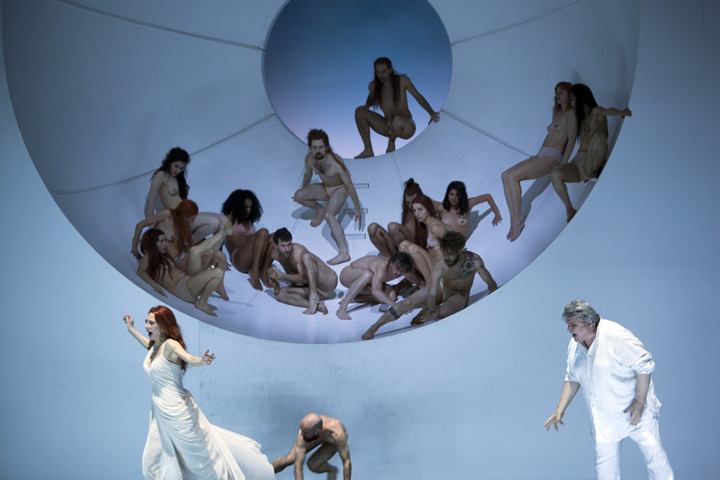
As is usually the case with me, when something grabs me - as did the Met's recent Tannhäuser -shouting protests notwithstanding  - I ended up listening to and watching three more Tannhäuseren First, the old Met cast of Cassily, Troyanos, Marton, Weikl,MacCurdy, Levine, next the premiere of the current run, and just now, finished the 2014 Staatsoper Under den Linden, which I'd heard, but never seen. While I was mildly hesitant with the staging after the Venusberg, it not only grew on me, it drew me in a manner more than an evening of traditional Medieval tableau (which I love and am NOT bashing so just STOP). Once I settled in I found the staging, directed by Sasha Waltz, who with Pia Maier Schriever designed it, together with superb costuming by Bernd Skadzig and the tremendous lighting design of  David Fin to be enormously powerful and I was, moved to tears at all the appropriate moments, but also in a few surprising places.  


Waltz, a renowned dancer and choreographer, infused every moment of her Tannhäuser with  dance and movement, at times making it feel almost like a physical manifestation of a moto perpetuo.  The Venusberg crowd (in a variety of costumes once they don actual clothing) wend and work their way into every scene, as observers, pilgrims, Elisabeth's family, and more. Their  gestures in and around the principal characters add depth rather than detract from the telling of this redemption tale. 


Musically, this performance is nearly ideal. As Heinrich/Tannhäuser Peter Seiffert is in his 60's and looks every one of those years, and vocally, at times sounds older than that.  And yet, there is still beauty in the voice when it isn't pushed and remains within a narrow range - mostly the mid-upper. Low notes can growl and higher passages feel pushed and can be both throaty and then switch on a dime, to thin and strain-y. Somehow he makes all of this work for him and the intensity of his Heinrich feels personal. In that vein, the Rome Narrative is rough going, but again, Tannhäuser is a man who's been to hell and back (so to speak) and the interaction between him and Wolfram is great theatre. 


As Wolfram, I honestly can't think of a performance (at least now) as beautifully perfect as nor as emotionally on the nose as As Peter Mattei's turn here. The man is, as ever, a masterful actor and the opening scenes of the third act are, for me, the heart of the opera. His commentary on, then scene with Elisabeth, found me (again) in tears and it all segued into the breathtaking beauty of O du mein holder Abendstern.  Waltz gives Wolfram some odd, dancerly moves to perform and poses to strike, but like elsewhere these do not deter but rather embellish the meaning of the opera's most beautiful aria.  Mattei takes on the dance and the gestures, and, with nothing on stage but Elisabeth's shoes and his shadow, through that gently commanding voice nearly steals the entire evening.


Ann Petersen imbues Elisabeth with angel-like purity, through a voice capable of sounding equal parts girlishly youthful, devout, and passionate.  She is truly ideal as Elisabeth. We don't see her name much here, but I just read an excellent  review of her in a revival of Simon Stone's brilliant Tristan (on video with Nina Stemme and Stuart Skelton), and I'd like to hear more, and how the voice has held up.

While he still sings beautifully, hearing the 2014 René Pape as Landraf is almost jaw dropping. It's a voice lesson in accuracy, conveyance of emotion, a seamless legato line and . . . well, he is simply marvelous. 


The rest of the cast all measure up, but I have to bring up the Venus. Gott in himmel (what an inappropriate phrase for this character!). While I still carry a torch for Troyanos (and Dame Gwyneth) Marina Prudenskaya's Venus is the epitome of schoolboy sexual fantasies.  Mama Mia.  Gorgeous and lithe she also posseses that both cuts and slinks through the siren's call with erotic venom. 

Barenboim leads the Berlin forces - chorus and orchestra in a glowing, dramatically propulsive reading that vibrates even in its quietest passages (i.e., Wolfram's Evening Star) and thrills from first note to last.  I don't know what other platforms it's on, but I do know it's yet another performance keeping me glued to MediciTV.

Labels: , , , , , , , , , ,

Wednesday, February 28, 2018

A Met Parsifal to Remember


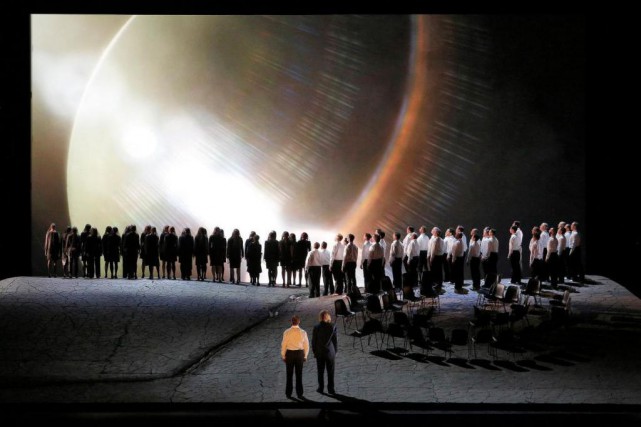
I was fortunate to be able to attend the final performance of the long awaited revival of François Girard's production of Wagner's Parsifal at the Metropolitan Opera. Perhaps I should change the word "fortunate" to "blessed." Parsifal is my favorite opera, I've heard and seen it many times, in a number of productions and I have no hesitation in stating Girard's is, hands down, the most perfect, emotionally gripping productions in my experience so far. Everything about it spoke to me in a way that was as much spiritual as it was "theatre." And what gripping theatre it was. Mr. Girard was, of course aided by Wagner's masterpiece, so a lot of the work was already laid out for him. This does nothing to lessen his accomplishment, but, in tandem, Wagner and Girard worked magic on a level that is rare in any opera house, and the Met does itself proud by the production of this union.


I have watched this production many times in its HD and video format (shout out to Met on Demand, worth its weight in gold) but nothing could quite have prepared me for the effect it had - nor the spell it wove on me - experiencing it in the house. Girard may have updated this to another era, possibly even the future, but he filled it with symbolism, gestures and experiences that felt as ancient as the first humans to walk upright. He explored Wagner's text more thoroughly than any traditional production I've experienced, including our relationship to animals and nature. The stating was complex in what it asked of its participants, far more so than could be gleaned from video; the constant movement, gesticulations, bowing, hand and arm gestures were dazzling, and mysteriously moving in their effect. They were not just "show," but filled with purpose, a history that, even if one could only guess and still not understand (as was my case) added to the sense of awe and wonderment Wagner built in to his libretto and score. There was at times, especially when viewed from the balcony and higher levels, the look of a heavily choreographed musical, not in a cheap, or frilly way, but just beautiful, the concentric circles of the Knights, for example had a "June Taylor Dancers" quality about it that surprised me yet fit perfectly to the staging and story.

The constant changing of backgrounds, shifting with the mood and color of the music was never less than breathtaking, and, while some I know complained about them, I felt only enhanced and heightened what was happening in the pit and onstage.

Musically, things could hardly have been improved upon. Maestro Yannick Nézet-Séguin led the Met orchestra and chorus in a masterful way that belies his experience, the participants responding completely to everything he asked of them. The cast was about as fine an ensemble of singers as has even taken part in a Parsifal, going back to the beginning of anyone alive's memory.

Foremost in that cast was the first voice we hear, Gurnemanz, here in the person of Rene Pape. There have been other beautifully sung Gurnemanz - Salminen, Hines, Moll and Siepi spring to mind - but for me, no singer has approached the text as delicately and as meaningfully as Pape has, particularly in this run. Some say Pape is not a particularly good actor, but I will say, as Gurnemanz, I can't recall a singer getting as "into the skin" of this character as this man has. Every gesture, facial expression, tear and note was of a piece, creating a Gurnemanz of enormous emotional and spiritual wisdom and depth. As opposed to his first Gurnemanz - a true figure of authority - here was a man of great humility and complete service to his order. His phrasing throughout was as delicate and purposeful as a lieder singer. Moments were caressed and uttered with an almost otherworldly beauty, and phrases such as:

"Nun freut sich alle Kreatur
auf des Erlösers holder Spur,
will sein Gebet ihm weihen."

are burned forever into my memory. It was that kind of performance.

Peter Mattei was a surprise the first time he approached Amfortas, a surprise in the very best sense, indeed. With a timbre lighter than we are normally used to hearing in the role, this was a youthful King whose suffering made one pity him in the most honorable sense. Mattei, with that beautiful voice, was capable of making us not only sympathetic to Amfortas, he went so far as to break out hearts and share in that pain. It was nothing short of remarkable. His restoration at the opera's denouement made us feel that the title character's own painful journey, was worth the trip, both to the opera house, and Monsalvat itself.

In most performance I have always felt Klingsor was never as deliciously malevolent as Wagner painted him. All that changes in the performance of Evgeny Nikitin. Here was juicy, brutal, unhinged menace, booming of voice and owning his place in the dark realm. There were subtle touches unseen (by me) before, for example, in his short prelude, Nikitin's Klingsor is not only ringing his hands and painting himself with blood, but he mimics some of the gestures of the grail ceremony we'd witnessed in the first act, most notably the kissing of the fingers which previously was passed from brother-to-brother, yet Klinsor has no one to pass this onto. There was a sort of pain, then anger on his face as his hands reached out to . . . no one. The moment was simultaneously telling, touching and chilling.


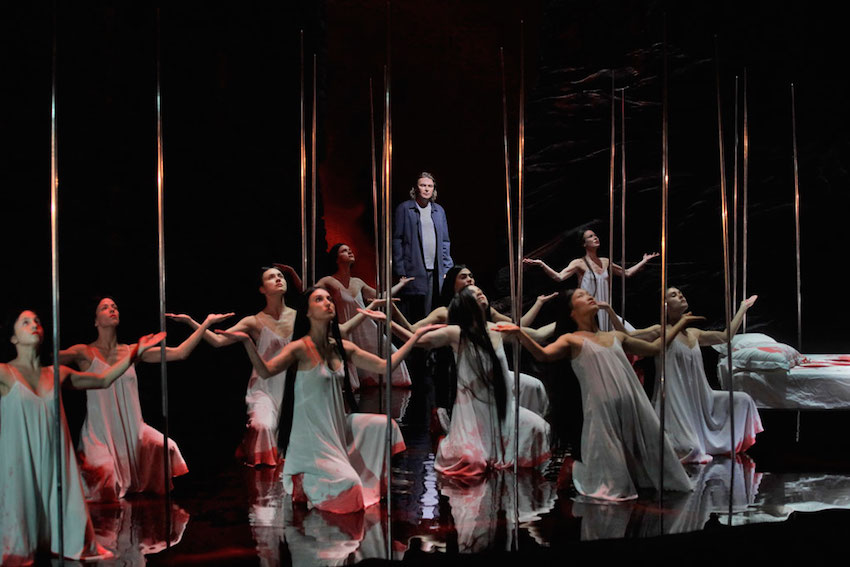
He was matched in his movements in the brilliantly choreographed movements of the Blumenmädchen who moved as one and made for as spectacular a stage picture as one could hope for. The singing by these "girls" was sensuous and had a youthful femininity that seemed fresh and erotic - both welcome elements. These were not middle aged women in flowing caftans trying to lure a pudgy tenor dressed as a boy, but physically alluring, manipulative menaces using their wiles. It was, in a word; hot.

Evelyn Herlitzius, who made her company debut in this run, presented us with richly drawn, emotionally gripping
Kundry. Bolder and perhaps more wild than many before her both vocally and dramatically she "felt" like Kundry. There was not the beauty of tone of, say, Crespin (who compared in that department?) or Troyanos, and top notes were on pitch, though often lunged at, the effect was special and one just believed this was Kundry.

In the title role we were treated to a much lighter sounding Parsifal than anyone can probably recall . . . certainly in my memory there has been no tenor who made this same effect. The "boyish" timbre of his voice bothered some, but me, not at all. While the voice has a "thin" quality to it, Vogt projects it masterfully, and made me believe every moment. I'd heard criticisms that Parsifal should sound "older" in the final act, but I personally don't buy into that. Most of us have had the same voice quality since we were young, and, as a friend told me (paraphrasing someone), "your voice is your voice, you can't pick up another one up at the corner store" adding, "especially during a second intermission."

As one always hopes for every opera, particularly Parsifal, the audience was about as well behaved as could be, coughing was at a minimum (usually only when dust seemed to blast out of the air conditioning system), no applause before the music was finished, everyone seemed hushed and caught up in the moment. Indeed, at the ovation, everything that had been held in check was given ample opportunity to explode, and that's the correct word for what happened when the curtain rose for bow time. Every singer received sustained applause and cheers, the chorus was roared at as was the incoming Music Director, who, after working so hard for so long, could not contain himself, running to every corner of the stage, hugging and shaking hands with a youthful exuberance that bodes well for the company's future. All things came together in a way that was uniquely special, and I received what I always want from a Parsifal: everything in the world.

Photos by Ken Howard taken from multiple internet sources

Labels: , , , , , , , , ,

Tuesday, February 6, 2018

Parsifal at The Met: Revival Redemption at Monsalvat


I had some difficulty tuning in last night and, there were several glitches on Sirius including an infuriating “This is a test of the Emergency Broadcast System . . . “ a few minutes into one of Gurnemanz’s 3rd act monologues and worse – Sirius dropping out during Parsifal’s final line and receiving the “content not available” message before Mahler began playing from another Sirius channel. Even these, however couldn’t (fully) spoil the effect that was being made over the air, and, based on good evidence, emanating from the house itself.

Yannick Nézet-Séguin led what can only be described as an extraordinary reading of an extraordinary score and his love for this score was made palpable in its execution. Moments, like some of those orchestral interludes during Gurnemanz’s monologues that change its tone which many others either gloss or languish over, here crackled with life, a vibrancy in the strings that was electric. The first transformation scene went about as beautifully as Knappertsbusch, with a similar sense of moving forward and at Gurnemanz’s response (my favorite line from any opera) to Parsifal’s observation:

"Du siehst, mein Sohn,
zum Raum wird hier die Zeit!"


We were all along for that journey. Here was shape and form, expansive where it needed to be, then firm . . . taut with a momentum like some great galactic force pulling each of us, inexorably, into its core. I was, as I always want to be by Parsifal, overwhelmed and transported.


That same care and detail, without being over precious was to be heard also in the Good Friday music, every measure part of the journey.

In the title role Klaus Florian Vogt will not likely be to the liking of some (most?) of our listers here. My first encounter with him – about ten years ago – found me perplexed . . . the tone that, I thought, of a countertenor. After a few years I’ve come to love his interpretations of both Parsifal and Lohengrin. Vogt began his musical career as a horn player with the Philharmoniker Hamburg and played in the pit for Parsifal. There is a purity of tone – almost treble like – in his singing that I feel works wonderfully in this role paired against both Frau Herlitzius and Herr Pape
brought an interesting aural tapestry, all the richer for its inclusion of light.

Making her company debut, Evelyn Herlitzius offered a wonderfully drawn Kundry. Bolder than many, more wild than some in her delivery. When she wanted sleep, you just know that no one in the world has ever been more exhausted than this lady. She took interesting liberties with her laugh at Klingsor – beginning it earlier and lasting longer and less “measured” than one is generally accustomed to. She was sensational and different than my other favorite Kundries who offered more plush to their sound (think Ludwig, Troyanos, et. al.) and more in the Modl and Meier vein. Whatever she did, it all boiled down to making me believe she really was Wagner's most fascinating character.

Of Klingsor, all one can say of Evgeny Nikitin is that he sings the role as though born to it. Too often for my taste has Klingsor had a wiry sound, more “Merlin the Magician” not enough menace. Not so Nikitin who roars through the part like a beautiful, sexy howling beast. There was evil, snarling beautifully through and, for some folks who like the darker side, there is a sinister, sensuality in the terror he offers with no apology. Brilliant.

His Blumenmädchen sounded sexier than usual, girly and wild (“Girls Gone Wild,” I remarked to friends last night on FB). They definitely didn’t sound like middle-aged matrons in caftans beckoning a hefty tenor in boy’s clothing. There was definite “snap” going on in their sound which somehow managed to be both luscious and lean. Delightful.

When Peter Mattei first took on Amfortas everyone (including me) thought why? Well, he showed us all why when this production first appeared here, and, as though we could possibly forget, reminded us again last night. The elegiac quality of his suffering is exquisitely portrayed, the sound, focused, unforced, open with a raw beauty so exposed it almost feels “raw.”

Rene Pape has, from the beginning, been one of the most beautifully sung, sonorous Gurnemanz in my experience. He belongs up there with the best interpreters of the role. While at this stage of the game a singer could just offer what he knows would “sell” – Pape goes beyond this. One can hear some age in his voice, softening the old knight’s sternness, and, if at all possible, deepening the intensity, whilst balancing it with gentleness. Nowhere was this more evident than in the Good Friday music, where he evokes nature itself and spins out such tenderness in:

"Nun freut sich alle Kreatur
auf des Erlösers holder Spur,
will sein Gebet ihm weihen
."

Just his mere utterance of “Kreatur” is a model of exquisite word painting.

Everything about this performance lifted my heart up last night, made me glad to be alive right now regardless of what else is happening in this crazy world. For six hours last night we had the opportunity to be lost in the time space continuum on our way to Monsalvat.

I can hardly wait to experience this live in a few weeks – and that, friends, is an understatement.

Photo Credits: Ken Howard/Metropolitan Opera

Labels: , , , , , , , , , , , , ,

Tuesday, September 23, 2014

Met's Season Opener: Le Nozze fi Figaro


I found - at least as presented over the Sirius broadcast, last night to be a thoroughly enjoyable "Le Nozze di Figaro" with some special moments, one being getting to know the voice of Amanda Majeski, whose quick vibrato I found to have a lovely Pilar Lorengar-ish flutter which I found enormously attractive.

While I'm no HIP-ster, Levine led a "modern opera house orchestra" performance that was brimming with life and energy.

I've heard some complaints of its dragging, but I found Levine's tempi frequently to be on the brisk side, while certain things were prone toward a Levine-ian exaggeration (which I sometimes mind and sometimes don't).

Overall, he shaped the evening with remarkable elasticity that bore the obvious stamp of his love for this opera. This was noticeable in "Dove sono", but nowhere more so than the in the first part of the Act II finale, where Figaro begins (for me) one of Mozart's most beautiful melodies at "Mente il ceffo, iogià non mento."

Last night Abdrazakov's Figaro began this moment a bit more brusquely than most (a nice effect in this lovely melody), then immediately smoothed out by Susanna and Rosina's "Il talento aguzzi invano," - until all three implore the Count to give in. Here, Levine seemed to breathe Mozart with almost imperceptible shifts of rhythm and creating a magic that brought tears to my eyes at the sheer beauty of the sound.

Not that any of this matters, but under Levine this moment occurred approximately an hour and 27 minutes into the show. Comparing it to three other recordings/performances (Salzburg 2006; the '75 Ponnelle/Bohm film with Prey, Fischer-Dieskau, Freni, Te Kanawa
&Ewing; and the HIP recording of Le Petite Band led by Kuijken) and this moment occurred, 8 minutes earlier than Salzburg, about a minute earlier than Bohm, and almost 7 minutes AFTER Kuijken! (Yes, I'm that obsessive and do this sort of thing all the time.)


Some complained about Isabel Leonard's voice being too big or mature for the character of Cherubino, but I wasn't one of them. I found the robust but still youthful sound appropriately "masculine" for this trouser role.

Marlis Petersen was charming and delighted the ear as Susanna, never once exhibiting exhaustion in this long sing (some refer to Susanna as the Brunnhilde of lyric soprano roles).

As mentioned Ildar Abdrazakov had a rougher hue to his sound than I typically like in the character of Figaro, but the basso's charm worked in his favor in creating the character, though at the upper reaches he sounded strained and faint. Still, he put his stamp on the role and while it won't go down as my favorite Figaro, he was certainly an enjoyable one.

Peter Mattei's Count Almaviva consistently offered some of the evening's finest singing and his actorly way with text served to bring to life a Count that was deeper on most levels than many present in the role, and one who reminded me of his character a few years earlier in The Barber of Seville. Marvelous work.


On an entirely different front, I got a laugh-out-loud charge from Deborah Voigt's "diva bitch fest" intermission feature, with Fleming and Co. There was a lot of talk about Fleming's upcoming "Merry Widow," but the future Hannah veered the conversation to her performances of the Countess in Paris during a political uprising, and then segued into her trip to Israel during a dangerous period. Voigt interrupted to say something along the lines of, "that's all very nice, but I want to talk about The Merry Widow." During her interview with Anna Netrebko, the Russian went on talking about how she's performed Susanna over 150 times, causing Voigt to quip how Anna was too temperamental to play the Countess. Even over the airwaves you could sense the Russian diva's irritation, before responding, "I don't like the Countess, she doesn't interest me." Voigt recovered by asking about Anna's gown, sending Nebs into a description of how the gown had been specially made for her by Yanina, the famous Russian designer who lives in Paris etc. This was followed by Mary Jo Heath's interview of Anita Rachvellischvilli, who immediately informed us she'd sung Carmen over 150 times and how her gown was also made by a famous designer, but she hates people who name drop, and he didn't feel the need her to advertise for him. Snap.

Nozze seemed an unusual choice for a season opener, but for this guy, it worked nicely. I very much look forward to seeing this production.

Labels: , , , , , , , , , ,

Saturday, March 2, 2013

Met's Stunning Parsifal in HD


This was simply (or, perhaps not so simply) one of the most amazing performances I've experienced of Parsifal, which is, of course, my very favorite opera. The new production is stunning, the hand-picked cast superb, each character caught up completely in the drama. I was only mildly concerned for my seatmates who'd never before seen Parsifal (though familiar with it from recordings). I needn't have worried for they were, as I was, blown away by all we saw and all we heard. During the intermissions  found myself chatting with the chap sitting on my other side, a longtime Met goer since his army days and being on leave in New York, yet had never managed to see it before. At the end, I asked, "So, how was your first Parsifal?" With tears streaming down his face, all he could manage was a faint,"I'm undone. Completely." Two complete strangers sharing the same experience and having the same reaction. Wagner can do that to us.

Musically, Gatti had the score so firmly in hand, and under him the Met Orchestra responded splendidly through every inch and measure of this amazing score. His nuanced, non-rushed reading glimmered in all the right places; the transformation music of the outer acts truly was transforming, the pulse (and pace) in Act II's opening, actually dangerous sounding ... chilling, as it should be. The Met Chorus, as ever, was superb, the multiple choir effects of the different levels of sound Wagner indicates coming through incredibly throughout the cinema's sound system.
Rene Pape's Gurnamenz is one that stands alongside the very best, his face registering so many emotions it was almost unbearably beautiful at times. During the first Grail ceremony, where Wagner finally gives him a vocal rest, his acting alone made every gesture, every movement and glance, genuinely felt. As he stared at Parsifal, Pape's eyes and even his mouth, registered a look of one who barely dared to hope that this young man could be "The One." As is always the case with this elegant singer, his way with the text remained a miracle.  In the Good Friday scene, just the simple way he uttered the phrase "Nun freut sich alle Kreatur" took my breath away, revealing a dignified rapture . . . a genuine rejoicing of nature and the meaning of this holiest of days. 

Jonas Kaufmann with his medium-sized tenor, gave a performance that captured the youthful casualness of the Innocent Fool, throughout the first act. He places the voice just right to be heard even softly, yet was fully capable in Act II of opening up for "Amfortas! Die Wunde!" With a sound that grows increasingly through its pain, his Parsifal finally comprehends . . . discovers what his purpose must now be, and ends that great monologue. with his desperate cry: "Erlöser! Heiland! Herr der Huld! Wie büss ich Sünder meine Schuld?" The intensity Kaufmann exhibited from this point onward was tremendous in every way. This really was Parsifal.
I enjoyed the interview with Peter Mattei, who spoke about people (like me) wondering something along the lines of, "Amfortas? You?" Haha! As it stands, Mattei, who we have grown to love in Mozart, Rossini, Tchaikovsky gave one of the most riveting, painfully beautiful accounts of the role I've seen or heard, his great narrative in Act I, heartbreaking. The integration between singer and role was perfection. What a glorious gift - and surprise this debut was. 

Evgeny Nikitin was as spooky and commanding a Klingsor as one could hope for. Malevolence, like blood, literally dripping from him as he made wild gestures and seemed to be uttering dark-god incantations.  This was a far cry from previous Klingsors in my experience, who were no more threatening than Uncle Fester, bald and sexless.  There was a verility still on display and again, that malevolence manifested itself in voice and deed and was not only palpable, it was terrifying.

Katarina Dalayman clearly knows the essence of Kundry down to her toes and her three (well, four) appearances captured every nuance of this eternally tortured woman. Girard took full advantage of his staging and whereas most Kundrys have been around for centuries, his has her having existed for millennia. The chemistry between Dalayman and Nikitin, Dalaymand and Kaufmann, Dalayman and Pape here made one of Wagner's most fascinating creatures even more so.

In the penultimate scene, we witness the spring in the dry, scorched topography coming back to life as water again flows with life, the perfect segue to the finale.  Entirely unique, Girard makes the entirety of the scene uniquely special, and, for me, the most overwhelming since Wieland Wagner's.  We watch Amfortas' healing, almost still in disbelief, and feel the awe and wonder of Gurnemanz, whose tested accepts his new King, were infinitely moving. Then, there is Kundry. Taking her rightful place in the final ceremony, and uniting with Parsifal the Grail and Spear, she is finally redeemed and allowed to die.  How much more satisfying this was rather than decades old trend of having her live on. The lady's tired, let her rest, already! . 

Francois Girard's production was a most remarkable achievement, along with Maestro Gatti and the company achieving a true realization of gesamtkunstwerk the likes of which I've rarely seen at this level. Even in this barren post-apocalyptic wasteland, there was a genuine, if raw, beauty about it all. The choreographed movements of the Flower Maidens - like Ninja roses from Hell, will (along with everything else I saw and heard) be burned, forever in my mind. Literally, unforgettable. Wagner's score has my eyes moist, and a lump in my throat from the opening notes of the Vorspiel to the curtain's final fall and today's performance - visually and sonically was no exception.


While I used not to be a fan of Barbara Willis Sweet, her work for the Met has not only improved, her video direction for today's performance sets the benchmark for how it should be done.  There were blessedly few long, intrusive close-ups, and instead she chose to capture the stage either in its entirety, or large portions of it. I didn't miss seeing long stretches of singers' dental work or nose hair.  Not one iota.

Our theatre was not only packed, it seemed there were no defectors, with everyone remaining, cheering, bravoing and applauding until long after the final credits had faded.

I shall not forget this afternoon and the exemplary work the Met gave us from start to finish. I'm on a high right now that is going to stick around for days. I look forward to a (hopeful) release of this performance on Blu-ray, to experience this slice of Wagnerian heaven again . . . and again.


Labels: , , , , , , , , , , , , ,

Saturday, February 16, 2013

Met's New Parsifal: Broadcast Review


A good Parsifal stays with me for days and last night's prima threatens (happily) to do just that. I remained awake much of the night thinking about what I heard (and wish I could have seen). For the principal roles I cannot imagine a cast better than last nights.

I had reservations about Ms. Dalaymanin the first act, I like a Kundry to be a bit more "pliable" vocally, and at times
Dalayman had a thickness to her sound that I felt occluded the writing.Nonetheless, in Act II, particularly after her first long narration, and her exchange with Parsfial beginning "War dir fremd noch der Schmerz" . . . here was genuine drama between the pair and I sat up straight for the remainder of the act, sometimes with chills, sometimes with tears.

Peter Mattei gave one of the most exposed readings of Amfortas' first Grail narrative in my entire experience, the voice gloriously rich and pouring out with a velvety sheen that made the character's torment all the more heart rending. Emotionally, it felt as if he was holding nothing back and the voice responded in a manner that enhanced every syllable of the text. Beginning with his pained cry/command to keep the grail covered ("Nein! Lass ihn unhenthüllt! Oh!") my heart began breaking for this wounded grail king. I can only imagine the effect it had on the innocent fool . . . going directly to Wagner's directions being alternately petrified, profoundly moved, and transported.


While some felt Jonas Kaufmann in the title role sounded "tired," I heard nothing that would make me think such. That burly, rich sound which annoys some and thrills others, feels just right in this music (perhaps more than any of his other Wagner roles, though his recent Lohengrin was amazing is still resonates with me powerfullly). His scenes with Gurnemanz both in the first and third acts were highlights and there were moments when the flow of one's voice into the
others revealed a quality that made me think they could've been long lost brothers. Act II slowly, but eventually took fire and Kaufmann truly came into his own at that critical moment singing "Amfortas! Die Wunde! Die Wunde!" with a strength and volume (at least over the radio) that altered the course of the story (as it should). This moment of epiphany was truly revolutionary and I FELT Parsifal's transformation immediately. Amazing, really.

Evgeny Nikitin was a tremendous, evil-sounding Klingsor. I was fully amazed at the almost complete change of voice he made from his entrance "Die Zeit ist da." with this almost thin quality - then growing into menacing mastery as he
summons Kundry forth. Nikitin was appropriately chilling. I look forward to (eventually) seeing how he plays this.

I first saw Rene Pape's Gurnemanz in 2003 (meeting him briefly the night before) and I immediately felt in both voice and interpretation he belonged inthe company of Moll, Salminen and Talvela. In the Good Friday music, Pape's Gurnemanz had me in the palm of his hands. The softening of this character from the first act to this is expressed so beautifully and Pape's command of the language ensures certain phrases that can slip by as little more than beautiful noise from non-native singers are turned into magic. This was particularly noticeable in a phrase like Nun freut sich alle Kreatur" where just the way he pronounces the word "Kreatur" is capable of creating a feeling that goes beyond the notes and the text. Far beyond.

I've seen some very mixed reviews so far on the conducting of Daniele Gatti. I liked what I heard, a lot. Sure there were some problems in the opening Vorspiel . . . enough at the very beginning to actually cause me to cringe a
couple of times, as the synchronization between conductor and about half the orchestra struggled to stay together. Finally, at about 5 minutes in (right around when all we hear are the flutes) . . . following a luftpause they all
seemed to pull together and coalesce and I felt the magic I feared I might not hear. A couple of other bumps along the way aside, I felt Gatti's slowish approach worked very well.

Slow, however, was not what we heard at the opening of the second act. Here, Gatti and the band blasted their way through Klingsor's music in a manner that would've made Boulez' head spin . . . it certainly did mine, and I LOVED the
almost dizzying effect Gatti provided here. (No, I don't want to always here it this way, but it was fun, and why not have a little horror house fun here?) I felt the temple scenes worked beautifully, Gatti and his singers finding the right (if frequently slowish) pace and the final moments were sublime.

I read where someone mentioned that listening last night the final sung note of the opera was completely inaudible. Not over my transmission and I've played it several times . . . it's ethereal and floating just the way it is supposed to.

I loved the inteviews with Terrance McNally and first lady of punk (and a personal idol) Patti Smith. Each offered their own thoughts on Wagner in general and Parsifal in particular. Insightful, contemporary and thought provoking from a pair I'd expect nothing less from.

So, all-in-all a terrific night of music making, the Met's musical forces allowing me to hear my favorite work while far away from Lincoln Center. That's a miracle in itself.

Labels: , , , , , , , , , ,