Friday, November 22, 2024

ROCK ME AMADEUS! National Theatre's Astounding Production


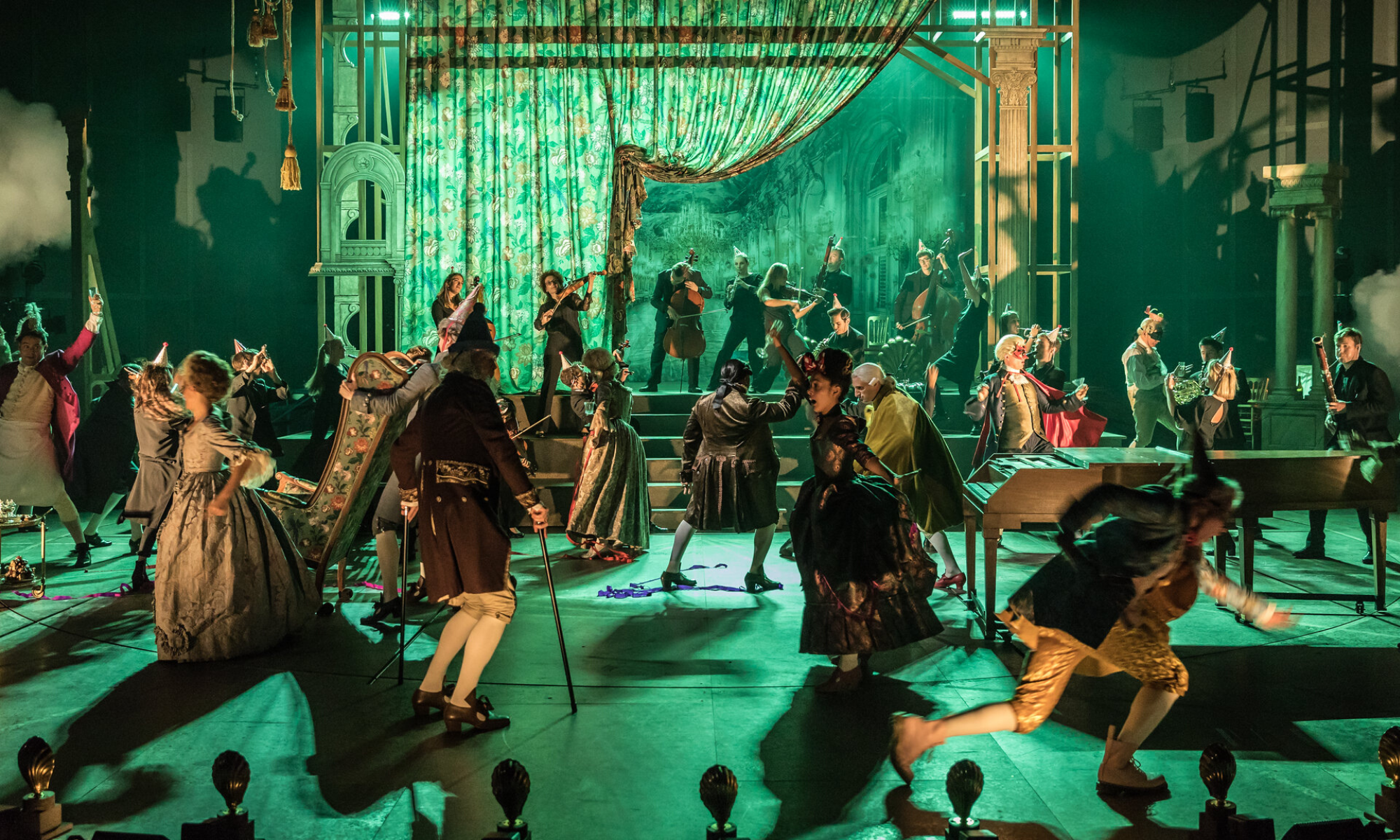
Time has prevented me from writing anything about my mind being blown a few nights ago watching the 2017 National Theatre production of Peter Schaffer's masterpiece Amadeus. It was exciting to see the work revived - in a different production and edition - in the same theatre it premiered at in 1979.  What a journey this play has taken over the decades since that first night.  


Michael Longhurst's gives this Amadeus about as stunning a production as it will ever likely receive and once again I've witnessed something that left me emotionally spent and incredibly grateful  I'm still alive. It made me remember that despite the wretchedness that surrounds us, the world still allows such magic as to make us forget it all long enough to remember how beautiful it can still be.  

Visually, sumptuous, Longhurst gives his Amadeus a widescreen film perspective, with a large moveable (automatically receding and projecting) platform that accommodates the numerous scene changes and handsomely holds his enormous cast, which includes the 21 member Southbank Sinfonia - so that everything, every gesture feels magnified . . . larger than life  

Since its premiere, Salieri has become one of the great villain roles of the last century and  attracted a wide variety of top flight actors ready to rant, rave and poison his rival, Mozart, but Lucian Msamati may be the best of the many I've seen. His harrowing portrayal covers every possible aspect of Salieri's personality - the pettiness, the jealousy, the rage and self-loathing - to the point I was alternately sympathetic and disgusted by him.  As it should be.

I initially had some issues with Adam Gillen's Mozart. Delivered in an exaggerated Cockney (as was Karla Crome's Constanza) that made increased his already annoying behaviour t o a level that was at times, difficult to take. He makes up for that to some degree with his physicality - literally throwing himself into every scene with an abandon that almost seems dangerous.  All of that however, pays off handsomely in the final 30 or so minutes of the play.  As Mozart's fortunes turn and his demise is imminent, Gillen's Wolfgang broke my heart - and I watched the final scenes in tears. It was beautifully painful and painfully beautiful.  


The Southbank Sinfonia provide not just a consistent soundtrack in music of Mozart and others, including arrangements by Music Director, Simon Slater, but also are part of the action, several of them with lines. The operatic scenes are spectacularly delivered on floating proscenium arches with Mozart in tow several times, and an interesting arrangement of the Queen of the Night's aria that has Papagena sort of echoing the high notes. Sounds strange but it works. Brilliantly. 

While I've loved this play for over forty years, right now I don't think I've ever loved it more. 

Labels: , , , , , , , , , , ,

Friday, January 20, 2023

Sly Shines in Aix's Giovanni

It's been a few years since I've really talked about it, a recent discussion reminded me of how much I adore Jean-François Sivadier's wildly savage and controversial Don Giovanni from the 2017 Aix Festival.

From the premiere stream five years ago it left an enormous impression on me on multiple levels.  beginning with a brisk and bold overture from Jérémie Rhorer leading his period ensemble, Cercle de l'Harmonie. For the balance of the evening, Rhorer is perfectly attuned with that same energy, combining the myriad elements of Mozart's masterpiece pulling out all the stops: dramatic, comedic, and, when necessary, the terrifying. His singers and players place the entirety of their work into a perfect, cohesive and most satisfying whole.

While some absolutely hated it, I found myself enthralled. It was like experiencing something I've known my entire life like the back of my hand, as if for the first time. That's always a rare and glorious experience.


Likewise, I found the casting nearly perfect with a group of exciting, young singers.  Isabel Leonard makes for a fetching, troubled Elvira; Pavoll Breslik puts in a wonderful turn as Ottavio who brings the only (welcome) solemnity to the frequently eye-popping action,. That, in and of itself, seems to set the rest of the antics off, making it all even more exciting.

Elenora Burrato (Anna), Julie Fuchs (Zerlina), Kzrysztof Bączyk (Masseto), and, most of all, Nahuel di Pierro's Leporello all add up to a glorious ensemble of singer actirs who light up the stage every moment their upon it, while doing solid justice to the score.  I cannot fail to mention (except by name) the beautiful young actresss playing Elvira's maid.  Her presence, from the beginning, is an integral part of this show.


At the center of everything is Philippe Sly's pulsating, fever-pitch Don, who, from overture to finale. is charged with a demonic, sexual, brash,feral energy that must to be witnessed to be believed.  He is electrifying in the role.  Seemingly in perpetual motion, I agree entirely with the critic who called this performance "absolutely mesmerizing, beautiful, horrible and in a frantic race into the abyss."    Yes!  That's it, precisely!


The movements of every character are so thoroughly choreographed - but never with artificie, always wedded beautifully to the music, it almost becomes, in a sense, an opera/ballet. Costumes, are a wild mix of several periods, almost as if the actors were putting on a show "on the spot."  It's all played out on a mostly bare acting platform with sheets as drops,and beautiful Murano-blown glass light bulbs adding to the "play-within-a-play" quality.  The entirety of this performance resounds with a youthful energy I've rarely encountered in any opera, much less Mozart's supreme dramma giocoso.  Hands down, this is one of the most electrifying Dons I've experienced.  Your mileage, however, as they say, may vary.


Labels: , , , , , , , , , , ,

Wednesday, September 24, 2014

History of the Metropolitan Opera's Opening Nights


I've been in several recent discussions regarding opening nights at the Metropolitan Opera. I'd mentioned I found this year's choice, "Le Nozze di Figaro" to be an unusual, but lucky one. Several friends disagreed saying it wasn't unusual at all and that it could work. I agreed that it could (and does) work, but still maintain for the Met it's an unusual choice. (The Met has only opened with it one other season, back in 1941).

The history of Met Opening Nights is fascinating, with the most frequent opera appearing to be Aida, the choice for
eleven seasons. Otello opened seven seasons and Faust and Roméo et Juliette each opened six.

I find it odd, and perhaps it's just a personal issue, but I'm not in favor of, as has happened several times in the Met's history using a Gala Concert to open the season in lieu of an actual opera performance. I'm sure, however, others would prefer this kind of evening but I don't call them opera lovers!

Following is a list of the Met's Opening Nights.

1883: Faust
1884: Tannhauser
1885: Lohengrin
1886: Die Königin von Saba
1887: Tristan und Isolde
1888: Les Huguenots
1889: Der Fliegende Holländer
1890: Asrael
1891: Roméo et Juliette
1892: (No Season)
1893: Faust
1894: Roméo et Juliette
1895: Roméo et Juliette
1896: Faust
1897: (No Season)
1898: Tannhäuser
1899: Roméo et Juliette
1900: Roméo et Juliette
1901: Tristan und Isolde
1902: Otello
1903: Rigoletto
1904: Aida
1905: La GIoconda
1906: Roméo et Juliette
1907: Adriana Lecouvreur
1908: Aida
1909: La Gioconda
1910: Armide
1911: Aida
1912: Manon Lescaut
1913: La Gioconda
1914: Un Ballo in Maschera
1915: Samson et Dalila
1916: Les Pêcheurs de Perles
1917: Aida
1918: Samson et Dalila
1919: Tosca
1920: La Juive
1921: La Traviata
1922: Tosca
1923: Thaïs
1924: Aida
1925: La Gioconda
1926: La Vestale
1927: Turandot
1928: L'Amore dei Tre Re
1929: Manon Lescaut
1930: Aida
1931: La Traviata
1932: Simon Boccanegra
1933: Peter Ibbetson
1934: Aida
1935: La Traviata
1936: Die Walküre
1937: Tristan und Isolde
1938: Otello
1939: Simon Boccanegra
1940: Un Ballo in Maschera
1941: Le Nozze di Figaro
1942: La Fille du Régiment
1943: Boris Godunov
1944: Faust
1945: Lohengrin
1946: Lakmé
1947: Un Ballo in Maschera
1948: Otello
1949: Der Rosenkavalier
1950: Don Carlo
1951: Aida
1952: La Forza del Destino
1953: Faust
1954: Gala Concert (Telecast)
1955: Les Contes d'Hoffmann
1956: Norma
1957: Eugene Onegin
1958: Tosca
1959: Il Trovatore
1960: Nabucco
1961: La Fanciulla del West
1962: Andrea Chénier
1963: Aida
1964: Lucia di Lammermoor
1965: Faust
1966: Antony and Cleopatra
1967: La Traviata
1968: Adriana Lecouvreur
1969: Aida
1970: Ernani
1971: Don Carlo
1972: Carmen
1973: Il Trovatore
1974: I Vespri Siciliani
1975: The Seige of Corinth
1976: Il Trovatore
1977: Boris Godunov
1978: Tannhäuser
1979: Otello
1980: Mahler: Symphony No. 2
1981: Norma
1982: Der Rosenkavalier
1983: Les Troyens
1984: Lohengrin
1985: Tosca
1986: Die Walküre
1987: Otello
1988: Il Trovatore
1989: Aida
1990: La Boheme
1991: Gala Concert (25th Lincoln Center Anniversary - Telecast)
1992: Les Contes d'Hoffmann
1993: Gala Concert: 25th Anniversaries of Domingo & Pavarotti
1994: Il Tabarro & Pagliacci (Unheralded 35th Anniversary for Stratas)
1995: Otello
1996: Andrea Chénier
1997: Carmen
1998: Samson et Dalila
1999: Cavalleria Rusticana & Pagliacci
2000: Don Giovanni
2001: Gala: A Celebration of Verdi
2002: Gala: Fedora Act 2; Samson et Dalila Act 2; Otello Act 4
2003: La Traviata
2004: Otello
2005: Gala: Nozze di Figaro Act 1; Tosca Act 2; Samson et Dalila Act 3
2006: Madama Butterfly
2007: Lucia di Lammermoor
2008: Renee Fleming Gala
2009: Tosca
2010: Das Rheingold
2011: Anna Bolena
2012: L'Elisir d'Amore
2013: Eugene Onegin
2014: Le Nozze di Figaro

Labels: , , , , , , , , , , , ,

Tuesday, September 23, 2014

Met's Season Opener: Le Nozze fi Figaro


I found - at least as presented over the Sirius broadcast, last night to be a thoroughly enjoyable "Le Nozze di Figaro" with some special moments, one being getting to know the voice of Amanda Majeski, whose quick vibrato I found to have a lovely Pilar Lorengar-ish flutter which I found enormously attractive.

While I'm no HIP-ster, Levine led a "modern opera house orchestra" performance that was brimming with life and energy.

I've heard some complaints of its dragging, but I found Levine's tempi frequently to be on the brisk side, while certain things were prone toward a Levine-ian exaggeration (which I sometimes mind and sometimes don't).

Overall, he shaped the evening with remarkable elasticity that bore the obvious stamp of his love for this opera. This was noticeable in "Dove sono", but nowhere more so than the in the first part of the Act II finale, where Figaro begins (for me) one of Mozart's most beautiful melodies at "Mente il ceffo, iogià non mento."

Last night Abdrazakov's Figaro began this moment a bit more brusquely than most (a nice effect in this lovely melody), then immediately smoothed out by Susanna and Rosina's "Il talento aguzzi invano," - until all three implore the Count to give in. Here, Levine seemed to breathe Mozart with almost imperceptible shifts of rhythm and creating a magic that brought tears to my eyes at the sheer beauty of the sound.

Not that any of this matters, but under Levine this moment occurred approximately an hour and 27 minutes into the show. Comparing it to three other recordings/performances (Salzburg 2006; the '75 Ponnelle/Bohm film with Prey, Fischer-Dieskau, Freni, Te Kanawa
&Ewing; and the HIP recording of Le Petite Band led by Kuijken) and this moment occurred, 8 minutes earlier than Salzburg, about a minute earlier than Bohm, and almost 7 minutes AFTER Kuijken! (Yes, I'm that obsessive and do this sort of thing all the time.)


Some complained about Isabel Leonard's voice being too big or mature for the character of Cherubino, but I wasn't one of them. I found the robust but still youthful sound appropriately "masculine" for this trouser role.

Marlis Petersen was charming and delighted the ear as Susanna, never once exhibiting exhaustion in this long sing (some refer to Susanna as the Brunnhilde of lyric soprano roles).

As mentioned Ildar Abdrazakov had a rougher hue to his sound than I typically like in the character of Figaro, but the basso's charm worked in his favor in creating the character, though at the upper reaches he sounded strained and faint. Still, he put his stamp on the role and while it won't go down as my favorite Figaro, he was certainly an enjoyable one.

Peter Mattei's Count Almaviva consistently offered some of the evening's finest singing and his actorly way with text served to bring to life a Count that was deeper on most levels than many present in the role, and one who reminded me of his character a few years earlier in The Barber of Seville. Marvelous work.


On an entirely different front, I got a laugh-out-loud charge from Deborah Voigt's "diva bitch fest" intermission feature, with Fleming and Co. There was a lot of talk about Fleming's upcoming "Merry Widow," but the future Hannah veered the conversation to her performances of the Countess in Paris during a political uprising, and then segued into her trip to Israel during a dangerous period. Voigt interrupted to say something along the lines of, "that's all very nice, but I want to talk about The Merry Widow." During her interview with Anna Netrebko, the Russian went on talking about how she's performed Susanna over 150 times, causing Voigt to quip how Anna was too temperamental to play the Countess. Even over the airwaves you could sense the Russian diva's irritation, before responding, "I don't like the Countess, she doesn't interest me." Voigt recovered by asking about Anna's gown, sending Nebs into a description of how the gown had been specially made for her by Yanina, the famous Russian designer who lives in Paris etc. This was followed by Mary Jo Heath's interview of Anita Rachvellischvilli, who immediately informed us she'd sung Carmen over 150 times and how her gown was also made by a famous designer, but she hates people who name drop, and he didn't feel the need her to advertise for him. Snap.

Nozze seemed an unusual choice for a season opener, but for this guy, it worked nicely. I very much look forward to seeing this production.

Labels: , , , , , , , , , ,

Sunday, February 9, 2014

Remembering Behrens on Her Birthday

Today would have been Hildegard's 77th birthday. Few singers have influenced my life and love of singing as much as this great lady. It's hard to believe that this August she will have been gone five years from us.

But this is not a mournful post, but rather a celebration of her birth of one of those singers who became a polarizing force in the world of opera. People loved her, people loathed her and, often there was not much room in between.

For me, Behrens' voice was one-of-a-kind; instantly recognizable and, as with the most committed of singers, always in search of how best to serve the composer. It's interesting to me how, a few years now after her death, whenever I play her recordings for friends, the almost universal comment is, "I don't remember her voice being this beautiful," a sentiment I, who have always found that voice so beautiful, have difficulty fathoming. But, I'm just glad they do.

There were so many roles I adored her in, but none so much as the one that introduced me to her: Salome. While I grew up on other singers of the role - great ones to be sure - Behrens was the very first who made me see and hear the depraved Judean princess as a girl, and that, my friends, changed everything. There were so many touches I'd never before heard, and I recall anticipating how she would belt out that first great phrase when her bloody prize emerged from the cistern. "Du wolltest mich nicht deinen Mund," - here, most sopranos deliver the moment with either a sense of exaltation or horror movie terror . . . effective either way but with Behrens you get both . . . each one simultaneously in an explosion of sound that, naturally, changes the course of the rest of the opera. Throughout Strauss' remarkable music Behrens sweeps through combining exquisite, silvery lyricism then ramping it back up with dramatic explosions of near volcanic proportion.

I'm ranting on (as usual) wanted something up here today to honor the birthday of this amazing singer who, right up until the day she was taken from us, was still filled with the joy of music, singing, working and teaching young singers.

If anyone finds themselves with a moment to spare today (or the next few), I hope you'll do yourself a favor and listen to the final scene from that legendary EMI recording with Hildegard (here along with Karl-Walter Böhm's Herod) under
Herbert von Karajan.

http://www.youtube.com/watch?v=aZ--rkoREP0

You may be gone, but Happy Birthday, Hildegard . . . and danke danke schön, dear lady.

p.

Labels: , , , , , , , , ,

Tuesday, May 4, 2010

Jonas Kaufmann Decca Recital: Mozart, Schubert, Beethoven & Wagner


For weeks now I've been obsessed with two extremely different CD recitals. I've written already about Simon Keenlyside's outstanding Wigmore Hall song recital and now it's time to rave about Jonas and his Opera Arias of Mozart, Schubert, Beethoven & Wagner.

In ''Dies Bildnis Ist Bezaubernd Schön'' I was immediately struck by a similarity to another tenor's rendition of it: Fritz Wunderlich's. No, the two German tenors don't sound all that much the same - but Kaufmann's almost seemingly innate beauty of line felt nearly identical to Wunderlich's. It is Mozart singing of an exquisite and unusual beauty.

The "Wunderlich Connection" continues with Schubert's too infrequently performed "Fierrabras" (of which a gorgeously sung, but bothersome regie production exists on DVD, Kaufmann gotten up as a young Schubert). As rare as the work tends to be, Wunderlich also is featured in a live performance. The opera has problems, but the recit and aria ''Was Quälst du mich, o Missgeschick . . . " might make a few converts to at least selections from this rather beautiful work.

An even more persuasive case for Schubert comes in one of the most exquisitely sung (and marvelously phrased) "Schon wenn es beginnt zu tagen" from Alfonso und Estrella. There is such delicate, almost gauzy shading in the middle of the aria, with Schubert's lied-like aria smelling strongly of Beethoven at times - and wondrously so. This really is a breathtaking performance in every way.

In the natural progression, Beethoven DOES arrive next in Florestan's great scene "Gott! welch Dunkel hier!" Here, Claudio Abbado's leads the Mahler Chamber Orchestra in one of the most sensitive preludes to this scene I have ever heard in a recording. Here, also, Herr Kaufmann outdoes himself from his live performance recording in giving a sense Florestan's depth of despair. - his opening "Gott!" - almost inaudible when he first enters - reveals a true groan of anguish as it swells to full tragic hopelessness - and from there builds into the ecstatic hymn of hope and love of life and Leonore at its end. Unbelievable. For a moment I searched my mind, "has there ever been a more sensitively and beautifully phrased performance of this? Vickers sprang immediately to mind, but I left him alone for a moment to answer myself with "with singing of such beauty and passion, why compare?"

The rest of the album's contents are five Wagnerian selections which bookend the disc. First up are Lohengrin's two famous arias and in them I think we're catching the beginning phases of one of the major Wagnerians of our very near future. The recital opens just about perfectly with one of the most heartfelt, richly nuanced renditions of "In fernem Land" I have heard in a long, long time. The conversational nature of the aria begins so gently, but with no loss of intensity as it builds, Kaufmann and Abbado stretching Wagner's lines with an almost gauzelike delicacy of dynamics that waver back and forth in the type of performance that has one on the edge of the seat, held rapt throughout as it explodes into the stunning climax only to again recede all of it so captured as if almost by some religious magic. And so it goes through all five Wagnerian arias.

Among all the operas I love, perhaps none is more dear to me (for many reasons) than Parsifal and in his two selections, Kaufmann captures that perfect balance of spirituality and storytelling so necessary in this role. The tenor's first cry of "Amfortas!" - the intensity and heartbreak inherent in his sound - almost as if built into it, reminded me (again) of Vickers in this moment.

To end this album with the entire final Grail Ceremony is an incredible touch (to me, at least) and while generally I would prefer this music not be taken out of context, Abbado leads his forces (including the Coro del Teatro Regio di Parma) in an effective reading that can only be commended and Kaufmann's
two shining moments as the Innocent Fool become the Grail King only whet
the appetite for what's to come. It should be something special.

Labels: , , , , , ,

Monday, September 21, 2009

Rene Jacobs: Idomeneo Perfection


Mein Gott in Himmel - this recording just blew my entire world apart - in a good way! It's no secret to those who know me, I adore Richard Croft in Mozart (well, in anything!) and while some prefer a beefier tone in this role, I completely love his work here. Croft brings countless "acting with the voice" nuances to every scene, imbues every bit of text in deeply thoughtful manner that make his King believable, heroic and richly human.

Ah, then there is the way he tosses tosses off "Fuor del mar's" coloratura fireworks (in Mozart's own "bravura" version). This reading is insanely fast - shaving almost a full minute off of any other recording I know of the same version (a criticism leveled at the entire set by a number of reviews). While it didn't appear to leave the singer so - it certainly left ME breathless by the end! I've never heard the coloratura in this aria sung with this kind of agility and speed and the result is tremendously thrilling, and tremendously beautiful. Aside from the fireworks, Croft like the very best singers, always knows how to thrill during the recitatives - something Jacobs seems to have worked out in great detail with the entire company, as the recits are here as dramatically exciting (well, almost) as the arias that follow. All of that aside, it is his singing of the opera's closing pages - in a reading that is so full of hope and joy that sells me on his interpretation of Mozart's greatest (to me) tenor role.

As to those recitatives, there has been a lot of complaining in the press that Jacobs has gone out of his mind and turned them into caricatures of how a recit really should go. Not for me (and evidently, not for many who have purchased this set and are similarly loving it). The recitatives are restored (I believe) to almost 100% and the fleshing out of them on the fortepiano almost seems to add another character to the opera itself. Mozart perhaps? Regardless, I think it's a stroke of genius and gives this set - already bursting at the seams with new(ish) ideas, an edge over other sets - at least for me. (I must say, several times I felt as though the foretepiano sounded like it should have a couple mugs of beer sitting atop it!)

Like the singer of the title character, everyone participating in this the set is so fully involved with their characters it's almost impossible to single out any particular singer - but I must, and it is, for me, a singer brand new to these ears: Kenneth Tarver, the tenor singing Arbace is a revelation. Singing with gorgeous tone, solid musicmaking, elegant of line his agility in rapid passagework is absolutely thrilling - and the tone seems to be one of those voices that truly sings "from the heart." I look forward to hearing a lot more from this young singer.

I'm a nut for any singer with the last name of "Fink" as, in my experience, they're always at the top of their game, and Bernarda is no exception. I tend to like her more in lied or baroque opera/oratorio, but she is simply wonderful here as Idamente, fully engaged and her scenes with Ilia are lovely and full of a genuine tenderness.

Though a studio recording, Sunhae Im, took (by my measure) a little while to warm up, her voice sounded just a bit underpowered and wan early on - but by "Zeffiretti lusinghieri" the tone is warmer, fuller - and the gentle, expressive manner in which she takes the aria is exquisitely beautiful, her ornamentations delightful, the ability to swell out and color the tone, most impressive.

Alexandra Pendatchanska became - about a dozen years ago - one of my favorite sopranos in a single hearing of her as Donizetti's Parisina. While I adore her "fierce" singing - there is Elettra's exquisite solo "Soavi Zeffiri" in that choral masterpiece "Placido e il mar," . . . divine would not be too strong a word to describe this moment. Of course, we LIVE for Elettra's final mad scene "D'Oreste, d'Aiace" - where she joins a long line of deliciously delirious predecessors (most notably, Hildegard Behrens who made this such a memorable coup d'theatre).

Previously having mentioned the chorus, the RIAS Kammerchor is here just about as thrilling as it gets in this music and their contribution to this set simply cannot go unmentioned - the chorus is one of the greatest characters in this drama; wringing out every moment of pathos, sounding properly and breathlessly terrified when called for, singing impeccably at every dynamic level, offering a glorious blanket of sound that envelops all.

Jacobs leads the Freiburger Barockorchester in what is, for me, the single most propulsive, action-packed reading of this score I have yet encountered. He's never afraid to let the timpani, brass or wind machines make their effects realizing Mozart himself packed all of this drama into the score. Many moments in this reading are the aural equivalent of "special effects" we'd "see" in movies. Everywhere is there a combination of muscle and grace, intensity and gentility - all coming off in a manner that seems to make the familiar even more alive and new.

There are moments that he gets better than anyone, such as the delicious quartet for Ideomeneo, Ilia, Idamante and Elettra "Andro ramingo e solo." This is one of the greatest ensembles ever set by Mozart, beginning with an almost deceptively simple quasi-fugal beginning that soon turns into a complex, thrill-a-minute drama of its own, all four characters either accepting their fate, declaring their love or cursing the gods and seeking revenge. It's "opera as concerto movement." The quartet simply grows and grows, and Jacobs builds the orchestral contributions to a pulse pounding pace, never coming close to overwhelming his singers, who each, respectively are coloring the text and musical line with an almost unbelievable sense of precision. The complexities of harmonies and textures of sound achieved here is alone worth the purchase of this set.

The box is a fairly lavish affair (particularly these days) with a nice four language libretto, essays by Jacobs, Silke Leopold, plot synopses, and smaller-than-postage stamp photos of the cast (would it KILL anyone to have decent photo sets in these things like the old days?) One silly touch is those teeny-tiny photos show up on three consecutive pages with the singer's characters translated into French, German and (for English speakers) the original Italian names. Why? To make up for this, the package is accompanied by a DVD (as yet unwatched by me) of the recording sessions. Why not?

For sheer thrill of Mozart music drama I don't know that we'll see a better recording of anything this year. It's a magnificent set that I'll look forward to playing often.

Labels: , , , , ,

Friday, April 3, 2009

Adoring Ameling - Elly Ameling - 75 Jaar

I recently purchased and have been spending time with the 5 disc set published last year by Heartselling (with Weijman's Media Groep) in celebration of Elly Ameling's 75th birthday. The recordings are culled entirely from live performances and I can say in all honesty that for any fan of this great lady this set is a must have - a treasure trove spanning the years 1957 through 1991 and offering a remarkable glimpse into the career of one of the 20th century's most beloved artists.

 There are some surprises not only in repertoire, but in the manner in which the music itself is laid out. Undoubtedly, some would have preferred a more chronological arc essaying the career from the beginning and working through, but this set takes a non-linear path jumping across years and achieving its order by devoting each disc to a specific theme or genre. Disc 1 -Opera (1957-1988) Disc 2 - German Lied (1973-1991) Disc 3 - French Mélodies( 1979-1991) Disc 4 - French, Dutch, Italian, English, Russian (1958-1989) Disc 5 - 20th Century Dutch (1966 & 1977) Each disc is a gem - a mini-retrospective of her career and while I loved luxuriating in each of them, two stood noticeably out in my early hearings.

The first is the disc of German Lied. What we get here is not the wonderful Schubert or Brahms we know from this singer, but rather offerings from three wildly diverse giants: Berg, Mahler and Strauss. The disc opens with Berg's mini masterpiece Der Wein - a unique hybrid combining elements of his 12 tone style with a "suggested diatonic tonality" (Perle). Ameling approaches this music no differently than Bach or Mozart - i.e., with discipline, musicianship, and artistry in equal measure, making for stimulating listening full of an almost preternatural beauty. Erich Leinsdorf and the Concertgebouw Orchestra, at every level, match the singer's intensity, making a most persuasive case for this piece. We jump 20 years to two of the last recordings in the set: a pair of Mahler's Rückert Lieder. Here we have the first and most noticeable contrast of the early and late career Ameling: the vibrato is a bit slower, wider now, an unfamiliar strain appears in the top notes, the voice, still beautiful, has not quite that same youthful freshness we associate with it . . . and yet - there is magic here - real magic. As she finishes - Ich bin der Welt abhänden gekommen: Ich bin gestorben dem Weltgetümmel, Und ruh' in einem stillen Gebiet! Ich leb' allein in meinem Himmel, In meinem Lieben, in meinem Lied! (I am dead to the world's tumult, And I rest in a quiet realm! I live alone in my heaven,

In my love and in my song!) I could not help but realize how inappropriate a young, fresher voice would be here. This music cannot really be "acted" in the manner of opera, and requires instead one who understands the contentment of resignation - an artist who possesses that mature joy inherent both in the text and its music. Such gracious insight cannot be acted and comes only from a life wealthy in experience and in that regard what Elly Ameling brings to this performance is extraordinary. I dare anyone not to be profoundly moved by her singing of this lied. The following Strauss set is a delight and capped by an exquisite reading (from 1983) of the Vier letzte Lieder with Sawallisch and the Concertgebouw Orchestra. All are lovely, but Beim Schlafengehen, (my favorite) is so beautifully captured that I had to stop and replay it before moving forward. It is as lovely a version of this song as I have experienced. Similarly, in Im Abendrot, the innate warmth of Ameling's tone embraces and envelops the songs' breadth of range and expression and the top notes positively glow. With sympathetic playing from her fellow musicians these Four Last Songs make for a very special listening experience.

 The other disc that I must write about introduces two new (to me) works: Bertus van Lier's 1949 oratorio The Song of Songs for soloists, orchestra and chorus and Robert Heppener's 1925 Cantico delle Creature di San Francesco d'Assisi. In the van Lier, Ameling puts across the English text idiomatically and exotically adding to the Eastern-influenced sound of the score. While decidedly modern van Lier has more a feel of the late romantic (think Schoenberg's Gurrelieder) while remaining highly original. The work itself is often thrilling, offering great opportunities for a trio of singers, chorus and orchestra. Its being in English, makes it even more of a pity it is so infrequently given outside of Holland. The piece closing the entire box set, Heppener's cantata Cantico delle Creature di San Francesco d'Assisi, has something of the miracle about it.

As I listened I could not help but feel part of some great benediction, so caught up was I in the sense of praise and mystery and glory of the music. A gifted composer, Heppener fell victim to the avant garde craze shortly after this critically acclaimed piece premiered. nearly disappearing until remerging at 60 to begin a second composition career. His work, based on the prayer of praise of St. Francis is nothing short of stunning. Written for soprano and strings (including harp) the solo line weaves throughout, incorporating an almost dance-like rhythm, before soaring off in praise and meditation. Ameling's singing here radiates that same joy Heppener seeks to invoke from the Saint in this marvelous piece. There is a sort of universal spirituality recalling both Messiaen and Villa Lobos (and not necessarily the works one might most obviously associate with these composers).

Here, too, is an evocation of the world great cultures and religions: Russian Orthodox, Greek, and (most notably to my ear) Spain, providing a rhythmic theme to which the singer returns throughout. I've found this beautiful piece and Ameling's rendering of it, has the power to hypnotize and I've not been able to listen to it once, without beginning it again. I can think of no more joyous, way to end this project. Time and space constrain my ability to describe, but do not represent my enthusiasm for the other three discs.

The disc of opera arias allows us a glimpse into a part of Ameling's career most of her fans never had the opportunity to hear her in. In addition to some ravishingly sung Mozart (Figaro, Cosi, Idomeneo) we also get arias from Bizet, Gounod, and Maillert.

The French disc brings delightful and expressive offerings from Debussy, Duparc, Faure and Ravel. Few singers can put across Faure and Debussy as magically as Ms. Ameling showed us throughout her long career and her distinct qualities for this music are here captured brilliantly and will be for many, a beautiful walk down Memory Lane. The songs - all of them - are touching, elegant, beguiling - the singer never taking a false step or lapsing into misplaced sentimentality. Ameling is able too, to add that necessary soupcon of insouciance so few singers are able to pull off without sounding arch or artificial.

The fourth disc is a smorgasbord - as varied as the programming we could always count on in an Ameling recital: Mussorgsky, Andriessen, Stravinsky, Dallapicccola, Rossini, Tosti and more, all dispatched with that joy of singing we Ameling fans learned early on to always expect, but never took for granted. The set is accompanied by a booklet with nearly a dozen lovely photographs of the singer throughout her career, prefaced by a facsimile of a handwritten note from Ms. Ameling, for the occasion as well as also a brief biography (in Dutch) and the texts of all material included in their original languages.

 There is much to recommend here and all of it to treasure. The very uniqueness of such a set, covering such diversity of repertoire and spanning so many years make it invaluable. For fans of Ms. Ameling, this truly is a "must have" box set, but also, for younger audiences or anyone who might be unfamiliar, here is a big, wonderfully fascinating retrospective of an important artist at her work. I know of no finer recommendation than that.

Labels: , , , , , ,

Tuesday, February 3, 2009

Sparkling La Finta Giardiniera


I've never really paid too much attention to La Finta Giardiniera by the 18 year old Mozart, in fact other than a fairly weakly-performed broadcast from Europe some years ago, have never before sat through the entire thing. All that changed the other night as I watched, in entirety for the first time, a DVD of the 1998 Drottningholm Festival performance I've been sitting on for a while now. What a surprise and joy it is to discover something previously only casually known, is actually a work of great depth and genius. I'd always dismissed this piece as a youngish-exercise by the young master, but
paying atention to the details, studying its characters revealed what a mature, sophisticated work this is. While the libretto is highly comical - sometimes hilariously over-the-moon, Mozart plunges into the depths of each character - allowing us to watch them develop into far more than their 18th century dramatic stereotypes: they become real flesh and blood human beings, their motivations and reasons for actions fully believable - even in a fantastically theatrical genre such as comedic opera.

The score is, I believe, one of Mozart's technically most challenging and, at least as played at Drottinghamm, offering great chunks of through-composed music that links one musical idea to another in unbroken chains in an almost Wagnerian style. The young Mozart was clearly a genius, but an untempered one. While he would go on to compose music known for its technical difficulties (think Queen of the Night, Kostanze, et al.) his
later style developed into a more nuanced approach, generally allowing his singers some much needed "breathing room" between difficult numbers. In "Giardineria," however, the teenage wunderkind created a sort of calling card - throwing his entire arsenal of creativity into a work which seemingly had little pre-existing model of such musical difficulty at the time. Mozart delivered the work to Munich on time for a mid December premiere, but the company was unprepared for the sophisticated and difficult score which
showed up and required an additional 3 weeks of rehearsals before finally premiering on January 13th!

The jewel that is the 400 seat Drottningholm Palace Theatre still employs the original 1766 stage machinery - fully intact - (thunder and wave machines, flying chairs, etc.) often used in its productions, the orchestra plays original instruments, wears wigs and dresses in the time period, allowing presentations of as close to a total recreation of 18th century opera as we're likely to see anywhere these days. Sadly, no flying chair is on display here, but with everything going on in this production, it's hardly missed!

Goran Jarvefelt creates a production that feels as if it traveled through time directly from Mozart to us. His use (as well as most of the productions I've seen from here) of the tiny Drottningholm stage is a textbook lesson in the creative use of limited space to its fullest
possibilities. He moves us swiftly through courtyards, bed chambers, workrooms, parlours, a wild forest, and a garden/glade. This is managed by allowing every singer to begin their bravura arias in the proper locale, then dropping the curtain as the character continues on the apron while the carpenters and stagehands quickly strike and reset the stage, sometimes partially visible through a small hole in the curtain! The characters, more often than now, acknowledge the audience, sometimes bow, or as in the case of the Count and Violante, wave an enthusiastic good-bye at the delighted crowd. The ends of Acts I and II find the entire company before the curtain, each bowing in character, adding immeasurably to the charm and sense of good fun.

Though its comedic aspects are never diminished, Mozart takes the darker moments of the characters - and creates scenes that plum the depths of despair and madness as powerfully as if they'd been lifted from a more tragic opera seria. The balancing act between dark and light here is at a level comparable to, say, Don Giovanni. Here, we can find Mozart's passion for taking something that starts out like an aria, then morphs into a duet, then a quartet, then an ensemble employing all 7 roles of the opera. That he achieves this with the skill of someone far greater in years and experience than he, only adds to the "genius" factor. It's remarkable, really.

Jarvefelt was blessed with a troupe of singing actors that are the epitome of each character they represent. While the voices of the generally very young cast are not always of the smoothest import, each inhabits his or her role, making the music sound germane to the complicated goings on.

Richard Croft nut that I am, I was pleased to see the then almost impossibly youthful tenor, garner the lions share of the applause (his bravura scene in Act II elicits the only chorus of bravos), but this, as all of Mozart's great works, is an ensemble piece, every character part of the puzzle and fully integrated into a brilliant whole. Croft looks silly in his foppish, spoiled young count wig and overdone make-up, later more natural, but always a little "girly" or "fey" - which he works to his advantage. Whether hopping from chair-to-chair with ridiculous speed, doing sommersaults, jumping atop tables or crawling under beds, he's lean and lithe and comes across fully inside the head of this young man. His scenes of madness begin comically, but then reach a level of pathos that, while not actually heartbreaking (this is a comedy!) are infinitely touching. He dispatches his difficult music with great elasticity, though sometimes his quick vibrato develops a rapid bleat some will find unattractive, but for me, suits this type of role beautifully.

Britt-Marie Aruhn as the title role - disguised as "the Pretend Gardener" offers sheer delight and, like Croft, goes from silliness to tragic character in seamless fashion. Her final duet with Croft's Count offers some of the most difficult timing changes and both pull it off with style, grace and charm to spare.

Ann Christine Biel as the wily, coldhearted, eye-on-the-prize, saucy servant Serpetta tries at every turn to steal the show, commenting asides to the audience. She pulls off this calculating character with such perfect comic timing and stage business, whether serving coffee, ironing or spying on the goings on, you'll find your eye focusing on her nearly every scene. I cannot imagine this great archetypal character being performed with more
aplomb or better comic timing than Ms. Biel offers here.

Annika Skoglund - at times bearing an uncanny resemblance to actress Julianna Margulies - is the heart-on-sleeve wearing Cavalier Ramiro, desperately pining away for the Count's flightly fiancee, Arminda. She looks "handsome" and sometimes is the most masculine acting character on stage! She has a warm, lovely sound that, with too much pressure, can get a bit of a shrillish edge, but that's not inappropriate given the character,
and those moments are minimal - and I almost feel guilty mentioning them here, so fine is the rest of her performance.

As the Count's intended, Eva Pilat, with pink streaks through her powdered wig, starts like a house on fire and never lets up. Meeting her fiance for the first time on their supposed wedding day, the spoilt, pampered princess makes no bones about who will be running the show and what punishments she will dole to her future husband should he ever fail to live up to her "standards." She makes clear she "uses the stick" (and we see her attempt to do so later), and threatens physical violence often. Pilat soars effortlessly through her music and, as nasty as she can be, still allows the audience to fall in love with her.

Petteri Salomaa's face is priceless. Though painted a bit too white, his mugging looks of surprise, that handsome wide mouth circling into an "O" straight out of silent movies, the man is a comic gem. A resemblance to Ashton Kutcher will not go unnoticed. Like the rest of the cast, he is a fiercely physical comic actor and the colors in his voice at times make it seem like two completely different singers are employed (and as he plays a
role "in disguise" this is a very good thing!).

The master of the house, Don Anchise - known as the "Podesta" tries to run this show - it is HIS house, after all, but all of his attempted machinations at controlling the chaos prove too much and the man who, at the beginning of this romp looked like a aging buffoon, comes to accept his fate - and that of all those he tried to cajole, control and convict, with enlightenment and panache. Stuart Kale, in his lemon-curd colored wig,
simply owns this role - one of the great comic roles every tenor getting beyond the years of romantic hero would be lucky to get. Kale sinks his teeth into each moment, playing it with the abandon and style.

Arnold Ostman conducts the Drottningholm forces in an exciting, rhythmically tour de force that propels the action, lingering only long enough to allow you to catch your breath. In fact, one advantage the viewer has over the live audience is the ability to hit "pause" or rewind a minute to catch something that flew by you visually or aurally. Nonetheless, I would have LOVED to have been part of the house when this was filmed, as it seems few people in the world were having more fun anywhere than were these folk.

Labels: , , , , , ,

Monday, May 12, 2008

Operatic Conservatism: A Response and Rejection of It

A few years back I found myself embroiled in an argument, defending Cecilia Bartoli’s intent on making an album of Salieri’s music – and thus writing in defense of the oft-maligned Salieri.

What prompted my defense was a published quote stating “Everyone is aware that Salieri’s music is severely lacking in musical substance, refinement and is generally unlistenable.” The quote went on to say that Bartoli (and anyone else performing Salieri) was scraping the bottom of the barrel . . . and there ensued more badmouthing about about the Emperor’s new clothes, etc.,

One of the things that bums me out most about the current classical music “industry” scene is that audiences seem to be becoming more and more conservative, less able, or perhaps only less willing, to being challenged by the new or unfamiliar. This keeps us from achieving any meaningful or deeper musical intelligence, since staying with the familiar we’re automatically depriving ourselves of activity that would enhance our awareness of tradition, its role and where music is going - as well as from whence it came.

It is this same prosaic attitude and inactivity which (in part) prevents new operas from being developed and actively becoming part of the repertoire. I recall how most of the professional reviews – almost all negative – for Jake Heggie’s "Dead Man Walking" offered neither admiration for, nor appreciation of, the risks the young composer took in attempting to write his an opera, his first. That he took on such a great challenge in a suffocating environment hostile towards anything new is even more remarkable. Interestingly, audiences found the work approachable, powerful and theatrical. It has gone on to receive productions throughout the world, despite continued negative press.

More and more I am disgusted by audiences who seem to avoid any sort of challenge - who want their opera, like most of their art, easily digestible; in some instances, even pre-digested. (I'll chew on my own, thank you very much.)

Recently I read a criticism of a production of Elektra I rather liked as not being deranged, demented or mad enough, comparing the heroine with Birgit Nilsson who “looked and sounded crazy from the start.” This got me to wondering: why is it we demand every damned cat be skinned the same way? If we're going to keep hauling out the same operas, is there, in today's climate, no room for at least a fresh look? Good grief, Nilsson last sang the role nearly 30 years ago and some of us still can’t move on? Still can’t accept a different perspective? Still can’t accept a different voice?

As familiar as I become with my favorite works, I'm forever seeking new ways in which to explore them, new things to find in them; to discover, as with a good friend that, while I may expect a certain level of comfort, there might be a challenge or two waiting in store as well. It keeps things fresh. Prevents mental mildew and ennui from setting in.

But that conservatism I'm complaining of extends not only to newer works of the last century and of our own time, but to ALL things unfamiliar; even (or especially) "old" things. Those that would suppose our enlightened age to possess the final word on what is worth exploring and rediscovering, knowingly or not, limit or minimize the efforts and gifts of those who blazed every path before us. To dismiss the exploration of the works of Salieri - or of any unfamiliar composer - is to automatically, without just reason, close ourselves off from the possibility of experiencing . . . well, possibilities. It wasn't too awfully long ago Bach was considered an inferior composer to Buxtehude, Hasse and Telemann and his works lay dormant, unperformed. In my own brief lifetime I've seen the operatic works of Handel go from being summarily dismissed as "too much of the same," to the latest craze.

The effort to offer only the familiar feels too much like an attempt of universalizing or homogenizing everything for a more common, blander palate. It is the equivalent of "one size fits all" when clearly it doesn't and can't.

There is perhaps a place for conservatism (and I don't mean tempering) in the arts which I possibly just don't understand, for I feel it the very antithesis of why art happens in the first place. Certainly some would argue it is to merely entertain, but what is wrong with letting it also enlighten?

There is something about the age in which we live that bothers me. Perhaps because of the time constraints we've put upon ourselves via making our lives easier than in prior centuries, we seem to have developed a feel we've only the time (or is it the need?) to have and enjoy only the very best. If this is so, how then can we use “only the best” as gauge or measure? Every day it seems as though I hear or read of our society’s increasing inability to enjoy or appreciate something that isn't the biggest, the best, the grandest, etc. - be it food, music, film, drama, architecture, gardening . . . whatever. It's a cheerless commentary then that ours has, in essence, become a society of size queens.

While Salieri's music may not be deemed genius (though who truly of us can play judge, outside of our personal tastes?) his compositions do offer something other than the steady diet of sameness to which we’ve become content (or overjoyed) sustaining ourselves with. I've enjoyed just about every bit of Salieri I've heard and can't (truly) understand the damning he gets. I've watched the Schwetzingen DVD of "Falstaff" at least a half dozen times now, and have grown to love it more each passing time. If there’s something wrong with me for liking this music, I hope I’ll remain blissfully ignorant of the cure!

I would never imagine disputing the greatness of Mozart, but we seem to forget – or even worse, not care - that there were others, many of them, who came before and during the time of music’s beloved golden child. So then, where are the performances of the composers from the Mannheim School? Franz Richter (who died only two years before Mozart) wrote some 100 symphonies (or more) 80 of which have survived to this day/ Ever heard one? He penned 39 masses, countless solo works, chamber works, motets, concerti, etc. In addition to his dazzling prolificacy as a composer, Richter was a performer: a highly celebrated opera and concert singer, successfully touring France, the Netherlands and England. Not only this, Richter was one of the most respected of musical educators, teaching many gifted composers and performers. One of his treatises on musical composition was translated into a number of languages and during his lifetime and after, taught around the world.

While there are perhaps a few of us who would be more than merely curious to hear more of his music, certain respected critics, have given him a casual listen, dismissing it with variations of the damnable "he ain't Mozart." Even with years of training and experience I'm glad my own ears are not so highly skilled for me to reject Salieri, Richter or anyone else as not "important" as ol’ Amadeus.

Another Mannheim composer, Ignaz Holzbauer, was widely acclaimed throughout Europe, moving outside of Vienna and finding work in Milan and Venice. Here's another wildly prolific composer who gave the world some 70 symphonies, many popular operas (including his own La Clemenza di Tito years before Mozart’s), numerous masses, concerti, chamber and solo works for a number of instruments. Anyone heard any good Holzbauer lately? I didn’t think so.

Then there was Johann Stamitz (father of the still, somewhat semi-popular Karl). Stamitz, Sr., was one of the very first proponents of the four movement symphony, long before Mozart adopted the switch from three to four movements - years, in fact, before Mozart was even born! Yet, often – and incorrectly, Mozart (and M. Haydn) are given more credit for the 4 movement development. Certainly Mozart and his contemporaries took the symphony to a higher level, but the groundwork had already been laid for them - they had only to take it and run. There’s certainly got to be some advantage in developing and advancing of an idea when one has the added benefit of not having had to "invent" the idea in the first place.

If we look at music as an evolutionary art we cannot - or should not – be so quick in summarily dismissing or ignoring its history. I don't believe it is should be a requirement of every listener to know "from whence we came" - but I believe too many of us call ourselves "music lovers" when in actuality we are music enjoyers; casual observers. Not a bloody thing wrong with that, but, if we profess to actually "love" something does it not behoove us to explore its history, understand it and accept it on its own merits for precisely what it is and from where it came? I can't imagine otherwise.

I've been thrilled to see the resurgence of interest in music earlier even then the early Viennese and Mannheim Schools (far earlier!). One of the highlights of my life so far was being able to experience a an absolutely life-altering performance of Hildegard von Bingen's "Ordo Virtutum." Short of having lived in the 12th Century, this opportunity would not have been possible in any other era than ours.

Now, hopefully we’ll live long enough to see more music by the aforementioned guys get a chance to also see the light of day. Now, that would be something!

p.

Labels: , , , , , ,