Saturday, April 13, 2024

Emotionally Volatile Baby Reindeer

Once again, Netflix goes out on a limb to reach beyond the predictable feelgood fair so many seem to want - and possibly need - in this dawn of a dystopian age we find ourselves living in. Baby Reindeer is tagged as a dark comedy, and while there are certainly comedic elements in it, it is steeped - almost mired - in a tragedy that already I'm hearing as being misunderstood by viewers dismissing it as unfunny, and  describing the tragic protagonist as "self absorbed" and "lazy."  I found Donny neither of these, but rather twisted with self-hatred and crippled by indecisiveness. We sense his desire to be wanted and loved, while fully aware aware that in his eyes he is unworthy of either. 

As Donny, Richard Gadd gives among of the most harrowing, frustrating and ultimately heartbreaking performances I've seen this year. Lanky and raw, his eyes, mouth and jaw move constantly from a place of fear that is set across his scraggly bearded, hollow face, both handsome and homely.  Every thought, every emotion plays across this mask in direct opposition of the poker face he imagines hides the true Donny.  

The pathetic journey of this failing and flailing comic becomes painful to witness - almost unbearable at times, but that is the point isn't it? To show what real suffering is, to reveal that complete inability to move forward because one is held back by fear and hatred.  This level of self-loathing is addictive and isn't meant to be pretty or funny. That's because it isn't. It cannot be.  It's made manifest through the jokes that die before they're even emitted from his lips, from the juvenile props that fail to offer any comic relief from his torment. And yet he goes on, confusing the now familiar humiliation of his life as a kind of twisted comfort.  

I grew frustrated to the point of anger with Donny, thinking "there are easy fixes, mate . . . just buck up, be honest be . . ." before realizing how many years I spent telling myself those same things. How frequently my looking in the mirror, telling myself "it's an easy fix, mate," when the reality was not only wasn't it not easy, there are times where there seemed to be no fix at all. Ever. Gadd captures this paralyzing inability with such poignancy I more than once found myself unable to hold back tears.  Finally, at long last comes the moment of self-confrontation one sensed had to happen to make all of this work.  Without knowing Mr. Gadd personally, all I can say is, he brings us to that place where actor and character fuse into a oneness, something so beautifully raw, so abraded it can only be seen as a revelation, a catharsis.  Yes, it's acting, masterful even, but it feels is more than that as well.  Maybe I'm wrong. Maybe I I don't want to know.

On the opposite side of that same coin is the chilling, harrowingly raw portrayal of Martha by Jessica Gunning. It is incredibly easy to dislike a creature such as Martha . . . manipulative, foul, deceitful, and wonder why Donny allows himself to be torturously abused by her at every turn. But we know why don't we? We know. First and foremost, he pities her, but it's more than that. He, unwittingly at first, recognizes that, beneath the surface, Martha is the same emotional ticking time bomb as he. Gunning brilliantly uses her face to convey elation, naughtiness, rage, pain and emotional blankness with an ease of facility equal to Gadd's Donny. Indeed, the two make an uncomfortably powerful match in Baby Reindeer. 


Time prevents me from going on, but I must at least in passing say that Nava Mau, Nina Sosanya, Tom Goodman-Hill, and Shalom Brune-Franklin, all give sensational performances in supporting roles that contribute to, and flesh out this dark, powerful story.  


In addition to portraying Donny, Gadd served as executive producer, and provided the excellent script, sensitively directed by Weronika Tofilska and Josephine Bornebusch. The series has a look that captures its mix of locations - homes, flats, bars, and London nightlife through its terrific cinematography. Similarly, the music flushed throughout the score's soundtrack is an emotional wild ride spanning more than a century ranging from Dvorak to Dusty Springfield, Bronski Beat, The Cars, King Crimson and Gary Numan - for starters..  

All in all, everything about Baby Reindeer makes it, at least for me, one of Netflix' most difficult to watch, yet gripping and emotionally satisfying shows from the past few seasons. That's something to be proud of. More, please.

Labels: , , , , , , , , , , , ,

Sunday, August 13, 2023

The Death of Stalin: As Black As Comedy Gets


I've put off watching this for several years, but a hot, wet, muggy day seemed the perfect opportunity to stay indoors and watch Armando Iannucci's droll, madcap, violent and uncomfortably hilarious farce.  As he showed us in his brilliant writing for the series Veep, Iannucci nothing is off limits when it comes to comedy, even if one or many may be offended.  The only people who should be offended by this (in my opinion) are communist Soviet sympathizers.  The entirety of the Soviet Union's leaders are deliciously skewered like Shashlik roasting on an enormous mangal. All of them, particularly the monstrous Stalin, deserve no less. 

Pedantic scholars may balk at some of the liberties taken with the history, but there is enough "there there" to make the film ring true enough, and it's fun to see most of the major players of the time portrayed as bloated, egotistical, brutally cutthroat apparatchiki out for their own interests following their leader's demise. 

The film begins with a variation on a story from Testimony, Solomon Volkov's controversial purporting to be Dmitri Shostakovich's dictated memoirs.  Radio Moscow is broadcasting a concert featuring renowned pianist Maria Yudina in Mozart's Piano Concerto No. 23.  Stalin is listening from his dacha and so moved he calls the concert hall's director, Andreyev - a hilarious turn by the brilliant Paddy Consadine - and demands a recording of the performance. Unfortunately, it was not recorded.  Panic ensues and Andreyev decides to restage the concert running into the auditorium, rushig to the stage banging a cymbal as the audience is leaving:

Andreyev:

(to the guards): Lock the doors! Lock the doors!

(to the audience): Don't worry, no-one is going to get killed. But I do need you to stay!

Technician:  Half the audience have gone. The acoustic will be very dry.

Andreyev:  Pull people in off the streets! Fat ones, so we won’t need so many!

Musician 1: I could call my wife. She’d dampen the acoustic.

Everyone agrees, except for Yudina who had suffered under Stalin. She agrees after being offered a ridiculous sum of money, and in an act of defiance, pens a note to the leader expressing her contempt, and slips it into the recording.  

This is just the first few minutes and what follows is worthy of a Marx Brothers movie - or perhaps more accurately, a Marx-ist Brothers movie.  

Iannucci holds nothing back and at times the gallows humor - which can get rather violent ad brutal - gets about as black as can be, so much so I, at times, found myself laughing hysterically while simultaneously cringing.

The cast is absolutely an inspired one starting with the aforementioned Paddy Consadine, along with Olga Kurylenko (Maria Yudina), Simon Russel Beale (Beria), Jeffrey Tambor (Malenkov), Steve Buscemi (Kruschev), Michael Palin (Malatov), Jason Isaacs (Field Marshall Zhukov) and scores more in a truly ensemble effort.

Not surprisingly, the film, which is a basically a British production has been declared by various Russian agencies, "an unfriendly act by the British intellectual class," . . . "a nasty sendup by outsiders who know nothing of our history" and a "revolting attempt to spark discontent."  The Death of Stalin was given a pre-release showing for, among other agencies, The Ministry of Culture, which withdrew the distributor's credentials and banned the release.  Two movie theatres, unaware of the ban, but still possessing copies of the film, showed it and then were successfully sued by the Russian government.  

What makes all of this even more delicious is only 30% of Russians approved of the Ministry of Culture's banning of the film, and in less than a year and a half The Death of Stalin was downloaded in Russia over 1.5 million times.   

One of the chief joys of this movie for me was it's incredible soundtrack. Acclaimed British composer Christopher Willis pays enormous homage to Dmitri Shostakovich that at times the music sounds so hauntingly familiar I found myself - a total Shostakovich groupie - wondering exactly what piece I was listening to, or if something from the master previously unknown had been unearthed. One critic called it "the greatest soundtrack Shostakovich never wrote." I'd agree.

Labels: , , , , , , , , , , , ,

Monday, December 26, 2022

The Menu: A Meal To Die For


 I just returned from watching my new favorite Christmas movie.  Okay, it's not about Christmas, but it is a gift of laughs and horror - and I got to see it Christmas day.  

The Menu is, hands down, among the most uncategorical flicks I've ever seen.  Social commentary, art, black (the blackest) comedy, horror, thriller, revenge . . . all take their places and each part, like the well constructed menu of the title, works in concert to complement the entirety of this, oh, too fabulously insane meal.  

Using the world of haute cuisine to present this morality tale, written by Seth Reiss and Will Tracy, director Mark Mylod skewers the super wealthy and turns it more into haughty cuisine.  In his hands the sublime and the ridiculous walk hand in hand, sometimes uncomfortably for the viewer, but really, quite perfectly.

Hawthorne is the brainchild restaurant of egotistical genius Chef Slowik, a restaurant on an island, with but a single seating of 12 diners each night, at the cost of $1,200 per head.  Naturally, the wealthiest, snobbiest, as well as poseurs and wannabes vie to dine there.  On this occasion, Chef has hand selected a dozen obscenely wealthy foodies, a mixture of old money, food snobs, a bad, narcissistic actor, a  well respected food critic and her editor, and a trio of youthful Wall Street punks.  

Pretentiousness runs in both the front and back of the house, along with insults, rudeness, rule breaking and social faux pas.


It's impossible to really review this movie without giving away critical details that make it so . . . delicious.  Sorry, but that IS the first word that comes to mind here.  The cast is a perfect ensemble, mostly equally balanced but for three performances that must be singled out. 

As Elsa, Chef Slowiks' "enforcer" - guide to the experience and mistress of ceremonies, Hong Chau is a force of nature.  Efficient to a fault, direct and lacking in anything resembling reasonable warmth she is chilling and terrifying in her way.  And an absolute delight. 

Anya Taylor-Joy (who impressed the world in "The Queen's Gambit") is Margo, the put upon and put down date of obnoxious foodie and human cartoon Tyler (Nicholas Hoult).  She's the most relatable character - one hopes - to the viewer.  She is splendid.


Ralph Fiennes as Chef Slowik, turns in yet another sensationally complex role, and, for me, one of the best performances of his career.  The very essence of calm and order he is at once proud yet disillusioned, and, is he perhaps, dangerous as well?  Difficult to say, but oh, what fun he must have had creating this egotistical monster.

As with every other aspect of The Menu, the look, the feel, the sounds of the restaurant, the score and design of the island all serve the Big Picture, and what a gloriously vain, eye-opening picture it is.

Labels: , , , , , , , , , ,

Sunday, February 21, 2010

Portland Stage: The Mystery of Irma Vep


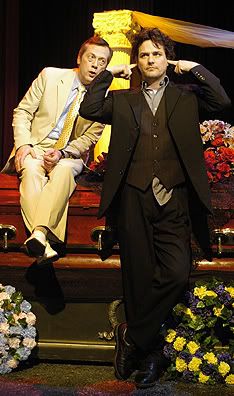
This afternoon I attended the final performance of Portland Stage's production of Charles Ludlam's "The Mystery of Irma Vep." It is no stretch to say I haven't seen an audience enjoy a show this much in years. The laughs, cheers, guffaws and groans emitted from the house served as an almost constant rhythmic counterpoint to the deliriously delicious delivery of the two actors required to play all of the characters in this mystery/horror/camp comedy.

Tom Ford (no stranger to either Portland Stage or playing multiple characters simultaneously) and Steven Strafford (making hopefully his first of many appearances with the company) delivered Ludlam's potent cocktail of high and low comedy (replete with horror spoof zingers, wicked double entendres, nods to Shakespeare, Joyce, Ibsen, etc.) making everything feel as fresh and new as when it premiered some 25 years ago: a modern classic.

Ford moved breathlessly between the randy peg-legged groundskeeper Nicodemus and the new mistress of the manor, Lady Enid, energy never flagging and a surefooted (even when with only one foot) sense of comic timing that left the audience equally breathless.

Wonderfully angular in form and face, Strafford struck a brilliantly delicate balance as he waltzed between the deadpanned Jane (the housemaid in this chamber of horrors) and the manic Lord of the Manor, famed Egyptologist Edgar Hillcrest. He was, in a word, remarkable.

Quicksilver costume (and wig) changes and nonstop dialogue at times made it seem like 3 or 4 characters were onstage at once - but nay, it was just this talented pair performing theatre magic.

Director, Christopher Grabowski paced the show beautifully, with nods to pop music culture at various points (e.g., Jane's breaking into Melissa Manchester's gooey,"Don't Cry Out Loud," and Lady Enid's energetic "I Feel Pretty" from West Side Story), allowing his actors breathing room (rarely) in a show that barely stops for its intermission. Oh, yeah, the soft shoe number lip-synching Bob Hope & Bing Crosby;s "Road to Morocco" caused near hysteria throughout the house!

Greg Carville's ingenious sound design had a Bernard Herman-esque film score quality (indeed, the theme from Pyscho makes a vivid and appropriate appearance) as well as endless rumblings of the storms that seem to eungulf the haunted estate of Mandacrest.

Lighting by Christopher Studley was as quick to change as our actors, fog rising here, the brilliance of a full moon filtering through the French doors of the drawing room, and a hilarious dimming and brightening to signify Lady Enid's seeming passage into madness. The tin can footlights added an inspired touch - and well used by the cast.

Anita Stewart created the locales - the Victorian mansion with its balconies, bleeding portraits, hidden torture chambers behind sliding bookshelves, a garden leading to the mysterious Hampstead Heath, and a wildly hilarious send up of the Egyptian horizon with two foot tall pyramids and Sphinxs that moved across the stage as Lord Edgar and his guide cross the desert in search of a tomb untouched by human hands since its sealing. At one point the stage curtain lowered almost to floor level as our bumbling pair navigate on their bellies through a "dangerous" crawl space to gain entrance to a resplendent tomb chamber with elaborate sarcophagus. Beautiful!

Loyce Arthur's costumes captured everything fun about this era, particularly Lady Enid's over elaborate multi-petticoated, bustled number . . . not to mention a wig I'm sure Maria Callas wore once in Andrea Chenier!

Ludlam may have subtitled his play "A Penny Dreadful" - but I can think of no better way to chase away the mid-winter blues

Labels: , , , , , , , , , , , , ,

Tuesday, February 3, 2009

Sparkling La Finta Giardiniera


I've never really paid too much attention to La Finta Giardiniera by the 18 year old Mozart, in fact other than a fairly weakly-performed broadcast from Europe some years ago, have never before sat through the entire thing. All that changed the other night as I watched, in entirety for the first time, a DVD of the 1998 Drottningholm Festival performance I've been sitting on for a while now. What a surprise and joy it is to discover something previously only casually known, is actually a work of great depth and genius. I'd always dismissed this piece as a youngish-exercise by the young master, but
paying atention to the details, studying its characters revealed what a mature, sophisticated work this is. While the libretto is highly comical - sometimes hilariously over-the-moon, Mozart plunges into the depths of each character - allowing us to watch them develop into far more than their 18th century dramatic stereotypes: they become real flesh and blood human beings, their motivations and reasons for actions fully believable - even in a fantastically theatrical genre such as comedic opera.

The score is, I believe, one of Mozart's technically most challenging and, at least as played at Drottinghamm, offering great chunks of through-composed music that links one musical idea to another in unbroken chains in an almost Wagnerian style. The young Mozart was clearly a genius, but an untempered one. While he would go on to compose music known for its technical difficulties (think Queen of the Night, Kostanze, et al.) his
later style developed into a more nuanced approach, generally allowing his singers some much needed "breathing room" between difficult numbers. In "Giardineria," however, the teenage wunderkind created a sort of calling card - throwing his entire arsenal of creativity into a work which seemingly had little pre-existing model of such musical difficulty at the time. Mozart delivered the work to Munich on time for a mid December premiere, but the company was unprepared for the sophisticated and difficult score which
showed up and required an additional 3 weeks of rehearsals before finally premiering on January 13th!

The jewel that is the 400 seat Drottningholm Palace Theatre still employs the original 1766 stage machinery - fully intact - (thunder and wave machines, flying chairs, etc.) often used in its productions, the orchestra plays original instruments, wears wigs and dresses in the time period, allowing presentations of as close to a total recreation of 18th century opera as we're likely to see anywhere these days. Sadly, no flying chair is on display here, but with everything going on in this production, it's hardly missed!

Goran Jarvefelt creates a production that feels as if it traveled through time directly from Mozart to us. His use (as well as most of the productions I've seen from here) of the tiny Drottningholm stage is a textbook lesson in the creative use of limited space to its fullest
possibilities. He moves us swiftly through courtyards, bed chambers, workrooms, parlours, a wild forest, and a garden/glade. This is managed by allowing every singer to begin their bravura arias in the proper locale, then dropping the curtain as the character continues on the apron while the carpenters and stagehands quickly strike and reset the stage, sometimes partially visible through a small hole in the curtain! The characters, more often than now, acknowledge the audience, sometimes bow, or as in the case of the Count and Violante, wave an enthusiastic good-bye at the delighted crowd. The ends of Acts I and II find the entire company before the curtain, each bowing in character, adding immeasurably to the charm and sense of good fun.

Though its comedic aspects are never diminished, Mozart takes the darker moments of the characters - and creates scenes that plum the depths of despair and madness as powerfully as if they'd been lifted from a more tragic opera seria. The balancing act between dark and light here is at a level comparable to, say, Don Giovanni. Here, we can find Mozart's passion for taking something that starts out like an aria, then morphs into a duet, then a quartet, then an ensemble employing all 7 roles of the opera. That he achieves this with the skill of someone far greater in years and experience than he, only adds to the "genius" factor. It's remarkable, really.

Jarvefelt was blessed with a troupe of singing actors that are the epitome of each character they represent. While the voices of the generally very young cast are not always of the smoothest import, each inhabits his or her role, making the music sound germane to the complicated goings on.

Richard Croft nut that I am, I was pleased to see the then almost impossibly youthful tenor, garner the lions share of the applause (his bravura scene in Act II elicits the only chorus of bravos), but this, as all of Mozart's great works, is an ensemble piece, every character part of the puzzle and fully integrated into a brilliant whole. Croft looks silly in his foppish, spoiled young count wig and overdone make-up, later more natural, but always a little "girly" or "fey" - which he works to his advantage. Whether hopping from chair-to-chair with ridiculous speed, doing sommersaults, jumping atop tables or crawling under beds, he's lean and lithe and comes across fully inside the head of this young man. His scenes of madness begin comically, but then reach a level of pathos that, while not actually heartbreaking (this is a comedy!) are infinitely touching. He dispatches his difficult music with great elasticity, though sometimes his quick vibrato develops a rapid bleat some will find unattractive, but for me, suits this type of role beautifully.

Britt-Marie Aruhn as the title role - disguised as "the Pretend Gardener" offers sheer delight and, like Croft, goes from silliness to tragic character in seamless fashion. Her final duet with Croft's Count offers some of the most difficult timing changes and both pull it off with style, grace and charm to spare.

Ann Christine Biel as the wily, coldhearted, eye-on-the-prize, saucy servant Serpetta tries at every turn to steal the show, commenting asides to the audience. She pulls off this calculating character with such perfect comic timing and stage business, whether serving coffee, ironing or spying on the goings on, you'll find your eye focusing on her nearly every scene. I cannot imagine this great archetypal character being performed with more
aplomb or better comic timing than Ms. Biel offers here.

Annika Skoglund - at times bearing an uncanny resemblance to actress Julianna Margulies - is the heart-on-sleeve wearing Cavalier Ramiro, desperately pining away for the Count's flightly fiancee, Arminda. She looks "handsome" and sometimes is the most masculine acting character on stage! She has a warm, lovely sound that, with too much pressure, can get a bit of a shrillish edge, but that's not inappropriate given the character,
and those moments are minimal - and I almost feel guilty mentioning them here, so fine is the rest of her performance.

As the Count's intended, Eva Pilat, with pink streaks through her powdered wig, starts like a house on fire and never lets up. Meeting her fiance for the first time on their supposed wedding day, the spoilt, pampered princess makes no bones about who will be running the show and what punishments she will dole to her future husband should he ever fail to live up to her "standards." She makes clear she "uses the stick" (and we see her attempt to do so later), and threatens physical violence often. Pilat soars effortlessly through her music and, as nasty as she can be, still allows the audience to fall in love with her.

Petteri Salomaa's face is priceless. Though painted a bit too white, his mugging looks of surprise, that handsome wide mouth circling into an "O" straight out of silent movies, the man is a comic gem. A resemblance to Ashton Kutcher will not go unnoticed. Like the rest of the cast, he is a fiercely physical comic actor and the colors in his voice at times make it seem like two completely different singers are employed (and as he plays a
role "in disguise" this is a very good thing!).

The master of the house, Don Anchise - known as the "Podesta" tries to run this show - it is HIS house, after all, but all of his attempted machinations at controlling the chaos prove too much and the man who, at the beginning of this romp looked like a aging buffoon, comes to accept his fate - and that of all those he tried to cajole, control and convict, with enlightenment and panache. Stuart Kale, in his lemon-curd colored wig,
simply owns this role - one of the great comic roles every tenor getting beyond the years of romantic hero would be lucky to get. Kale sinks his teeth into each moment, playing it with the abandon and style.

Arnold Ostman conducts the Drottningholm forces in an exciting, rhythmically tour de force that propels the action, lingering only long enough to allow you to catch your breath. In fact, one advantage the viewer has over the live audience is the ability to hit "pause" or rewind a minute to catch something that flew by you visually or aurally. Nonetheless, I would have LOVED to have been part of the house when this was filmed, as it seems few people in the world were having more fun anywhere than were these folk.

Labels: , , , , , ,

Monday, December 29, 2008

Slings & Arrows


Not since Northern Exposure can I recall a large-scale ensemble television series that handled so many complex elements so successfully and with such heart as Slings & Arrows.

Set in the fictional town of New Burbage, Canada, the series revolves around a large theatre company with a world famous festival, modeled on the world renowned Stradford Festival (which gets at least several nods in its direction throughout the series). But the New Burbage is very much it’s own baby and what a baby it is!

Without giving away too much, let me say this: The series gets going with a bang as Geoffrey, a former member of the company (and whose last performance, as Hamlet, featured his complete mental collapse), arrives for the funeral of Oliver, his sworn enemy, former friend and director, and until just days ago, the long time Artistic Director of the company, who was tragically killed in a highly comic manner. Still mentally unhinged (and working only as a director, following his onstage meltdown), Geoffrey is surprisingly voted in by the board as the Company’s new (interim) A.D.

In addition to dealing with former friends, he must face his former lover, the Company’s long time leading lady, Ellen, herself now worried about aging gracelessly into the roles of mothers and nurses. He’s got even bigger problems however, as he is singularly haunted by the ever present ghost of Oliver who still tries to control the company – and Geoffrey from beyond the grave. A device that could in lesser hands become contrived and tiresome is here handled with such aplomb, skilful writing and an absolutely delicious, tour-de-force performance by the absolutely brilliant Stephen Ouimette who would have me in stitches one moment, and in tears the next. In addition to the ever changing elements of three seasons filled with raucous goings on, the major productions and cast changes, etc., one of the most important elements of the show is the coming to terms of love, loss, aging, forgiveness and acceptance – with Geoffrey and Oliver two sides of the same coin. Even more than the rekindling of romance between the leading couple, this relationship, nearly more than any other, defines “Slings & Arrows.”

All of that would be fine enough, but in addition we get crisp, smart writing and plot lines as we’re introduced to dozens of characters who make up the New Burbage Festival. Former Kids in the Hall star Mark McKinney, is one of the creators and writers – as well as stars – of the show and he is sensationally funny as every financial-type with aspirations and dreams of a career in the arts rolled into one, uptight, prickly mess.

Surprisingly (to me) my favorite character in the entire series became Anna, the Assistant Administrator who, nearly singlehandedly, holds the entire place together as the no-nonsense intermediary moving gracefully between the worlds of “talent and the business.” Always put upon, oft forgotten, treated shabbily by nearly all, Anna’s tenacity is a beautiful, life affirming portrait of the resiliency of the human spirit. It’s a terrific role and I wasn’t surprised to find that the actress playing her, Susan Coyne, is one of the creators and principal writers of the show. That’s probably how she gets some of the best lines of the entire series, including one that caused me to shoot beer out of my nose (a handy trick) “If you EVER try that again, I’ll slap you so hard your COUSIN will fall down!”

Every one of the series too short 18 episodes is an absolute gem, rich with black humor and covering a myriad of topical topics. We watch as the Festival deals with Eurotrash directors, marketing deals of death defying stupidity, the cultural dilemma of crossing over to newer audiences, dealing with the dying off of classical theatre attendance, professional jealousy, aging and death. Sandwiched deliciously in the middle of the three seasons is the (fairly) in-depth peak at producing a major Shakespearean play. Season 1 gives us Hamlet, Season 2, Macbeth, and Season 3 – King Lear. Each play beautifully points up the relevancy of the work to the goings on in every aspect of everyone’s lives.

My Christmas present to myself this year was watching the entire series in 3 days – each day a different series. I can hardly think of a group of folk I’d rather have spent that time with!

Slings & Arrows, Burbage Festival, Paul Gross, Martha Burns, Shakespeare Festival, Canadian television, black comedy, Hamlet, Macbeth, King Lear, Stephen Ouimette,

Labels: , , , , , , , , , ,