Friday, November 22, 2024

ROCK ME AMADEUS! National Theatre's Astounding Production


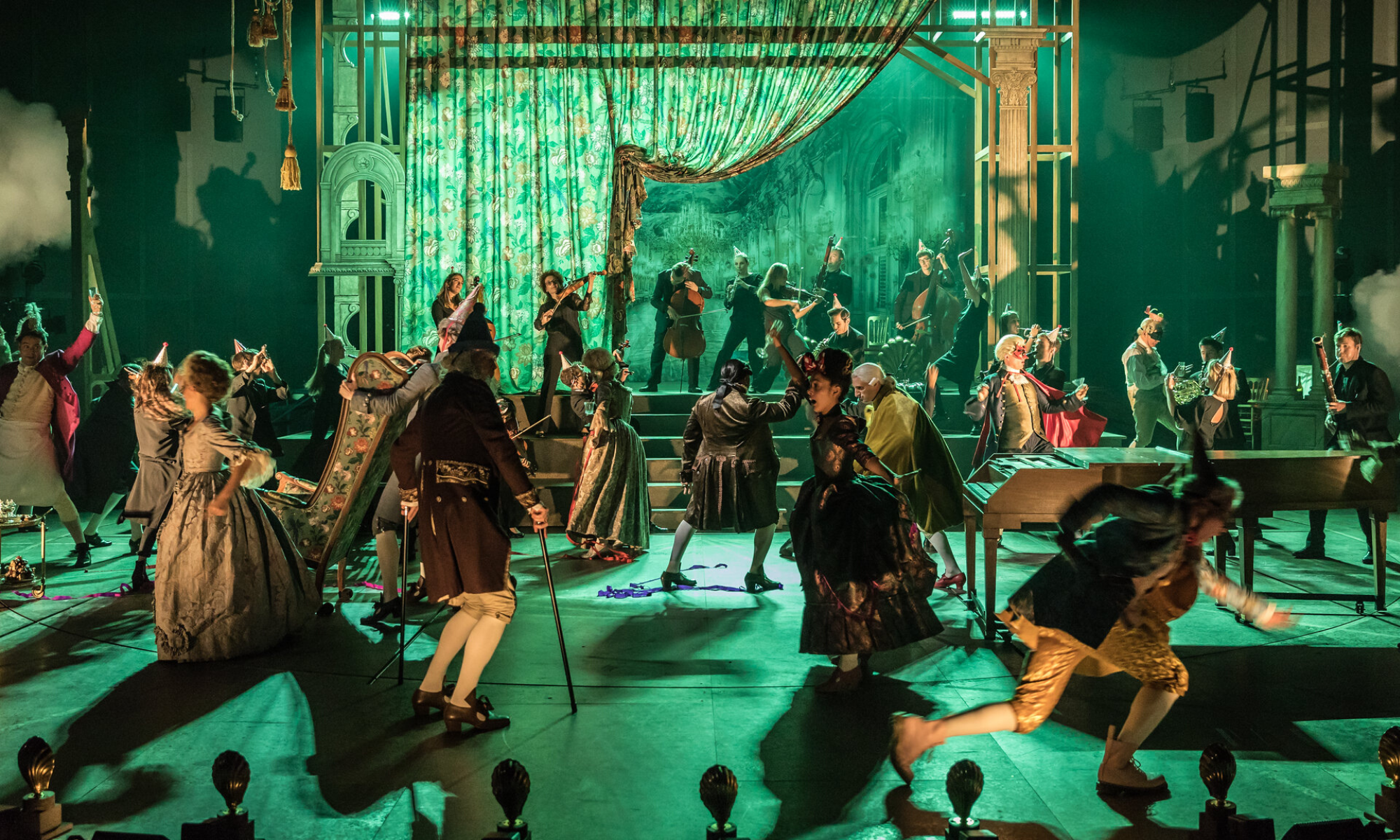
Time has prevented me from writing anything about my mind being blown a few nights ago watching the 2017 National Theatre production of Peter Schaffer's masterpiece Amadeus. It was exciting to see the work revived - in a different production and edition - in the same theatre it premiered at in 1979.  What a journey this play has taken over the decades since that first night.  


Michael Longhurst's gives this Amadeus about as stunning a production as it will ever likely receive and once again I've witnessed something that left me emotionally spent and incredibly grateful  I'm still alive. It made me remember that despite the wretchedness that surrounds us, the world still allows such magic as to make us forget it all long enough to remember how beautiful it can still be.  

Visually, sumptuous, Longhurst gives his Amadeus a widescreen film perspective, with a large moveable (automatically receding and projecting) platform that accommodates the numerous scene changes and handsomely holds his enormous cast, which includes the 21 member Southbank Sinfonia - so that everything, every gesture feels magnified . . . larger than life  

Since its premiere, Salieri has become one of the great villain roles of the last century and  attracted a wide variety of top flight actors ready to rant, rave and poison his rival, Mozart, but Lucian Msamati may be the best of the many I've seen. His harrowing portrayal covers every possible aspect of Salieri's personality - the pettiness, the jealousy, the rage and self-loathing - to the point I was alternately sympathetic and disgusted by him.  As it should be.

I initially had some issues with Adam Gillen's Mozart. Delivered in an exaggerated Cockney (as was Karla Crome's Constanza) that made increased his already annoying behaviour t o a level that was at times, difficult to take. He makes up for that to some degree with his physicality - literally throwing himself into every scene with an abandon that almost seems dangerous.  All of that however, pays off handsomely in the final 30 or so minutes of the play.  As Mozart's fortunes turn and his demise is imminent, Gillen's Wolfgang broke my heart - and I watched the final scenes in tears. It was beautifully painful and painfully beautiful.  


The Southbank Sinfonia provide not just a consistent soundtrack in music of Mozart and others, including arrangements by Music Director, Simon Slater, but also are part of the action, several of them with lines. The operatic scenes are spectacularly delivered on floating proscenium arches with Mozart in tow several times, and an interesting arrangement of the Queen of the Night's aria that has Papagena sort of echoing the high notes. Sounds strange but it works. Brilliantly. 

While I've loved this play for over forty years, right now I don't think I've ever loved it more. 

Labels: , , , , , , , , , , ,

Sunday, January 6, 2019

Why Regietheater Doesn't Work

Why Regietheater Doesn't Work


Hänsel und Gretel - Staatsoper Berlin

Okay, perhaps I got your attention - and you stand on one side of this argument or the other. Yes, the title is a misleading, particularly to those who know me as champion of a lot of regie productions, but the statement is also, unfortunately true. When inspired and when it workk, something not necessarily simultaneous as one might believe, regie can illuminate a familiar opera up to levels we'd not before thought of. It can provoke discussions on works too frequently "ho-hummed" despite their being well-attended, respected works of the lyric theatre. Good regietheater can shake us up, pull us out of the seemingly ordinary and elucidate a work as familiar as your staid, old Aunt Claire who for years has bored you to tears, until your discovering she was a topless dancer at the Folies Bergère and had a lesbian affair with Josephine Baker. Huh? What? Exactly.

Pelléas et Mélisande - Salzburg

Unfortunately, a good chunk of Regie fails for a number of reasons, but chiefly two: First, the director does not know enough about and/or truly respect the work entrusted to her or his care; and second, opera singers are not good enough actors to pull off the stunts required by those untrusting directors. I have a lot of opera singer friends who may get upset about that, and believe me, as a former (though never made it to the pros) opera singer, I mean that not as a slam in any way. I'll explain.

Pelléas et Mélisande - Salzburg

All opera singers are trained in acting and some, naturally gifted, could easily transition to the spoken stage and make a career there - athough why anyone would choose to not sing when one can is something both foreign and incomprehensible to me, not to mention ridiculous. Others not so gifted in the acting department (and that's the majority), can and often do succeed through sheer discipline, dedication to their art and guidance from their teachers, workshops, coaches and directors. These singers cultivate their skills to the highest level, and like any well-practiced skill, are often leave an impact that can be, and frequently is, stronger and more impressive than the so-called "natural." Think about how many performances you've attended where a singer, not particularly known for their acting, uses all of the tools of their trade to suckerpunch your heart and leave you in wide-eyed stun mode by what you've witnessed from them. These are the singers who have learned how to work with the music to serve the composer, how to create an effect that may on some surface level wow us, but even more importantly, dig beneath the surface and can transfuse the composer's music from their soul into our own. This is the magic of opera.

Tannhäuser - BayerischeStaatsoper München
When that connection is not understood by a director, there is a break in the chain between the composer, the singer and us, and this is never a good thing. Never. Ever.

We know a director doesn't trust the material (even if she/he is unaware of that) whenever We see them giving singers "business" to draw our eye to something, all while that something is remains in the mind of the director alone. It is not transferrable to either the singer, or to us, the audience., The singer may execute this business precisely as instructed, even to the satisfaction and delight of the director, but its meaning remains obscured to the point of being not only unnecessary, but actually intrusive.

Don Carlos - Düren, Germany

I recently watched a baroque opera where the director has updated the action and places one scene in a bar where two blokes are downing shots. One of them, the tenor, elaborately struggles to, then succesfully lights a cigarette, which he then waves around in what appear to be meaningless and distracting gestures. We look for some meaning in them, but there ultimately are none. He finishes his smoke, then mid-aria, his friend gestures for a smoke, the tenor offers him one, lights it, then reaches back into his pocket, withdraws and lights another for himself. Throughout the remainder of the aria he continues to perform the awkward gesticulations waving the cigarette about as if punctuating the text of this one sentence, da capo aria. At it's conclusion he tosses the cigarette behind the bar and storms out. What happened? It's anyone's guess.

Smoking onstage is a difficult enough thing to pull off, and is always an audience distraction with nearly everyone wondering: "is that a real cigarette? Is the singer a smoker? Doesn't the smoke bother other singers?" but most of all "why is this character smoking?" Too quickly and all too easily that unnecessary action it becomes the central "thing" to watch, and, instead of furthering the action or our understanding, only further separates us from the actual opera itself. Likewise, the singer, also is distracted by performing this hand ballet so irrelevant to the plot and to what he's singing about, all of it producing an effect wholly unrelated to the opera, and unnatural to the storytelling in every way possible. This is never a good thing. An actor from the spoken stage may be able to pull this off, but this is not the spoken stage, it is opera, and we all know things are wildly different in this world. That's why there's a difference. Of course, there's also the fact that like onstage nudity or unnecessary violence, more often than not, it's a cheap and uninspired gimmick and the lazy way out of putting meaning into a scene.

Too many theatre directors working in opera are or become self-indulgent and, instead of realizing the world in which they've chosen to inhabit, one filled with its own traditions, foibles, blessings and curses, imagine they are, instead at DV8 or La MaMa and working with beings whose bodies are trained for an entirely different kind of magic. We've seen and heard from directors how have even exhibited outright contempt for opera and its sometimes opera-sized singers. Of course there are elements that abound and abide in ALL theatre, which at its heart is nothing more than storytelling, but the manner in which those stories are told differ as widely - and as wildly - as the very art forms by which they're being told and defined by, be it ballet, opera, puppetry, Noh, Kabuki, or African dance.

Parsifal - BayerischeStaatsoper München
The traditions of every type of theatre must be respected and honored. We often witness that respect in every type of theatre, but, increasingly, in the opera house, we see less and less of it, despite the platitudes we may hear from directors who may say otherwise. Too many times I've heard a director say "I embrace the challenge of working with the diverse world of opera, it's vastness, the various shapes and sizes of its singers and history of traditions," only to see the final result being singers awkwardly shoe-horned into costumes and productions they are uncomfortable with and unnatural in.

There are those who will misread what I've written as a diatribe against regietheatre, when nothing could be further from the truth. What I'm against is bad regie, just as I'm against bad traditional productions which do nothing but present works as museum pieces, works that have earned their status as repertory pieces and deserve far more than to be preserved in mothballs.

Labels: , , , , , , , ,

Sunday, February 21, 2010

Portland Stage: The Mystery of Irma Vep


This afternoon I attended the final performance of Portland Stage's production of Charles Ludlam's "The Mystery of Irma Vep." It is no stretch to say I haven't seen an audience enjoy a show this much in years. The laughs, cheers, guffaws and groans emitted from the house served as an almost constant rhythmic counterpoint to the deliriously delicious delivery of the two actors required to play all of the characters in this mystery/horror/camp comedy.

Tom Ford (no stranger to either Portland Stage or playing multiple characters simultaneously) and Steven Strafford (making hopefully his first of many appearances with the company) delivered Ludlam's potent cocktail of high and low comedy (replete with horror spoof zingers, wicked double entendres, nods to Shakespeare, Joyce, Ibsen, etc.) making everything feel as fresh and new as when it premiered some 25 years ago: a modern classic.

Ford moved breathlessly between the randy peg-legged groundskeeper Nicodemus and the new mistress of the manor, Lady Enid, energy never flagging and a surefooted (even when with only one foot) sense of comic timing that left the audience equally breathless.

Wonderfully angular in form and face, Strafford struck a brilliantly delicate balance as he waltzed between the deadpanned Jane (the housemaid in this chamber of horrors) and the manic Lord of the Manor, famed Egyptologist Edgar Hillcrest. He was, in a word, remarkable.

Quicksilver costume (and wig) changes and nonstop dialogue at times made it seem like 3 or 4 characters were onstage at once - but nay, it was just this talented pair performing theatre magic.

Director, Christopher Grabowski paced the show beautifully, with nods to pop music culture at various points (e.g., Jane's breaking into Melissa Manchester's gooey,"Don't Cry Out Loud," and Lady Enid's energetic "I Feel Pretty" from West Side Story), allowing his actors breathing room (rarely) in a show that barely stops for its intermission. Oh, yeah, the soft shoe number lip-synching Bob Hope & Bing Crosby;s "Road to Morocco" caused near hysteria throughout the house!

Greg Carville's ingenious sound design had a Bernard Herman-esque film score quality (indeed, the theme from Pyscho makes a vivid and appropriate appearance) as well as endless rumblings of the storms that seem to eungulf the haunted estate of Mandacrest.

Lighting by Christopher Studley was as quick to change as our actors, fog rising here, the brilliance of a full moon filtering through the French doors of the drawing room, and a hilarious dimming and brightening to signify Lady Enid's seeming passage into madness. The tin can footlights added an inspired touch - and well used by the cast.

Anita Stewart created the locales - the Victorian mansion with its balconies, bleeding portraits, hidden torture chambers behind sliding bookshelves, a garden leading to the mysterious Hampstead Heath, and a wildly hilarious send up of the Egyptian horizon with two foot tall pyramids and Sphinxs that moved across the stage as Lord Edgar and his guide cross the desert in search of a tomb untouched by human hands since its sealing. At one point the stage curtain lowered almost to floor level as our bumbling pair navigate on their bellies through a "dangerous" crawl space to gain entrance to a resplendent tomb chamber with elaborate sarcophagus. Beautiful!

Loyce Arthur's costumes captured everything fun about this era, particularly Lady Enid's over elaborate multi-petticoated, bustled number . . . not to mention a wig I'm sure Maria Callas wore once in Andrea Chenier!

Ludlam may have subtitled his play "A Penny Dreadful" - but I can think of no better way to chase away the mid-winter blues

Labels: , , , , , , , , , , , , ,

Thursday, November 12, 2009

Bernstein's Exquisite Peter Pan


“Peter Pan” was a score I was once in love with, heard live in concert performance, but which I (as well as many others) have put in the back of the memory banks.

While I no longer have the original cast LP, the discussion had me pull out a wonderful five year old recording on Koch Classics I’d also not paid much attention to, but which I’ve played a number of times the past few days and have fallen in love with this score – to the point of being enthralled enough that I’d wish someone would mount a major revival of this Peter Pan. The score is an absolute gem.

The first song is Wendy’s lullaby “Who Am I?” – a lovely, lyrical piece but showing Bernstein’s penchant for difficulty of extremes of range requiring a singer who can sustain some hushed, piano high notes. Similarly, Wendy has more high note challenges – keeping them within the scope of the hushed music in the exquisitely tender “Build My House.” Bernstein’s mastery of this kind of music produces a sort of swoon in the orchestration that spills over into the listener of this most beautiful song. The lyrics themselves raise this far, far beyond a mere children’s story –

Make the ceiling strong
Strong against the storm
Shelter when the days grow shorter
But build my house of love,
And paint my house with trusting.
And warm it with the warmth of your heart.
Make the floor of faith.
Make the walls of truth
Put a roof of peace above.
Only build my house of love.

They fit right in with the universal, almost archetypical themes Bernstein yearningly makes in nearly all of his stage works from West Side Story to A Quiet Place. A bit more wistful is Wendy’s closing song “Dream With Me” though still hardly your typical Broadway ballad. (And it’s a wonderful final number).

As stated this was a “play with music” – NOT a “musical” in the sense we think of today. Historically, this sort of “score” harkens back to the great theatre music composed by Beethoven, Grieg, Debussy, Mendelssohn – a sort of lost practice that (with few exceptions) is just not much enjoyed anymore. A pity.

Though the songs come few and far between (and no spoken dialogue is offered in the recordings) there appear to be three principal singing roles: Wendy, Captain Hook and the chorus. As with Wendy and Hook, Bernstein has given challenging, difficult and exquisitely atmospheric music for the choristers. (Some will note how the women’s chorus “Neverland” has a hypnotic, almost Philip Glass-like minimalism – even in the manner Bernstein chooses to end the song. (Can’t tell me Glass was not familiar with this score!)

Similarly the chorus for The Pirate Song – provides wonderful, rhythmically comical work for the men with a sort of built-in theatrical bravura aria for Captain Hook.

Hook gets it even better in “Captain Hook’s Soliloquy” – called a “song” – it is in every other way but title an “aria” (and has been picked up by operatic baritones, and recorded as such by no less than Thomas Hampson). Again, though set for a “children’s story.” – the dark inward look and psychological insights Hook sings of would confuse almost any child. But for grown ups it is glorious stuff.

Hook and his henchmen get another doozey of a tune in the hilarious “Plank Round” (a wonderful bit where every line rhymes with “plank” – and the accompaniment is a brilliantly minor-key rendition of the opening of Bach’s Brandenburg Concerto No. 3. Genius – and guaranteed to put a smile on yer mug!

With such wonderful songs as these, the bulk of Bernstein’s “Pan” score falls to the incidental music and overall, it is a rich score full of surprises, and covering a wide range of emotions. Melodically, rhythmically and theatrically we hear a lot of Bernstein’s ideas we’d hear earlier and later from “On the Town,” “West Side Story,” as well as from his symphonic works.

In the new(ish) recording, the original orchestrations by Trude Rittman and Hershy Kay are expanded upon by a team led by Alexander Frey, who also restored and edited the score. Broadway/Pop soprano Linda Eder, baritone Daniel Narducci and an uncredited (but wonderful) chorus join the Amber Chamber Orchestra under Frey’s leadership in a reading that is atmospheric, respectful of the original, and (sigh) just a real treat to spend some time with.

A “bonus” comes in the form of “Spring Will Come Again” a lovely, but forgotten song Bernstein composed for – but dropped from Wilder’s “The Skin of Our Teeth.”

This recording was clearly a labor of love and the efforts are well worth it. For anyone looking for some off-the-beaten-path, wonderful, music, some delightful and touching unfamiliar songs I can’t recommend this recording highly enough.

Labels: , , , , , , ,