Monday, December 19, 2022

THE BANSHEES OF INISHERIN. Martin McDonough Does It Again
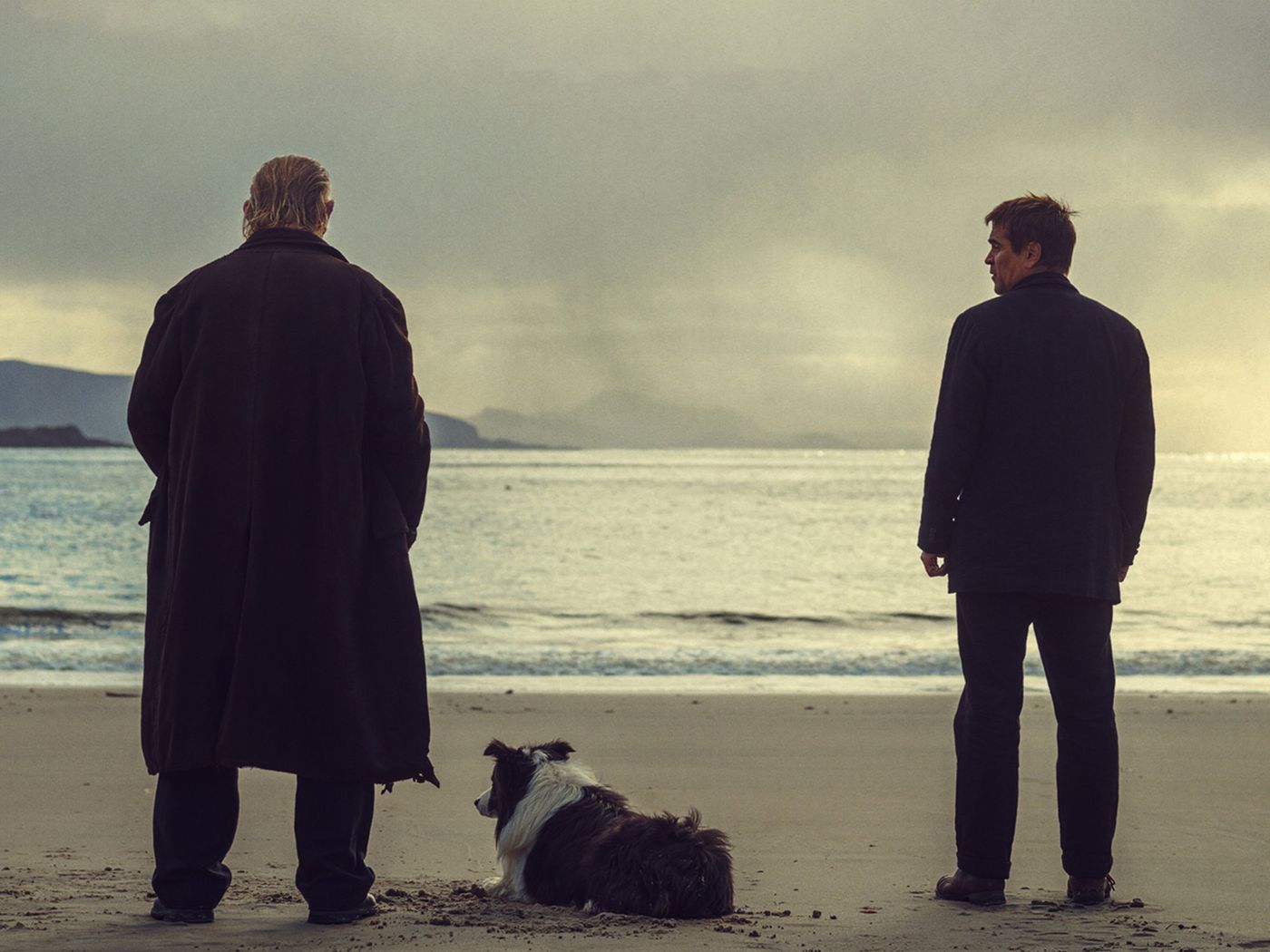
As he did with In Bruges, writer/director Martin McDonough strikes cinematic gold with a pair of actors at the top of their game. Again. 

McDonough's The Banshees of Inisherin is my favorite kind of movie:  a genre busting, black comedy, horror, realistic fantasy, tragic revenge drama with an oversized heart and a cast of characters that are, each and every one of them, as memorable as its two stars.  And what stars McDonough gives us: Colin Farrell and Brendan Gleeson.  Both actors here give some of their most rewarding work ever committed to film.  And they're surrounded by a well of talent so memorable and well written, I pretty much fell in love with every character in this movie, set during the last days of the 1923 Civil War.   

It's hard to describe without giving spoilers, but I don't believe what I have to say here spoils anything, in fact, reading commercial reviews - which I held off reading until after viewing it myself - give away far more, so feel free to press on.  

Banshees is the tale of Pádraic (Farrell) and Colm (Gleeson), a pair of previously inseparable friends on the tiny island of Inisherin. The film begins with Colm essentially declaring he wants Pádraic out of his life - forever, fully intent never to speak or see him ever again. Pádraic is crushed, but also naturally curious as to what the cause of this sudden "divorce" is, but no easy answers are forthcoming.  In his pursuit to understand the reasons behind it his confusion progresses from sadness to despondency, to resentment and revenge. 

Farrell's Pádraic is, from the start, a sort of sweet, good guy, none too bright, but earnest and well loved by all.  Except now by Colm.  The actor gives a sort of wounded bird quality throughout his performance which is endearing and not just a little heartbreaking.

As Colm, Gleeson is a gifted fiddle player and teacher, his modest home on the shore, filled with odd artifacts like ancient puppets and masks.  Admitting to suffering "from despair, there is a sad almost moroseness to Colm from the get go. Wedded to his resolve to shut Pádraic out of his life, I found I myself was perplexed, digging deeper into their friendship, and I realized, like Pádraic, I was searching for reasons to explain this and never fully coming up with one.  At least not a good one.  Then again, I'm not Colm. (Note: a reason is given, but I, at least after a single viewing, am not buying it for a second.)

To show the strength of his conviction that the pair should separate, the gifted fiddler states that should Pádraic ever speak to him again, he will sever a finger.  From here we move into a bit of the genre of horror story, and wonder, along with Pádraic "will hewon't he?"  All of this adds an element of uncomfortable anxiety to the viewer (or at least this viewer). 


Pádraic shares a tiny home (and a single bedroom) with his sister, Siobhán, who receives an absolutely, gloriously understated performance from the wonderful Kerry Condon. All I can say about Condon's Siobhán is, just try not to fall in love with her.  I couldn't not. She's fiercely protective of her brother whose affinity and love for their animals, a horse, some cattle and the miniature donkey, Jenny, who will steal your heart.  This loyalty and protection, however, does not prevent her brother from driving her absolutely crazy at times.

Siobhán, is well read and wise, a woman who holds her own, and yet it is evident from our first glimpse of her, and by every ensuing look, gesture and action, this is someone who clearly feels trapped - a prisoner - serving time on this tiny island.  Through all of this you can quite sense her longing to leave Inisherin.  Forever.  

Other quite remarkable performances come from the drunken police officer (Gary Lydon) and Dominic, his abused, dimwitted, but observant son, brilliantly played by Barry Keoghan, and David Pearse's foul-mouthed priest. And then there is the pipe smoking, ghoulish old Mrs. McCormick of Sheila Flitton, whose presence is enough to give one - everyone - the creeps.  You need only catch a glimpse of her and can feel your skin clamming up.

In addition to the amazing performances from its cast, cinematographer Ben Davis captures the island, and the surrounding waters in an almost mythic fashion; fog and shadow, fire and light and every other element creates an absolutely gorgeous feast for the eyes.

Carter Burwell's score adds yet another dimension, and there are musical insertions that point up every dramatic moment to nearly unbearable levels of beauty and grief. Among these features are operatic/song  offerings from John McCormack, Jessye Norman and Juliane Banse, as well as moments from Carl Orff's opera Der Mond.  

As I watched, I kept feeling as though I knew these characters from somewhere else.  They and the story being told, seemed so thoroughly literary . . . I felt almost certain I'd read this tale in some ancient collection of Irish short stories. Of course, nobody does the tragic trifecta of quiet despondency, loneliness and heartbreak quite like the Irish.   

It really is just about perfect

Labels: , , , , , , , , ,

Monday, January 17, 2022

Coen's Magnificent The Tragedy of Macbeth


There should be no doubt in anyone’s mind that Joel Coen’s magnificent adaptation of Shakespeare’s tragedy will receive nominations for virtually every category in every filmic award.  In truth, it should sweep all of them.

While very much a film, Coen’s Macbeth is simultaneously wholly original, yet also a hybrid combining the best the worlds of cinema and theatre have to offer.  It does not exist in any sort of reality, but (if you’re like me) resembles far more the abstractions of a dream – or nightmare – than places actually seen or visited.  Shot in the Academy frame, entirely in black and white one enters into, from its earliest frames, a world of startling, horrific beauty.  At first, I was reminded of the visual style of Olivier’s Hamlet and other films of that stark mid 20th century style, but Coen actually gives us even less in the way of those ornate and antiquated settings, as his sets and costumes figure into no real sense of history, though have the feel of a story told a thousand or more years ago.  

Stefan Dechant’s physical production is amazing. each setting sitting stunningly in every frame.  It is all angles and shadows, rooms that open into forests, bodies of water that appear and vanish as if by sorcery, staircases and halls that stretch on for eternity, mazes of battlements which seem to have no entrance into nor exit from. It is a world that is never really night or ever really day.  Dechant, along with the art and lighting teams. painstakingly painted surfaces, costumes, shadows into the sets, and more to achieve this gloriously ungodly place.  The closest references I can think of are the great silent German expressionist films, and indeed, their influence is strongly felt throughout.  Additionally, I was fascinated to learn they did not use movie lighting, but rather theatre lighting for the entire project.


Initially, I was put off, if only mildly, by the accents – The American actors, notably Denzel Washington and Frances McDormand as Mr. and Mrs. Macbeth, speak with “American” accents while the U.K. cast speak with their native dialects.  It only took a minute or two to settle in, and that issue was, until now, quickly forgotten.


In the title role, Mr. Washington gives a commanding performance, but several times falls into that Shakespearean trap of rushing words too quickly. I’m not certain what sequence the film was made, but those incidents happen exclusively in the Thane of Cawdor’s opening speeches – then never again.  But I am picking at nits here.  His Macbeth is evil and tragic, a pretender, in that while he believes the witches predictions, he is nonetheless tortured., and elicits a self-doubt which he attempts to eradicate with bravado, a quality that, of course, serves to do him in. 


Ms. McDormand is nothing short of miraculous as Lady Macbeth, a scheming, selfish, and brilliant, horror of a woman, cloaked in elegance and poise, while her manipulations of all around her, husband included, cannot disguise her desperate grasp for power. She is the ultimate, self-entitled bitch. McDormand’s appearances find her beautiful, hardened, and finally pitiful. While she holds nothing back throughout, it is in the final, Sleep Walking scene where she weaves together all of the disparate elements of her Lady in the penultimate tragedy of the story. 


Together, McDormand and Washington are glorious, beautiful savages, feeding off one another. Having now seen them together, I cannot imagine one’s performance without the other.

Corey Hawkins, Brendan Gleason and Harry Melling are all equally excellent as McDuff, Duncan and Malcom.

Alex Hassell’s performance as Ross stands out in a way that makes the role even larger in scope than it feels in the play. Ross' incredible, flexible face beams out humility, sincerity, rage and evil from one scene to the next.  He’s clearly having a field day (or however long the shooting process was) here, and the payoff is huge.


Playing all three Witches, Kathryn Hunter is entirely terrifying and fascinating in a performance that must be seen to be believed. Each of her appearances as The Weird Sisters is, for anyone familiar with the play, something to anticipate. Her ability to morph into several characters, not to mention manuevering her body in inhuman ways, is something to behold.  Of this startling performance I will not say more.

Shakespeare’s tale requires an immense supporting cast of some thirty actors, each role weighted with significance, integral and inherently important to the telling of this most nightmarish of tales. In these parts Coen and his creative team have assembled a roster of talent that makes every single one characters pop, coming vividly to life.

Composer, Carter Burwell has worked on a number of Coen family projects, and here aides in setting Macbeth’s tone with his highly atmospheric, but unobtrusive score, never seeking to manipulate the story or us, nor pushing things forward for its own sake, but rather an integral cog in the greater machine.

Cinematographer Bruno Delbonnell has also worked with the Coen’s before, and his work here offers a perfect example why this guy has been nominated for. and won, a ridiculous number of international film awards. It is spectacular to behold.

Macbeth was my introduction to Shakespeare, I was only six years old and understood little of it, but it scared the living daylights out of me then, and still does over fifty years later.  As a boy, I didn’t know why, but I now I see this is ultimately as much a horror story as it is a tragedy.  It is the story of the way the world was, the way the world became . . . and the way the world remains..


Labels: , , , , , , , , ,