Saturday, January 26, 2019

Minnesota Opera's Great Doubt


I was starteled - in the best possible way - to turn on the TV tonight in time to see Great Performances was offering Minnesota Opera's premiere production of Douglas Cuomo's opera Doubt with John Patrick Shanley serving as librettist, having adapating his well known play, and screenplay, for the operatic stage. I'd missed any pre-publicity of this, and found it a return to the good old days with Maine PBS presenting two Friday nights in a row with opera! I somehow also missed ever hearing anything at all about this opera and initially thought it a brand new work, filmed perhaps this past season. Wrong again; Doubt the opera premiered in 2013 meaning it went unaired nearly six years until tonight's presentation. It was well worth the wait.

One of the first things I noticed is the Ordway Theatre must have the largest orchestra pit I've ever seen, or perhaps just a trick of the cameras? From that pit, Christopher Franklin conducted Cuomo's enormous score which, even through home speakers, thundered, cajoled, wove and hypnotized in a most impressive way, particularly for a first time operatic composer.

There were some standard New American Opera issues, the composer seemingly grabbing everything from that particular aisle at the musical supermarket with cans of Adams, Barber, Bernstein and Copland and mixing it with Glass. Even Menotti seemed to show up if only libretto-wise, Shanley turning some awkward phrases and purple prose into the mix.

While I had to supress the occasional groan at a Bernstein, clarinet "jazz" riff, or muted trumpet, Cuomo proved he was capable of creating something original, and when "borrowing" invoked more than just the Americans ; there was, for instance an almost Brittenesque quality to his use of percussion and equally impressive. There were also full-on blasts of sound and structure evoking the symphonies of Shostakovich. Despite all of this, I would hope that both librettist and composer will (if they've not already done so in the ensuing six years since) find some kindly editor and prune a bit of the unnecessary wordy text to remove some music more earthbound than inspired.


Vocally, it would have been difficult to assemble a finer cast, Christine Brewer showing her Wagnerian chops in decidedly un-Wagner-like music, and digging deep into the surpressed emotions of the troubled Sister Aloysius. Baritone Matthew Worth was boyishly handsome and a fine physical actor which worked to his interpretation of Father Flynn. Vocally, Worth is in command of a truly beautiful, almost sensuous baritone, and sang with great authority and commanding presence which contrasted brilliantly with his darker side almost completely hidden. Adriana Zabala struck all the right notes as the innocent young Sister James, naive yet knowing, and soaring, when appropriately, as both balance and catalyst between her superiors. Denyce Graves, as the troubled mother of the boy at the center of the tale, was given the least interesting music of the score, yet sank her formidable chops into it and presented a portrait of a conflicted mother just trying to keep her young, gay son alive to see another day.

At his best, Cuomo knows how to make magic and Father Flynn's sermons and church scenes are among them, one in particularly a true coup de théâtre. As Father Flynn shares a parable to the congregation, the enormous crucifix and the altar disappear as the parable comes to life before our eyes in a stunning moment both musically and emotionally profound.

The work from the Minnesota Opera Chorus, and the children in the cast were all, likewise, first rate, adding complexity and occasional humor to the proceedings.

Robert Brill's sets moved with cinematic sweep, literally allowing scenes sometimes no longer than a minute to flow seamlessly from one to the next, moving the story swiftly through the classroom, locker room, , board room, garden, darkened corridors, offices, church, each believable and with a sense of the elaborate found in Catholic schools of the era. Director Kevin Newbury moved everyone with that same cinematic ease, drawing direct, emotional performances from his exceptional cast.

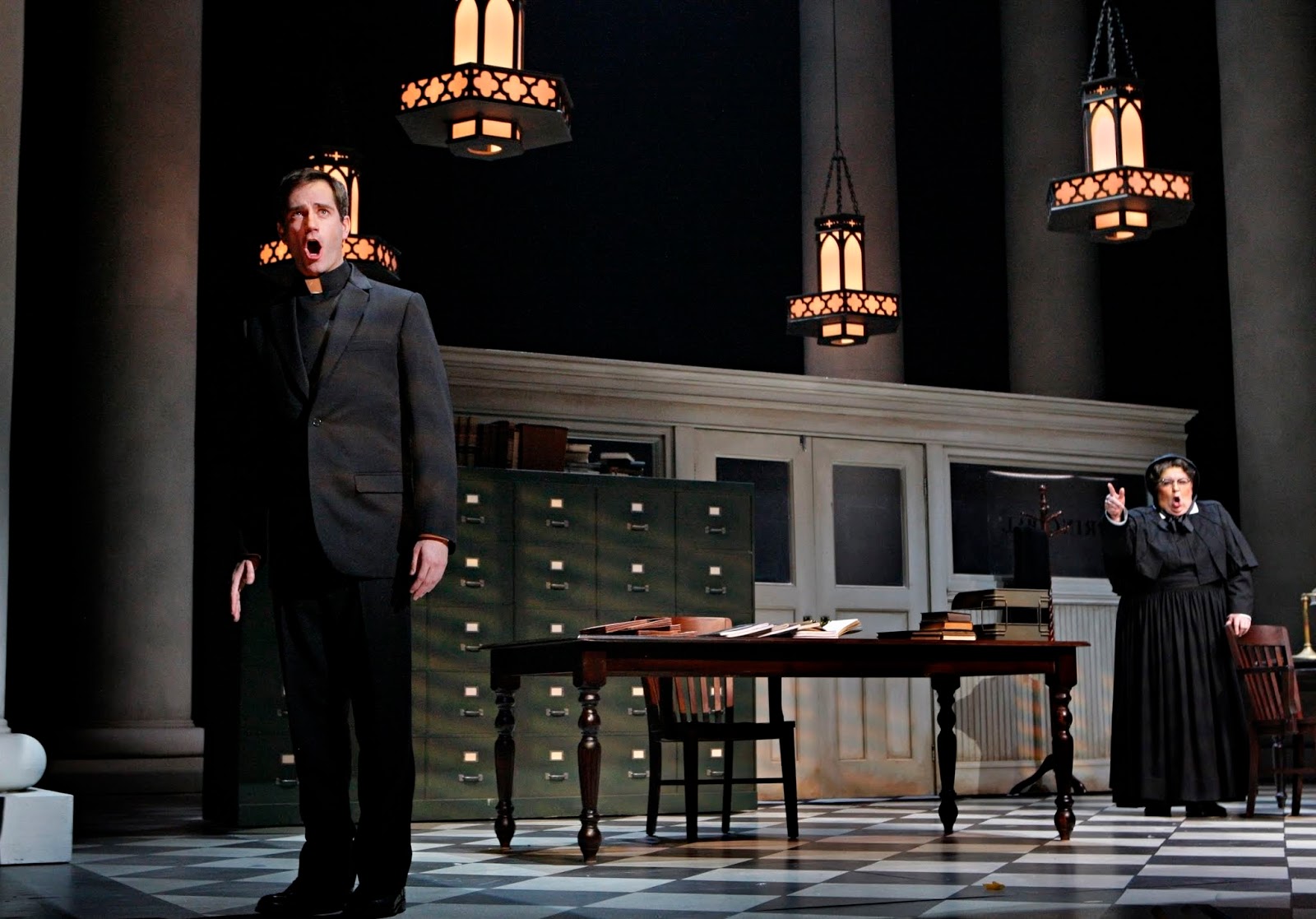
I look forward to revisiting this work again, and while it may not have the immediate appeal of some of the new American operas that have grabbed the heart, such as Kevin Puts' "Silent Night," it certainly deserves that chance. For that, I'm grateful PBS dared take this chance and make it an opportunity . . . . or should I say, "opera-tune-ity?"

Labels: , , , , , , , , , , , ,

Tuesday, May 19, 2009

Arjuna's Dilemma


Having owned this on CD for a good while now, I only recently sat down and studied the whole thing, listening from start to finish (mulltiple times) in order to get the intended effect the composer was looking to lay on us (at least musically). The work has definitely grown on me . . . so much so that I truly regret not having taken the opportunity to catch it in New York this past season.

Cuomo's score is a curious thing - alternately whimsical (in a good way) and profound. Its middle-Eastern/Indian flavor notwithstanding, the opera seems (to me) primarily to be jazz based. Arjuna's music strongly reminded me of the work of some of the great avant garde and progressive jazz ensembles from the 70's and 80's. One hears definite (and definitive) influences, particularly John Zorn and those familiar with Anthony Braxton and the Rova Quartet will swear at least several moments were inspired from some of his complex pieces. I also happen to think there’s some Carla Bley hiding in there, too!

Labeled a chamber opera, I'm certain a lot of Arjuna's charms were meant to be seen as well as heard, meaning some of those qualities simply cannot come through in an audio only format. I say this not to be dismissive of the composition, as clearly its original intent was to be seen AND heard and this is reflected in the score.

Cuomo skillfully weaves a fascinating sound palette blending various styles with one another, and at times INTO one another. Thus, we move from Indian raga, through more formal minimalistic stylings, to jazz riffs, and (for my money) some gorgeous polyphonic writing reminiscent of the likes of William Byrd and Thomas Tallis and, more recently, Arvo Paart. There was at least one moment where both Philip Glass's "Songs from Liquid Days" and the Boubil/Schoenberg musical "Les Miserables" came to the very forefront of my mind. This is not a bad thing (in my opinion). Though considered an opera – implying “sung” – I think the majority of the score is actually instrumental, and decidedly more jazz than "modern classical" music. Only one "legitimate" solo voice appears, Arjuna himself, here sung by tenor Tony Boutté, who's free, open sound blossoms beautifully in several of the scores biggest bursts of melodic invention.

In several bits of purely instrumental music, I heard an almost identical "riff" familiar to me from John Adams' "Vishnu" chorus from Doctor Atomic (written about the same time). Considering the subject matter at that precise moment, any number of parallels seem to come into into play, adding layers of richness both ironic and theatrical.

All in all, this is a noteable addition to the ever expanding genre that is "modern opera" - and a most welcome one, to boot!

Labels: , , , , , ,

Monday, May 18, 2009

Green Day - 21st Century Breakdown


Here comes that 90’s whining, non-motivated post-punk bank with yet another critically acclaimed work – their second in a row to be termed “an opera.” How did the boys follow up their most critically acclaimed (and surprisingly successful) punk opera, “American Idiot?” By composing and recording an even bigger, punk opera (in three acts, no less!): “21st Century Breakdown.”

“Breakdown” really is that rare masterpiece of pop which the record companies have been hungry for and mourning the loss of, all while simultaneously doing everything in their power to ensure these kind of albums don’t happen at all. That it got made at all is rather amazing – and that it’s “Green Day” who got there – is a rather telling – and WELCOME surprise – and a healthy indication that the music industry is not quite as dead or stagnant as many would like us to believe it is.

As with “American Idiot” the boys have looked to the mess of the world around them for inspiration finding plenty to fuel their cantos of complaint and contemplation. While most rock/pop musicians are drone on endlessly about the banalities of unreciprocated love or busying themselves at press conferences denying their homoerotic locker room entanglements and media-grabbing antics “Green Day” harkens back to the days of social consciousness of the folk strummers – and the angst of 70’s punk. That they’re capable of blending it all into a sort of unifying stew . . . an amalgamation of “pop styles” that existed before they sauntered onto the scene is a welcome sign of hope for an otherwise very tired and often lackluster pop industry.

The songs run a surprising gamut of styles from well scrubbed, no frills post-punk to enormous anthem-like ballads “21 Guns” (which they performed beautifully – and powerfully – on the Saturday Night Live season finale). There’s something inspiring here, too, hearing angry young men sing a call to arms as they do in one of the opera’s most hypnotic numbers, “Do you know you the enemy?

“Bringing on the fury
The choir infantry
Revolt against the honor to obey
Overthrow the effigy
The vast majority
Burning down the foreman of control . . .
. . . Violence is an energy
Silence is the enemy
So gimme gimme revolution”


Yes . . . Gimme revolution, too! It's all awfully inspiring, provocative and infectious. Rather quickly I found myself singing along - each song almost instantly memorable even after but a single hearing. I must say, I find it most interesting (and just a bit amusing) that, for two records in a row now, rock's most unexpected bad boys have chosen to describe their work as opera. They'll get no argument from me.

Despite the praise being heaped upon it, a lot of critics are saying this latest “opera” is “too perfect” (what in insane thing to say) and cannot possibly repeat the success of “American Idiot.” Yet, what’s truly interesting to me is that “Breakdown” (unlike “Idiot”) is in actual preparations for a fully-staged theatrical presentation by the Berkeley Repertory Theater, which opens in September. Can Broadway and London, or even Hollyweird be that far behind? The songs – played back-to-back, last just a touch over 70 minutes – which, with some “breath” between them (and stage business) could make a nice short evening length work. Arjuna also runs at 70 minutes. These two could share a fascinating bill someday!

I’d imagine that neither of these two operas will win much fandom on this list – but each serves to show that opera as a form is very much still alive . . . and a lot more than high notes, bad wigs and dying courtesans.

Labels: , , , , , , , ,