Friday, November 22, 2024

ROCK ME AMADEUS! National Theatre's Astounding Production


Time has prevented me from writing anything about my mind being blown a few nights ago watching the 2017 National Theatre production of Peter Schaffer's masterpiece Amadeus. It was exciting to see the work revived - in a different production and edition - in the same theatre it premiered at in 1979.  What a journey this play has taken over the decades since that first night.  


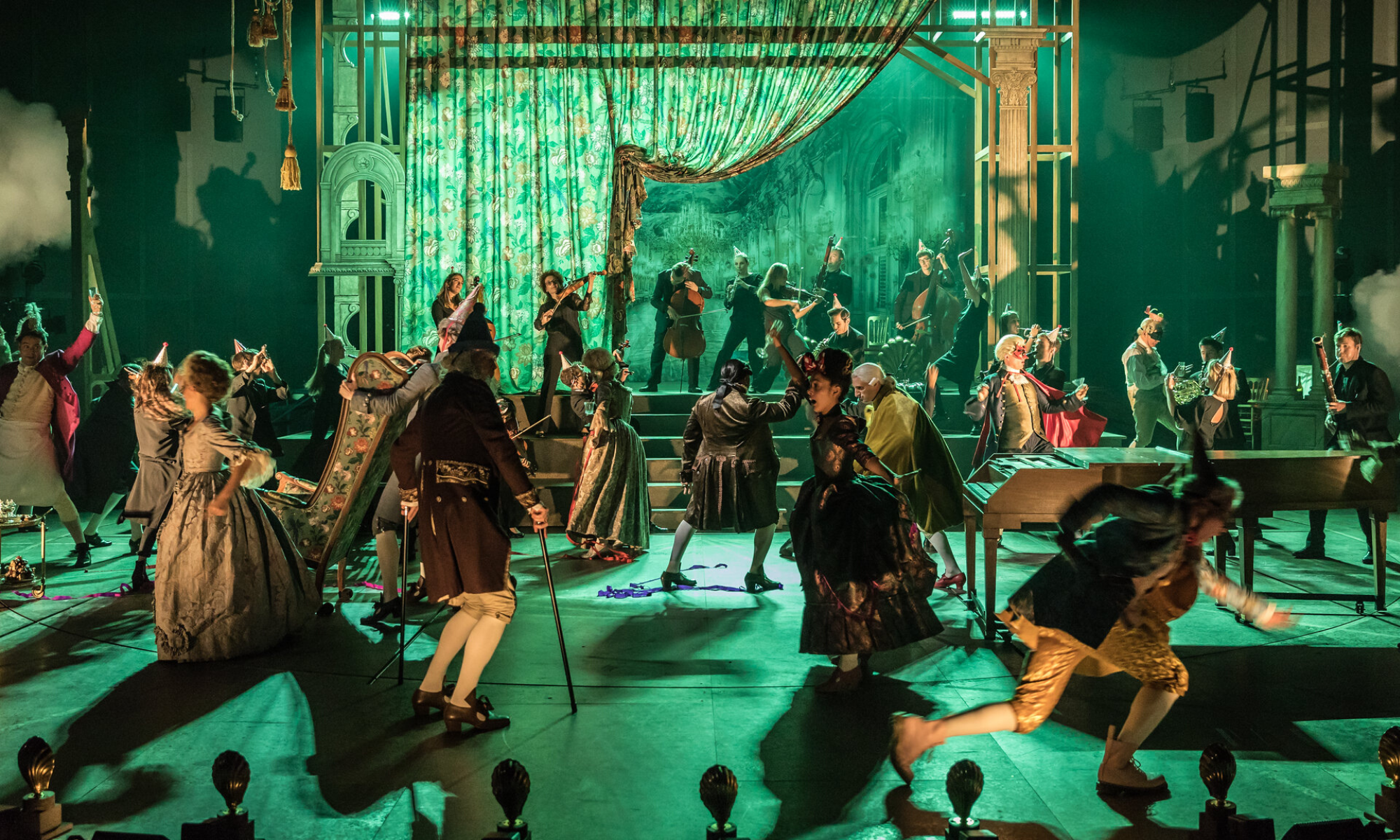
Michael Longhurst's gives this Amadeus about as stunning a production as it will ever likely receive and once again I've witnessed something that left me emotionally spent and incredibly grateful  I'm still alive. It made me remember that despite the wretchedness that surrounds us, the world still allows such magic as to make us forget it all long enough to remember how beautiful it can still be.  

Visually, sumptuous, Longhurst gives his Amadeus a widescreen film perspective, with a large moveable (automatically receding and projecting) platform that accommodates the numerous scene changes and handsomely holds his enormous cast, which includes the 21 member Southbank Sinfonia - so that everything, every gesture feels magnified . . . larger than life  

Since its premiere, Salieri has become one of the great villain roles of the last century and  attracted a wide variety of top flight actors ready to rant, rave and poison his rival, Mozart, but Lucian Msamati may be the best of the many I've seen. His harrowing portrayal covers every possible aspect of Salieri's personality - the pettiness, the jealousy, the rage and self-loathing - to the point I was alternately sympathetic and disgusted by him.  As it should be.

I initially had some issues with Adam Gillen's Mozart. Delivered in an exaggerated Cockney (as was Karla Crome's Constanza) that made increased his already annoying behaviour t o a level that was at times, difficult to take. He makes up for that to some degree with his physicality - literally throwing himself into every scene with an abandon that almost seems dangerous.  All of that however, pays off handsomely in the final 30 or so minutes of the play.  As Mozart's fortunes turn and his demise is imminent, Gillen's Wolfgang broke my heart - and I watched the final scenes in tears. It was beautifully painful and painfully beautiful.  


The Southbank Sinfonia provide not just a consistent soundtrack in music of Mozart and others, including arrangements by Music Director, Simon Slater, but also are part of the action, several of them with lines. The operatic scenes are spectacularly delivered on floating proscenium arches with Mozart in tow several times, and an interesting arrangement of the Queen of the Night's aria that has Papagena sort of echoing the high notes. Sounds strange but it works. Brilliantly. 

While I've loved this play for over forty years, right now I don't think I've ever loved it more. 
Labels: , , , , , , , , , , ,

Tuesday, November 12, 2024

Andrew Scott is Vanya. and Alexander, and Sonia, and Michael, and . . .


Labels: , , , , , , , , , ,

Saturday, February 24, 2024

Fiennes and Okonedo: Antony and Cleopatra on Fire

I just spent the past three plus hours transported to Rome and Egypt along with Shakespeare's Antony and Cleopatra, in the guises of Ralph Fiennes and Sophie Okonedo. Director Simon Godwin has created a modern, yet still timeless world for Shakespeare's characters to spring to vivid life in, and while overall the cast was excellent, with superb performances by (nearly) all, the show is aptly named for this formidable couple. Shakespeare did well with his titles, eh ? 


Fiennes' Antony is one of surface bravado but with deep and myriad underpinnings of ego, self doubt, jealousy, delusion, loyalty and genius. An interesting, and telling choice, was to portray Antony as an alcoholic, subtly but effectively putting his choices and actions in a light I'd never considered before. When Caesar sends Thidius to "steal" Cleopatra, and seeing through Caesar's intent, toys with the boy, he begins kissing her. Antony staggers in, waving a half empty bottle of Bulleit bourbon (my old favorite!) and his rage seems fueled by the whisky, orders the boy whipped and beaten, and unleashes his rage upon his queen, including what sounds like a liberty taken with the line "Ah, you kite!" (you can imagine what's in its place). Fiennes moves like an aging dancer, elegant one moment, clownish the next, crawling on the floor, all with abandonment of regard of to how he appears. He simply (or not so simply) . . . just "Is."

As his Cleopatra, Sophie Okonedo is . . . formidable seems too slight a compliment for her performance. As many shades as Fiennes' Anthony presents, Ms. Okonedo seems to go even further. She is regal, elegant, sexy, a swaggeringly dangerous beauty, loud of voice and character. She gives such depth to a character already complex on the page that it is difficult not to be overwhelmed by her, which is as true of the viewer as it is of the many characters in the play. 


While their scenes alone and with others felt daringly theatrical, together Fiennes and Okonedo created fire. The Johnny Cash/June Carter song lyrics "We got married in a fever, hotter than a pepper sprout" kept springing to mind. The pair almost seem to have a secret language in each other's company that goes beyond words and gestures and straight to the passion and soul of their partner. Godwin had a gift in the pairing of these two formidable actors and the result of their work together is thrilling, almost always on edge and, even for someone knowing the play well, full of constant, welcome surprise,  

Some criticism was made of the initial run (back in 2018) of the length of the play and how Godwin's production - setting each scene in its own locale, rather than a unit set - added unnecessary stretching to an already long work. Similarly, criticism abounds about how Shakespeare knew not how to end this play, a good half hour between the deaths of Antony and Cleopatra. Nonsense. We've moved into an era where plays are frequently shorter than ever, while we easily spend three hours at the cinema watching planets explode, with trite dialogue wanly delivered by beautiful actors afraid of their voices, in films with quick cuts geared toward those with Attention Deficit Disorder. This is not Shakespeare's fault . . . it's ours. If one can give oneself over to the glory of language that speaks beyond the obvious, that is rendered from the hearts and minds of superb artists, on a stage that serves all of it up splendidly, i can think of no better use of a few hours of one's time.  

The film of this live performance is available on several pay streaming platforms presently, and, happily as of today, free on YouTube. Go watch it. Now.  

Labels: , , , , , ,