Tuesday, April 29, 2025

Pelléas Perfection From Rouen


(NOTE:  This was published in 2021, but correcting a typo forced the current date.)

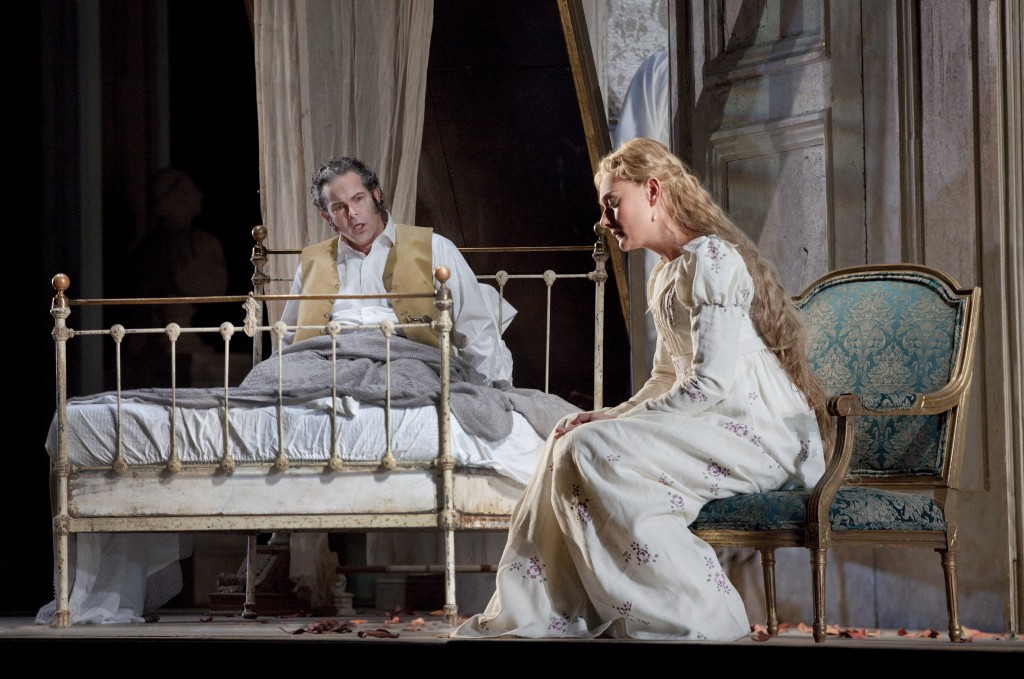
One night this past February, seized by my endless insomnia, I stumbled onto - and then stayed up all night - watching Éric Ruf's incredible production of Pelléas et Mélisande from the delayed feed from Rouen that day. Since that night, I literally cannot count the number times I've watched since. Easily a dozen. This Rouen production, along with Vienna's current one, is perhaps the best I've ever seen.


First, not that it should matter, but physically, this is just about the most attractive casting  since Richard Stilwell and Frederica von Stade over 40 years ago.  Like Richard and Flicka, these kids are ideally suited to their roles, vocally and dramatically. Additionally, strange as it sounds, there is an almost Shakespearean quality to Ruf's austere unit set, adding yet another level of mysterious drama to an opera that already is filled with it.

Nicolas Courja is among the most complex, conflicted Golauds in memory, matching his more celebrated equal, Simon Keenlyside in the Vienna production. If I were forced to chose between them . . . well, I could not, and so won't.

Golaud is almost always a bit gruff from the get-go, but Courja, youthful and almost crazy handsome, plays the role much younger than we're used to seeing it, which creates an element of reality where, with the brothers closer both physically in age, and in manner, makes Mélisande's love for each entirely believable. Courja's Golaud is gentle, loving and kind to Mélisande. The way he looks at her, touches her - he is the personifcation of love. I cannot recall a Golaud I can say that about, ever, not even Simon's.  All of that loving kindness makes his turn-around all the more remarkable. It's an enormous dramatic payoff as serves to intensify his rage and violence . . . his emotional unhinging becoming all the more believable . . . and terrifying. We see before us a man who has descended into complete madness from rage and jealousy.  Courja's delivery of the text, and his physical actions come from the very soul of Golaud. He is brilliant.


As the title lovers, Adèle Charvet and Huw Montague Rendall quite simply took my breath away. They look and act like teenagers, particularly Rendall who appears to be no more than 18 at times, and moves both athletically and gracefully like a physically fit kid. Not often can we say that about any opera singer.  The same holds true for Ms. Charvet.  Of course, none of this "they look great" business would matter if they could not sing these roles, but, blessedly, this is not even remotely the case. Vocally, they're close to perfection, with Rendall probably taking a slight edge, and top honors for the best singing in an evening that is absolutely filled with great singing.

Jean Teitgen and Lucile Richardot as Arkel and Genevieve, albeit with far less to sing, were the equal of the three central characters. Teitgen in particular makes the most of his scenes, and his most famous line, Si j'étais Dieu, j'aurais pitié du coeur des hommes" (If I were God, I would have pity on the hearts on men) with an old man's broken hearted weariness. The sentiment and its delivery are devastating. I could feel his words in my soul.

The staging on this unusual unit set is never shy of incredible.  Rich in visual symbolism - with its enormous, stage covering fishing net, the grotto, the pond/stream with its enormous stones surrounding it, which the lovers move across . . . all of it is tremendous to behold.

The murder of Pelléas, always one of the most chilling in opera, is, in its way, as horrifying as Siegfried's, and the shock and terror of this opera I've known and loved over half a century now still causes me to let out a gasp in any production (well, most of them).  But here? Wow.  No matter how many times I've watched it now, I cannot stop my hand from flying upward, instinctively covering my mouth.

Reinforcing all of this is the Rouen house orchestra, under the extraordinary Pierre Dumoussaud.  Together, they give a reading of Debussy's score that matches the best of any I've heard from an opera house orchestra, and better - by far - than most. Dumoussaud imbues every note - every phrase of Debussy's masterpiece with understated conviction that always serves the drama perfectly. His players respond in kind throughout with gauzy, dreamy, powerful, textures that transport one directly to the heart of this story. This extends to the interludes which, each time, serve perfectly in heightening the sense of drama and tragedy.

This Pelléas should not be missed by anyone who loves the opera. For those who think you don't like it, if you can handle French subtitles, this may be the one production that could well change your mind.

Labels: , , , , , , , , ,

Saturday, August 28, 2021

Pelléas et Mélisande : Golaud's Turn


I have now watched Marco Arturo Marelli's brilliant 2017 Pelléas et Mélisande  produced for Vienna about half a dozen times, and, despite my raves when first seen, each ensuing viewing has become a more powerful experience than the one that preceded it.  

Though the costumes seem to place it in the early 20th century, Marelli has created a sense of a world without time, for the residents of Allemonde.  As has been true for most productions of Debussy's masterpiece of recent vintage, the story here similarly unravels on a unit set.  But, oh, what a set.  

Marelli has trapped his audience, along with Maeterlinck's doomed characters, in the dimly lit, grim, cheerless vaults of the forbidding Allemonde castle where nature seems to be a foreign concept. It has, in fact, become something spoken of . . .  alluded to, but never, ever seen.  Here the walls are impregnable to the outside world, and impenetrable to daylight.  A lagoon occupies the stage floor, and to drive the point home, Marelli has filled it with stagnant water navigated by multi-level precarious walkways.  


The effect works in perfect tandem with Debussy's complex score alternating from its dreamy gauziness, filled with lives of angst and worry, then punctuated with Golaud's unpredictable outbursts of malevolent violence.  It is only the outsider, Melisande who escapes, in what I can only describe as some sort of vision and apotheosis.  The dying or dead heroine of the story, is accompanied by eight graces who lead her spirit away by boat. . .  away into an orange, sunstreamed horizon - the only natural light we glimpse during the tale's duration, and this but for only a minute before being plunged back into the forboding dank world of this doomed castle. 

Water is in fact a constant element throughout Marelli's design, and its symbolism seems born of myriad possibilities, not the least of which include life, death, cleansing, stagnation, and entrappment, but ultimately also, escape.   

While I'm not generally a fan of singling out a non-titled principal character taking the focus of a production, Marelli makes the anchor of this Pelléas et Mélisande, Golaud.  In truth, it isn't a far stretch to say Debussy's opera could easily be titled "Golaud."  The role is here taken by the remarkable Simon Keenlyside, who was, for a good stretch of his career, one of the finest interpreters of Pelléas.  I have no reservations saying this:  even as good as he was, his work in the title role never touched (nor was it required to do so) the depths of despair we witness as the hero's older half brother. 


Marelli bookends the opera's opening and closing moments with twin failed suicide attempts by Golaud, who, as the tale begins, has neither the strength nor will to live.  In the opening scene, he props his rifle under his chin, stopping only when he spies the mysterious Mélisande crying.  Then, in the final scene, racked with remorse, shame and guilt so deep he cannot bare it, he again readies the weapon for his death, saved by his son, who, weeping, pushes the gun away before embracing and kissing his father, who can only look off into the distance, blindly.  Keenlyside is in his element vocally and theatrically, presenting a doomed man in the same league as Wozzeck.  It is perhaps the finest thing I've experienced him in - even if only on video (and I saw his wonderful Pelléas to Lorraine Hunt Lieberson's mesmerizing Mélisande).  Keenlyside makes Golaud's weeping, remorse and moaning sound as if arising from the profound depths of a truly hopeless soul, and I discovered that fighting back my own tears the most futile of exercises.   

Adrian Eröd's light, flexible baritone perfectly suited Pelléas' character.  His was not the youthful looking "boy" we usually see, but rather closer in age to Golaud, which worked well dramatically.  That said, he's physically spry and athletic (though a bit cautious on the dangerous walkways, which is understandable), and his fascination and love for  Mélisande feels more naturally childlike than born of passion. 


 This approach works with Olga Bezsmertna's fascinating, statuesque Mélisande, their love for one another feeling genuinely innocent. The murder of Pelléas becomes less horrific than most productions lately, yet somehow all the more wrenching because of Golaud's profound, almost paralyzing depression.  Here, there is no need for Mélisande to run away to hide, her husband will not be coming after her next and the scene becomes absolutely soul crushing.  


Kudos to the creative team for giving Mélisande a glorious mop of hair that extends to the floor and truly gives her not only a quality of mystery, but also imparts a character out of an ancient tragedy.  This effect is made all the more powerful during what can only be called (at least by me) as Mélisande's Apotheosis or Transfiguration.  


Bernarda Fink is a Geneviève of great motherly warmth, much more present than we usually see.  She is also vulnerable and visibly frightened by what she sees going on in the castle.  Franz-Josef Selig nearly steals the evening as the old blind king, Arkel.  The voluptuousness of his tone, it's warmth is stunning, and adds to a character who, despite having "seen it all" still offers compassion and hope.  

I typically cringe whenever a female soprano is assigned Yniold, but here diminutive coloratura Maria Nazarova makes a more believable - and well sung boy - than just about any "real boy" I can think of in recent memory.  

The highest praise goes to Maestro Altinoglu who has just the right "everything" going on with the Vienna Philharmonic, and dispatches Debussy's score in a reading that is both contemplative and propulsive.  Blessedly, the sound engineers captured all of this with refined precision that allows every instrument, every voice to be heard almost as if for the first time.  In a review immediately after the premiere, one critic described the effect as "a love affair between conductor and orchestra."  I'd agree.


(Note:  Unfortunately, this recording seems not to be any longer available, though I'd wager it can be found through the "usual channels," if not easily so.)

Labels: , , , , , , , , , ,

Thursday, September 21, 2017

Pelléas et Mélisande : Faith Esham and Jerry Hadley - Wow!


I’ve been listening to a fascinating performance of Pelléas et Mélisande from 1992. Lyric Opera of Chicago with Faith Esham, Jerry Hadley and Victor Braun. Teresa Stratas was taking over the role for Frederica von Stade, but cancelled the first two performances so Faith Esham made her Lyric Opera debut. Pelleas is among my favorite operas, so I’ve heard many pairings over my lifetime (so far) and, fan of both Ms. Esham and Mr. Hadley that I am, was not quite prepared for the performance they presented on opening night. I generally prefer a tenor in the role (Richard Stilwell, Simon Keenlyside, taking top honors for baritones) and Hadley does not disappoint in that regard. He and Esham both had very bright sounding voices which sounds so “right” in French, their diction crisp yet fluid – perfect for Debussy’s “problem” opera. The scenes between Esham and Braun’s Golaud have a depth and bite that could convince even non-fans this is a drama more than about “nothing.”

At the start, Braun seems a tad less gruff than many a Golaud, but he gradually sinks into a sort of cruelty - a violence that ever grows in its intensity until it becomes downright horrifying, even before his ultimate crime.

My favorite tenor Pelleas has, for a time, been Richard Croft and Hadley’s performance here does not take him down from the shelf, but boy, is he terrific in his own way. Croft has an elegance that fits in with Debussy’s soundscape – just about perfectly. Hadley, on the other hand, does not skimp on matters musical – and in certain moments (notably in the Tower scene) brings his own brand of elegance. More often than not, however, there is a slight “roughness” (not the sound itself, but the way he handles the role) that is unusual yet perfectly in tune with his and Esham's take on the lovers.

Esham’s first of several utterances of “Pelleas” in the Tower scene is sparked with an undeniable eroticism that shocks . While many Melisandes retain an aloofness throughout the role, Esham makes her seem almost familiar, yet somehow just as puzzling and troubled. In the middle of a scene she may add a touch of nervousness to her sound emphasizing the girlishness which, along with that brightness and ease of the language (her best roles truly were Manon, Juliette, Leila, Marguerite . . . ) makes this a special performance. Also, like a tenor Pelleas, a soprano (as opposed to mezzo) Melisande really changes the tone of the opera.

The great Act IV love scene drips with passion and Esham and Hadley sound as if they can barely contain themselves – and then when Hadley’s Pelleas reaches, “Et maintenant je t'ai trouvee. . . je ne crois pas qui'il . . . ait sur la terre un femme plus belle!" they – and we – realize they cannot. Breathless passion mounts into a sudden, slow ecstasy, each singer now sounding, somehow, a bit older, as if the realization of this love has aged them. It's almost more like they're playing "grown up,” which makes Golaud’s sudden appearance and slaughter of Pelleas more unbearably than it already is, Melisande's final cry adding an extra punctuation mark of horror.

Yvonne Minton, turns in her customary excellence in the fairly ungrateful role of Genevieve, and Dimitri Kavrakos is touching as Arkel. Soprano, Lucy Tamez Creech has a very boyish voice, though it appears she sang Yniold from the pit while child actor Joel Eng pantomimed onstage.

James Conlon, like every conductor of this opera, has a passion for it that comes out through his masterful reading of it. He brings out the sonic wonderment of the score, while keeping everything and everyone in near perfect balance. I would have liked a bit more “oomph” and drive at the beginning of the love scene, but this approach and gradual build up certainly makes good dramatic sense. The “special effects” of the percussion section – bells, etc., absolutely sparkle and shine. During the first intermission of the broadcast, he is interviewed and offers terrific insights into Debussy’s masterpiece and the characters who populate it. He draws an interesting parallel between Arkel and Pelleas that I’d never really thought about before. I love when someone sheds new light on something that can, at times, seem almost overly familiar. It puts things back into the right perspective and makes me, as here, love that thing all the more.

Since recently moving, and giving away/selling many of my recordings I’m not certain how many of “Pelleas” I still own, but this would have been, according to my estimation, the 32nd in my collection. I think that qualifies me as a Pelleas obsessive, oui?

p.

Labels: , , , , , , , , , , , , ,

Saturday, June 3, 2017

Pelleas et Melisande: An Obsession

Thursday, June 23, 2016

Pelleas Goes Broadway!


While there have been successful opera productions on the Great White Way . . . The Saint of Bleecker Street, La Boheme, Porgy and Bess, etc., no one to date has taken the challenge of producing Debussy's mercurial family drama, "Pelleas et Melisande." Until now.

Legendary director John Doyle announced he's bringing his stripped down vision of "Pelleas" to the Ethel Barrymore in a production that features one of his trademarks: each character playing an instrument when not singing. The production features a newly pared down arrangement of Debussy's score arranged by William "March of the Falsettos" Finn.

Cast and orchestration details are as follows.

Pelleas: Jeremy Jordan on the English Horn
Melisande: Katherine McPhee on the Trombone
Golaud: Michael Cerveris on the Cello
Arkel: Kelsey Grammer on the Banjo
Yniold: Billy Porter on the Marimba
Genevieve: Cher on the Ukulele

Can't Wait!

Labels: , , , , , , , ,