Thursday, February 22, 2024

Falling Figaro: Not Too Deep, But Delightful
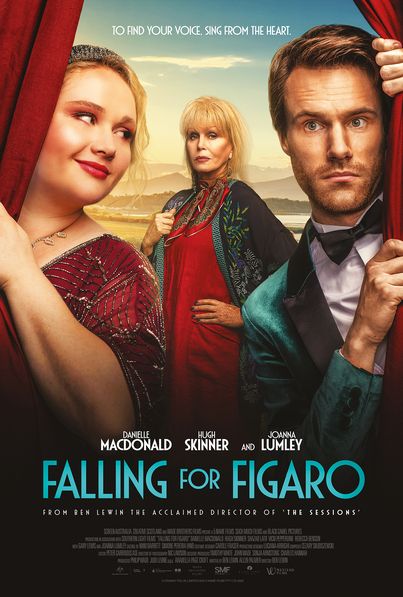
Upon receiving a major promotion at a London financial firm, American Millie Cantwell, leaves her job, long-term boyfriend, and posh London flat to take up residence at The Filthy Pig, in the Scottish Highlands - in tiny village tiny village of Drumbuchan to pursue her lifelong dream of becoming an opera singer. 

Drumbuchan, you see, is where Meghan Geoffrey-Bishop, one of the opera's former great divas, lives in a ramshackle, leaky-roofed cottage bequeathed to her by an alleged fan. ("After seeing my Tosca, a woman came up to me and told me she was leaving me her home in Drumbachan.  It was only after I arrived that I  wondered if she actually liked my Tosca.")

Geoffrey-Bishop is cruel, venomous in the worst way, petty, temperamental and a true bitch. You know a true "diva." She agrees to take on Millie to prepare her for the "Singer of the World" competition . . . I'm sorry  . .  . the "Singer of Renown" competition. (wink).  She bilks Millie an outrageous sum for the lessons, and the young hopeful gladly pays. Geoffrey-Bishop has only one other student, Max, a handsome, awkward young baritone who has a strange relationship with his teacher - a cross between mother and lover, but actually neither.  He has entered, and lost the competition four years in a row, and was promised by his teacher, she would focus solely on him. Now, with Millie, there is competition - and a sexual attraction. A humble guy, Max wears a number of hats at the Filthy Pig; janitor, maintenance man, plummer and chef.    

The film was obviously made by people who know something about opera, but there are obvious glaring moments that will be caught by true opera fans, although as I laughed and winced through these, I wondered if it was a kind of "wink and a nod" like an insider's joke.  There is in the diva's studio, a photograph of her as Tosca, but it is her head photoshopped onto the famous photograph of Callas during a curtain call of the famous Zeffirelli London "Tosca."  There is a similar photo of her Norma, while oddly enough there is another well-known photo of a casual Callas seated and lovely.  

The score is filled with operatic music, some of it sung, some of it interestingly arranged for a variety of instruments, and we hear the singers in music from Barbiere, Don Pasquale, La Traviata, Romeo et Juliette, Carmen, Don Giovanni, and more. 

The villagers of Drumbachan seem to love opera, and Millie wonders why everyone is so nice to her.  The inn's owner explains, "Well, right now you ARE the economy." . While the film is not great, and doesn't plumb the depths of the opera world in any seriousness it is very easy to watch and its characters rather loveable, even Madame Geoffrey Bishop. She is played by Johanna Lumely, with aplomb, zero humility and just the right amount of self-centeredness.     

Danielle Macdonald fairly sparkles as Millie, sometimes cluelessly, sometimes annoyingly but you can't help but root for her, even in this almost ridiculously unbelievable scenario.  

Hugh Skinner is marvelous as Max. You're puzzled by his sullenness, his somewhat childish behavior and his face is marvelous at making quizzical looks with eyes that make you wonder what the hell is going on in that head.  

Though neither actually sing in the film, Macdonald and Skinner each studied voice and languages in order to get the lip syncing right and show an understanding of the text.  

There are too few films about opera for those of us who love it, and it's nice to get a semi-romantic comedy that at least tries to get things right.  So, deep?  Nope.  Fun?  You betcha.

Labels: , , , , , ,

Saturday, June 14, 2014

Moffo's Exquisite Butterfly.


Hands down, this is easily the finest thing I’ve ever seen from Moffo. With almost no prior professional opera experience, Moffo gives a performance that would be hard to equal in every area of this difficult role. Without a bit of Japanese-style make up, the young soprano moves, sings and creates a Cio Cio San that one cannot imagine bettered – at least I couldn’t (imagine it, that is!).

Both Un bel di and Che tua madre are stunning and punch up the dramatic without overdoing it. Speaking of not overdoing it, Moffo never oversings and, in fact, presents Un bel di almost as if whispering a confidence to Suzuki. The end of the love duet is capped beautifully with Moffo’s ecstatic heroine collapsing backwards into Pinkerton’s arms in as romantic a gesture as has been captured on film.

Opera films from the 50's could frequently be laughable (though endearingly so, but here, there are, in fact, a number of incredible directorial choices both innovative and illuminating, and I say this despite having seen more Butterfly’s than a net would hold (Annette who?) At the start of Act II, we see Butterfly lying on her stomach reading or writing something in Japanese characters, looking every bit the bored-out-of-her mind teenager. It lasts only a minute yet this simple action deepens and fleshes out this complex character, adding a slightly comical note while endearing this Cio Cio San to us even more, if such a thing were possible.

The most touching business occurs during Butterfly's all night vigil. At the very beginning of the Humming Chorus, Moff's Butterfly unwraps Pinkerton’s ring and, in a magnificent dumb show worthy of the finest silent screen actresses, Moffo’s face and features both glow and grow with womanly intensity until she is ultimately swept away by all emotion, yet keeps much of it inside and we somehow see and sense this in a performance both infinitely delicate yet powerful. Cio Cio sand then winds her way back to the bridge path on which she walked to her wedding, settles there and remains alone, away from her child and Suzuki. As Puccini's score signals the early morning sounds, the camera reveals Suzuki and Trouble, inside, still asleep on their cushions. Suzuki rises and as the fantastic score begins sweeping all away in joyous intensity, she begins running frantically, pulling up all of the shades in a sort of deconstruction of their home, flooding it with light exposing the myriad flowers still strewn wildly about. Stepping outside she discovers Butterfly, still kneeling on the bridge where she has spent the night alone, waiting. This is pure lump in your throat stuff, folks and Moffo - even not singing a note - is absolutely amazing. Another marvelous touch occurs at the end of the story, as we watch Butterfly crawling, those flowers to welcome Pinkerton caught up in her hair as she dies. Every gesture, every expression came off with a spontaneity from one who believed she was Cio Cio San. I certainly did.

Then there’s Pinkerton. Unfortunately, Renato Cioni, looking rather handsome and not embarrassing himself too terribly as an actor, offers the roughest voiced, most inelegantly phrased Pinkerton I can recall ever encountering. He sort of shrieks his music throughout with his high notes showing a particularly dreadful technique: a flattening out of vibrato creating an ungodly, painful white sound - the opposite of what anyone wants in Puccini, and certainly not right for Pinkerton. At least he looks good and the director keeps him away after the suicide.

Miti Truccato Pace takes the prize as perhaps the best acted and most sympathetic Suzukis to ever have sung the role, at least on screen. Marvelously touching and in perfect harmony with Moffo's heroine.

Afro Poli is a thoughtful, old school Sharpless, older than usual, but richly voiced and pointing up all of his music with actorly attention.

I've read many complaints about the picture and sound quality of this film which, quite frankly I don't understand. This was a live telecast from January 24, 1956 and we’re lucky to even have it around, in ANY quality, but honestly, I thought the transfer used by VAI to be outstanding. Still, people still seem to think it should look and sound like something from Lucasfilms!

Highly recommended.

Labels: , , , , , , , , ,

Tuesday, February 18, 2014

Galina Is Katerina: The REAL Lady Macbeth of Mtsensk


I waited 30 years to see this and was not disappointed - only happy to have lived long enough to finally have this opportunity.

First off: Vishnevskaya. For those, like me, who'd only experienced this artist in concert or at the very end of her operatic career, to finally witness her in a complete role as tailor-made for her as this proves to be overwhelming. She opens the film with Katerina's boredom" aria in a voice entirely unrecognizable one that harkens back more to her jazz and nightclub singing roots than the world of opera. It as though she were channeling Billy Holiday while imitating Rosa Ponselle.

Visnhevskaya's face is unbelievable. Forget about expressions changing over the course of a film - her face becomes some great mask which frequently in less than the blink of an eye can transform her from appearing angelic, saintly, demonic, tortured, and instantly go from looking like a teenager to a run down, broken old woman. Likewise, she presents as stunning and beautiful one second and grotesquely haggard the next. To call watching her "fascinating," is an understatement.


Though she insisted she performed her own stunts in the film's tragic and violent ending (which here, are bone chillingly horrifying) they simply HAD to use a stunt double in one scene (though you can't really tell), when Katarina violently kicks out her bedroom window (which IS clearly Vishnevskaya) leaps out about 8 feet - (and almost 3 stories in the air!) dropping to a landing beneath her, then tears down the stairs like a madwoman possessed. I rewound it about 5 times to try and detect where the switch was made . . . but could not.

Mikhail Shapiro's film is gorgeously grotesque. 1966 Soviet cinema wasn't among the technically best the film world had to offer, and yet Shapiro's techniques, seems comprised of equal parts Hitchcockian hyper-realism and the surrealstic spookiness from the earliest days of film like Wiene's "Dr. Caligari." There is a visible pulsating quality in the transfer (in the original, too? I couldn't know) a sort of silent movie "flicker" in the washed out, oddly green/blue hued sepia toned color. Ingeniously, Shapiro sometimes layers image over image, such as the opening scene where we watch Katerina, sitting in a window looking out as the images she describes are projected, like home movies, against the exterior walls of her home. It is a brilliant device that early on pulls us directly into the mind of Katerina and how later, despite her brutal actions, retains our sympathy for her.

With the score so severely cut to fit within the framework of the film, we loose some truly great music, but the film version points up the very limits of ennui and violence of the tale into nearly unbearably vivid relief.

Those unfamiliar with Shostakovich's score - or scared of it - will here get some of the most tuneful and beautiful music from this opera and, as cast here, one practically revels (whenever possible) in its "Fiddler on the Roof" nightmare quality.

For the lovemaking music that begins the second act , Shostakovich draws on the romantic Russian tradition with music of ineffable sweetness, which in this context becomes as jarring and unsettling as everything that comes before or after it.

Unafraid to combine horror and hilarity, Shapiro adds yet another amazing sequence to the film when Katerina, first hears the ghost of her freshly murdered father-in-law. Onstage, this scene usually means Boris belting out his lines in white theatrical "ghost" make-up, etc. In the film, Shapiro preys on Katerina's nightmarish guilt as, truly ghostlike, he bursts through a set of doors, a nearly cartoon-like head 50 times larger than life hovering and singing over Katerina and Sergei's sleeping bodies. I found myself simultaneously laughing and cringing in horror. Yes, I loved it.

The final scenes of that endless march through Siberia is enough to chill one right to the marrow. As a big fan of Vishnevskaya, I've read her account innumerable times, but even that had not prepared me for those final, violent plunges as she takes Sonyetka down with her into that horrible, icy death. Vishnevskaya's Katerina has become absolutely unhinged, ratcheting the horror even even further in an image I won't divulge, but can honestly say one I did not see coming.

I am (for more than obvious reasons) delighted to be alive right now, but also to have lived live long enough to be able to indulge the senses with the visionary work of unknown masters of yore coming to light, like the nearly forgotten Mr. Shapiro.

Anyone on the fence about this one should just climb right over to the other side. This is truly amazing operatic filmmaking . . . vastly unlike anything one is likely to ever have seen before or since.

Labels: , , , , , , , , , ,