Wednesday, July 30, 2025

Parsifal: Memories of the World Premiere


On the 26th of July, we celebrated the 143rd anniversary of the world premiere of Wagner's inal music drama, Parsifal. Rather than calling it an opera, the composer referred to it as a Bühnenweihfestspiel, in English, a stage consecratoin festival playFor those who share my near cultish obsession with this masterpiece there is a wealth of material and fascinating accounts of its creation, premiere and all other manner of Parsifilian lore and facts, but for anyone who hasn't read it, I can't recommend highly enough Charles Dudley Warner's account of the world premiere of Parsifal.  He shared his thoughts, writing at length about it for The Atlantic, his account being published in January 1883.  A most insightful and revealing piece it is, in its way, nearly as moving as Wagner's final work itself.  Warner describes in great detail the intricacies of the the staging, (more than some may like) but does so with such heartfelt enthusiasm and awe, it pulled this reader back into another time and space (see what I did there?)  One gets a sense of where he is coming from (and where he is going to go) from the introduction:

It is the purpose of this paper to give the impression made by the performance of Parsifal at Baireuth, last summer, in view of certain strictures upon the motive of the drama, and without any attempt at musical criticism. In order to do this, I shall have to run over the leading features of the play, already given in the newspapers. Criticism enough, and of an unfavorable sort, there has been, though I heard none of it in Baireuth, nor ever any from those who had been present at the wonderful festival. Perhaps that was because I happened to meet only disciples of Wagner. I fancy that the professional critics, who did publish depreciating comments upon the new opera, and upon Wagner’s methods in general, felt more inclined to that course after they had escaped from the powerful immediate impression of the performance, from the atmosphere of Baireuth, and begun to reflect upon the responsibilities of the special critics to the world at large, and what in particular was their duty towards the whole Wagner movement, assumption, presumption, or whatever it is called, than they did while they were surrounded by the influences that Wagner had skillfully brought to bear to effect his purpose on them.

* * * * 

Of the ending of Act I Dudley wrote:

During the repast of which Amfortas has not partaken, he sinks from his momentary exaltation, the wound in his side opens afresh, and he cries out in agony. Hearing the cry, Parsifal clutches his heart, and seems to share his agony, but otherwise he stands motionless . . . the knights rise . . . slowly depart in the order in which they came. To the last Parsifal gazes in wonder; and when his guide comes to speak to him, he is so dazed that Gurnemanz, losing all patience at his unresponsive stupidity, pushes him out of the door, and spurns him for a fool. The curtains sweep together, and shut us out from the world that had come to seem to us more real than our own.

For a moment we sat in absolute silence, a stillness that had been unbroken during the whole performance. There was not a note of applause, not a sound. The impression was too profound for expression. We felt that we had been in the presence of a great spiritual reality. I have spoken of this as the impression of a scene. Of course it is understood that this would have been all an empty theatrical spectacle but for the music, which raised us to such heights of imagination and vision. For a moment or two, as I saw, the audience sat in silence; many of them were in tears. Then the doors were opened; the light streamed in. We all arose, with no bustle and hardly a word spoken, and went out into the pleasant sunshine.

I recall the first time I read this description, I could feel my heart swelling, recalling my own experiences with the opera, and imagining his.I loved this.


Warner went on with a moving description of the curtain at the end of the second act:

When the act ended, the audience, still under the spell of the music . . . sat, as before, silent for a moment. Then it rose en masse, and turned to the high box in the rear, where, concealed behind his friends, Wagner sat, and hailed him with a long tempest of applause.

Finally, there is the sharing of his overall experience with Parsifal:

I, for one, did not feel that I had assisted at an opera, but rather that I had witnessed some sacred drama, perhaps a modern miracle play. There were many things in the performance that separated it by a whole world from the opera, as it is usually understood. The drama had a noble theme; there was unity of purpose throughout, and unity in the orchestra, the singing, and the scenery. There were no digressions, no personal excursions of singers, exhibiting themselves and their voices, to destroy the illusion.

The orchestra was a part of the story, and not a mere accompaniment. The players never played, the singers never sang, to the audience. There was not a solo, duet, or any concerted piece 'for effect.' No performer came down to the foot-lights and appealed to the audience . . No applause was given, no encores were asked, no singer turned to the spectators. There was no connection or communication between the stage and the audience. Yet I doubt if singers in any opera ever made a more profound impression, or received more real applause. They were satisfied that they were producing the effect intended. And the composer must have been content when he saw the audience so take his design as to pay his creation the homage of rapt appreciation due to a great work of art.

I'm listening to today to a magnificent live performance from the place it all began: Bayreuth. It is under the leadership of Pablo  Heras-Casado - who has become a magnificent interpreter and for me approaches the level of Knappertsbusch and his legendary performances from the same house 70+ year ago. Today's cast is one of the best that can be assembled: Andreas Schager (Parsifal), Georg Zeppenfeld (Gurnemanz), Michael Volle (Amfortas), Ekaterina Gubanova (Kundry) and Jordan Shamajam (Klingsor), and Tobias Kehrer.  It's almost time for the second act so . . . 

Enthüllet den Gral! - Öffnet den Schrein!


Labels: , , , , , ,

Monday, April 19, 2021

Serebrennikov's Parsifal from Vienna: Profound and Compassionate

Images of  Kirill Serebrennikow's new production of Wagner's final opera, "Parsifal," have been playing in my head constantly since finishing watching it, filmed live at the Vienna State Opera.
Being my favorite opera, I've seen and listened to countless productions, either live or on video.  Serebrennikow's ranks among the very best, if also among the most disturbing.  

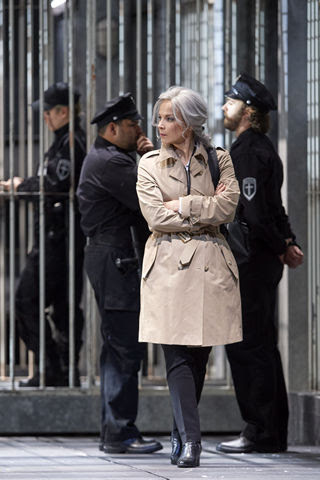
Set in a rundown Russian prison, the normally placid Grail Knights here become prisoners - violent, corrupt, proud, but every bit as doomed as in Wagner's original  The director, (who is under house arrest and had to direct from Russia via camera) is clearly knowledgeable of the enormity of Russian Prison Tattoo Culture, and here, the ink flows and is on display constantly.  We even watch on as Gurnemanz tattoos one of his fellow prisoners.  The tattoo culture brings the men together and, in a sexualized, capitalist way, is their legacy to the outside world. 

In and out of that world is Kundry, who appears to be an opportunistic  photo journalist fascinated by these men who easily stop their fighting to remove clothing articles, striking poses they appear to perceive as dominating masculinity.  They may be aware of being used, but also aware, it's all they have.

The first two acts represent a memory play for the hero who is now older, and invisible, watching as if a ghost - the violent, lonely history of his past, younger self - the innocent fool.  Serebrenikow fills the action with symbolism and uses this premise to create an unexpected if pointed poignancy that belies the violence of this microcosm.  At one point, Parsifal watches himself asking "Wer ist der Gral?"  And, clearly having played this moment over a thousand times in his mind, mouths the answer Gurnemanz provides.  

Another moment:  As Amfortas, mad with self-inflicted pain, is finishing his howling - just before the Grail ceremony music begins he scrawls the first part of the lynchpin on which everything hangs:   "Durch Mitleid wissend,"  - "Enlightened through compassion. . . "   and is shown that compassion first by Gurnemanz, then by the boy Parsifal who gently caresses the head of Amfortas, before embracing him, and in a gesture of comfort and respect, kneeling beside, then placing his head on the tortured king's shoulder.  

The act continues with these overwhelming images, matched to Wagner's magnificent score, and ends as solemnly and beautifully as any production you might imagine. With such an overwhelming first act, the ensuing ones have their work cut out for them.  Unfortunately, each begins somewhat weaker, less inspired and gave me cause for concern that the best was not yet to come. 
Fortunately, both acts, whether by design or "just one of those things" spring into life midway through and are, in their own way, equal to the mesmerizing first.   Throughout all three acts, a trio of enormous projection screens above the stage provide us a voyeur's perspective of the prison goings on - which can make for tough viewing - as well as the young Parsifal's journey to, in, and out of the beautiful, haunting ruins of the prison and the beauty of nature surrounding it.

I could go on with more of the imagery that provides emotional suckerpunches, i.e., the meeting of the two Parsifals, Kundry's ultimate recognition of who this hero is, the heart tugging (and Fidelio-esque) opening of the prison, but must stop somewhere.

Silent throughout, young Russian actor Nikolay Sidorenko - bearing a striking resemblance to a young Kaufmann, portrays the youthful Parsifal powerfully, his journey (both onstage and onscreen) moving and inspirational.
Musically, this is as satisfying a Parsifal as I can recall.  I don't believe anything is "perfect" - but this comes about as close to that mark as it gets.  

Jonas Kaufmann gives, for me, the most complete performance I've seen from him in any role, vocally and theatrically - he is perfect, the voice sounding more "tenorish" than baritonal and (at least in this recording) able to pour out the sound in a way I've not heard from him live or on recording. 

Perfect IS the word I want to use in describing Georg Zeppenfeld's Gurnemanz - a role I've now seen/heard him twice in, and who is the finest interpreter of it today.  I'd add him - quite easily - to the best who've ever sung it.

Of late, Amfortas is portrayed with more and more violence and/or torture, and Ludovic Tezier's Amfortas while definitely in that mold, is still somehow different.  His beauty of tone is here used to express a world of pain that is outside of anything else we see or hear in this production.


In one of the most significant role debuts in memory Elīna Garanča, with Serebrennikow's inspiration, puts a spin on Kundry unlike any of past temptresses I can recall.  Physically, with her silver wig, she remains one of the most gorgeous creatures the world of opera has been privileged to see.  Vocally, Wagner's anti-heroine has seldom sounded as good.  Even through all ranges, her top notes have a shine, a security and power, that eludes most mezzos, as well as sopranos who attempt the role.  

The chorus of the State Opera is the equal of the principals, offering up volume and when required (which is often) a hushed tenderness that is  heavenly.

Philippe Jordan begins the opening Vorspiel and shapeshifts it in a manner that befits what we shall see over the next four and one half hours.  At times, I found his conducting a bit foursquare and with an almost martial quality.  When I thought about the setting, and the drama as given here, it made perfect sense.  The tightness would, without forewarning, grow, gleam and expand into a tonal universe that was filled with awe and wonder, taking the earthbound and sending it into the heavens.


Serebrennikow is already receiving angry criticism from traditionalists who cannot find their way into accepting this type of interpretation.  Sadly, much of that criticism is coming from those who have not - and never will - bother to experience it for themselves.  

As for me?  I can only praise all of the efforts made to bring this to life during this impossible time, right down to having to film the production because of an outbreak of the dreaded COVID-19.  I can't think of a Parsifal more appropriate for our time.

Labels: , , , , , , , , ,