Sunday, March 22, 2026

The Met's Tristan und Isolde in HD: Stunning In Sight and Sound


For an art form we've recently been told "no one cares about" a number of opera companies have been having sold out shows playing to packed enthusiastic audiences. One enjoying that kind of success is The Metropolitan Opera's new, and long-anticipated Tristan und Isolde, which has not only sold out its run, but done the very rare thing of getting most of the cast on board for one more show.  This is not to say opera still isn't hurting, it's what the arts tend to do, but should dispel any foolish notion that no one cares.

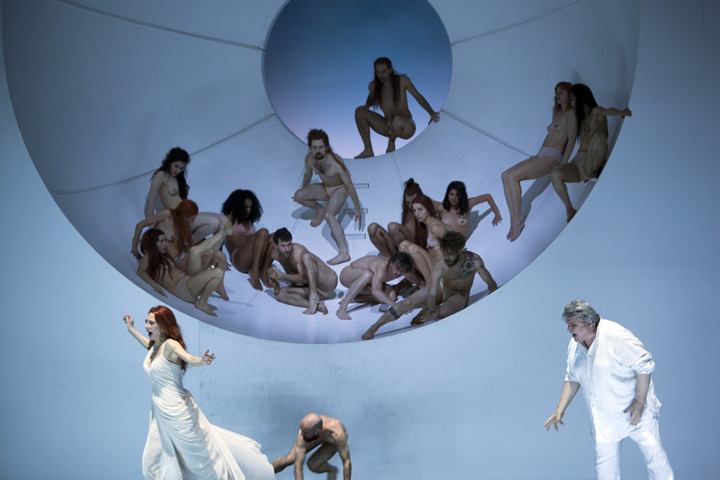
Yesterday, I had the absolute pleasure of attending the HD cinema transmission of Tristan, and it was well worth the wait. While I had a caveat or two about Yuval Sharon's now already controversial production, I'm only one among many who found it enormously satisfying, dramatically moving, and musically, this is the real deal. Sharon's production is - like-it-or-not, stunning. Depending on where you are on the traditional vs. regie scale, it can be either enormously thought provoking and emotionally satisfying, or busy and annoying. I fall in the former camp, and loved almost every moment.  

Like Wagner's score, Sharon gives us layers and levels and Es Devlin's remarkable multi-level, stage literally fills the stage top-to-bottom, side-to-side creating seemingly disjointed playing areas. On the stage floor level is a table where siti stage doubles of the title couple, while above is an enormous oval, that will change shapes, become interlocking tunnels, open and shut, and offer views e.g., from an eye, a camera aperture, even a kaleidoscope. The changes happen with a dreamlike fluidity matching mood and music  that felt natural, even as I watched in awe.  


As has been the case throughout history, the production itself almost feels secondary (something that would drive the dramatist,Wagner, insane), because it is the music that draws all to Tristan. First. Foremost. Always.

Yannick Nézet-Séguin is a conductor I both enjoy and get annoyed with. Since the beginning he has shown a tendency to relish too much in his orchestral bath of sound, frequently not seeming to  understand what the word balance means.  I've heard some of the biggest voices in opera rendered all but inaudible under his baton. When he gets something right, however, it's very good indeed. Such is the case of his reading of Tristan. It's his kind of opera - a synthesis of voice and orchestra that blend into that oft-used reference "oceanic" in that Wagner's score comes through the house in waves of sound that pulsate . . . ebb and flow throughout the house. Each of the preludes perfectly captured the mood and spirit of the act to follow. The strings were cutting deep with a resonance you could feel - even through loudspeakers in a cinema. The exquisite writing for winds had such plaintive delicacy as to sound like the very essence of deep sadness. Wagnerian magic poured out of the pit from start to finish.

That magic extended to the cast, most notably its title characters. Only months after her already historic debut several as Isolde (and rather shortly after a much publicized delivery of twin boys)  Lise Davidsen again shows what kind of beauty is possible in this challenging role.  The possessor of an enormous sound, Davidsen is also a cautious, intelligent singer with an ever increasing good dramatic sense if not necessarily by instinct. Where I felt roles like Leonora (Forza), Tosca, et al. never satisfied me, whereas the Germanic repertoire suits her perfectly, and no role to date more so than her Isolde. With only two outings under her  belt, she is already a leading Isolde, and I have no doubt we shall see Ms. Davidsen devleoping into one of the great Isoldes of any age. I'm just letting that sink in. 


Her Isolde had both spit and spirit . . . not an overly haughty princess, Davidsen nonetheless easily conveyed a regality, even when being somewhat submissive to her lady, Brangäne
. She laughs, reveals a fear-based anger, one might call it contempt ,even - toward her captors,and her curse rings out with non-disguised venom. That she manages to do so while sounding breathtaking is almost a revelation of sorts. This Isolde is capable of strong-arming both Tristan and Kurwenal in the beginning, but also makes the potion taking business among the most believable in my experience. Her business with a knife pointed at Tristan's throat was an effective image - and brilliantly revealed by the staging; the action framed in and as the knife's edge. (That probably doesn't read well if you've not seen it - but the effect was stunning). Much like her Isolde for Spain, Davidsen seems to fully believe in the director's vision which makes her Isolde beautifully believable. We can feel everything she feels, see what she sees, and the effect of that cannot be overstated. The Liebestod is taken at an incredibly slow pace, which recalled Hildegard Behrens and Bernstein's 1982 performance  in that while indeed slow, never languishes or becomes shapeless. Indeed, both soprano and conductor imbue Wagner's chromaticism with a pulsing, yearning quality that by its end, very nearly stopped my heart.  


Michael Spyres was never a singer I might never before have imagined as Tristan, but after hearing him as Pfitzner's Palestrina and Wagner's Siegmund, was very intrigued by the prospect of this bel canto prince's transformation to Sir Tristan. What I experienced yesterday reconfirmed what I thought opening night; this is the  Tristan of my dreams today. We have several marvelous tenors in the role right now, but for me, none sound as "beautiful" to my ear as does Mr. Spyres. There appeared to be no vocal challenges (not that there weren't) he couldn't tackle, and, at every measure, I believed this was Tristan. In fine form throughout the first two acts, Spyres approached the Tristan Challenge - that voice-wrecking, backbreaker of what is arguably opera's longest mad scene, sounding as fresh as he had four hours earlier. The voice sailed with ease and an evenness that captures all of the frenzied hysteria and tumult of the dying Tristan. 


The third act also brought out English horn player Pedro Diaz from the pit onto the stage.  Costumed and woven into the action it provided a beautiful kind of symbiosis drawing even closer the inseparable relationship between music and drama. I thought it another perfect touch. 

Sharon's use of acting doubles here was at its most potent.As the silent Tristan lies dying, the singing Tristan is in that tunnel above, watching  himself as he passes into an afterworld. A host of white clad dancers move around and almost through him, his movements blending into theirs in a sort of eternal dance of spiritual energy that I found haunting in the way the music makes me feel. During this transition from life-to-death we watch Tristan witnessing the too-late arrival of his beloved  - now very pregnant - Isolde, and here, at his final cry - "Isolde!" found me falling to pieces. The stage image, one I never myself could have imagined - hit me with an enormity of emotions - I was all over the place, filled with sorrow, a strange satisfaction, but most of all, a sense of wonder. 


Few operatic side kicks are as crucial to the development of a work's title characters than Brangäne and Kurwenal. Although servants, each serves as confidant, friend, sibling and guardian with  unwavering love and loyalty. These relationsips, in a very large way, define who Tristan and Isolde are.

 Ekaterina Gubanova has been Planet Earth's go-to Brangäne for twenty years, and while not as fresh now as then, she remains among my favorites in this role.  and the voice on this occasion sounded stronger, sturdier and warmer than opening night. At every turn one feels this is Brangäne down to her core.  


I am a  huge fan of Tomasz Konieczny, but both on opening night and yesterday, his first act Kurwenal sounded a bit blowsey - the vibrato a tad wide and unfocused. However, as on opening night, all of that went away and Konieczny, always marvelous actor sounded more robust and even. making an enormous impact. One of the most moving parts of Tristan is Kurwenal's love for and loyalty to Tristan, as we watch him tenderly care for his dying friend, followed by Tristan's recognition of that devotion. There is a bond here at a level rarely seen in Wagner, or indeed, any opera. Kurwenal's final words, "Tristan, beloved, do not scold your faithful friend for following you" is one of those lines that has the power to destroy me emotionally, and Konieczny did not disappoint.


Ryan Speedo Green brought both a tragic nobility and warmness of tone befitting King Marke. His big monologue at the discovery of the lovers felt more subdued than I've seen before, and . if his King isn't yet on the level of  say, Pape or Salminen, it very much feels headed in that direction, which makes me eager to experience him in the role again. 

The roles of the Young Sailor, Melot, and the Shepherd were respectively taken by Ben Reisginer, Thomas Glass, and Jonas Hacker who all contributed strong performances when being seen or unseen. The men of the Met's chorus were properly stirring and "chanty" in the first act.

After hearing so much negative criticism of the production itself, I was surprised that the sold-out audience at Apple Cinema Westbrook - of which I appeared to be the youngest member of - reacted so positively, discussing the staging, almost all of them loving it, "beautiful" being the most used description. At the first intermission the pair of ladies to my right, let me know they were not among those loving the production however, and apologized for giggling several times. I thought that was endearing, but by the end, both women were wiping their eyes with tissues, and invited me to look into the seniors adult courses on opera at University of Southern Maine..  Meanwhile my seatmate to my left, loved everything about about it. Barbara was a delight, an 84 year old Polish woman who moved here in 1975. We talked about Wagner, and she found it interesting that I was obsessed with Wagner in my childhood, "I grew up in Poland during World War II - we didn't have Wagner!"  

Most objections against this Tristan seem reserved for the final moments, with Isolde giving birth to a son, before the Liebestod. I didn't like the idea when hearing about it, but seeing it - I found it perfectly fulfilled Sharon's vision of Wagner's spirituality - combining infinite tragedy with eternal hope, and regeneration. As the silent Isolde dies alongside Tristan, the singing Isolde, her outer garments now pared down to purest white, sings to her child and all of us below, Brangäne gently handing over the orphaned infant to King Marke.  I cannot speak to the effectiveness of how this played in the house, but in HD, that final image of the King cradling his wife's child in his arms, gently kissing him as we watch Isolde moving through the tunnel towards Tristan - towards eternity, was as beautiful an image as I've ever seen.


The entire afternoon had the feel of triumphant and important journey - a genuine event, and as we poured out of the lobby, into the brightl, sunlit beautiful first day of Spring, those hours in the dark with Wagner and company felt like a renewal of life. 

Labels: , , , , , , , , ,

Friday, November 28, 2025

Stutzmann and Cura: The Paris Tannhäuser


I just finished watching something I did not know existed: The 2017 Paris Tannhäuser from L'Opéra de Monte-Carlo.  Though billed as a world premiere that just doesn't sound right. Whatever it was, it began with me already slightly prejudiced against it, yet by its conclusion moved to tears, finding myself wanting to experience it all over again. 

Performing it in this version - and in French - seemed to change not only the vocal line (in interesting ways) but also the texture and feel of the opera. In fact, its very orchestral fabric felt lighter, and, I'm not certain how to phrase it, but not quite Wagnerian seems  right - even if that doesn't sound right.  It felt very French. Peut-être oui? Anyway, I loved it. 

I had a few issues with some of the staging. It opens with the Venusberg, as a barefoot Henri arrives onstage alone with an enormous opium pipe. It's nearly 30 minutes before Henri sings, what with the Venusberg Vixens and Venus herself taunting, teasing and smoking with him. This was the part that felt silly to me, but in thinking about what I saw afterwards - I realize it works, and I need to go back with a better mind set. 


To his credit, Jose Cura is absolutely commanding in the title role. In excellent voice, while looking like a strung out wreck from his debauchery in the Venusberg, he pours himself into Henri with a commitment that made me care and have concern for Tannhauser as a character, in a way I rarely have. I'd go so far as to say, this Tannhauser may be one of the very best performances I've seen or heard Cura give - and I like this singer whose work can be variable.  He is gripping from start to finish dramatically as well as musically. By the time we arrive at the Rome Narrative Cura reveals he knew to pace himself, to reach this near mad scene  having reserves of strength and it was impossible  - at least for me - not  to want to forgive this sinner.   

I've heard Nathalie Stutzmann conduct this same opera several times now, and here she leans into the French tradition, beautifully controlling everything with a masterful touch in a way that makes it not feel or sound quite like Wagner.  If I sound crazy, it's merely because I am - and find it difficult to put into words. The best I can do is express my absolute surprise (and joy) at the enormous difference between say, this performance and the recent ones from Bayreuth or the Met - which were also excellent, by the way.  Additionally, Maestro Stutzmann's singerly attributes manifest in a way I appreciate and have heard from other great singer/ conductors (the Canadian Barbara Hannigan comes to mind) - placing the right emphasis on what comes out of the pit with a strong emphasis on vocal placement, and making the French libretto sound even smoother than German. 


Mezzo, Aude Extrémo is about as sensual a Venus as one could want, and it's interesting to see her physically return during the final scenes of the opera in a last ditch effort to pull Henri back to her world.  

Annemarie Kremer is lovely as Élisabeth, though in the third act there is a bit of a light steel to her sound where I wanted a bit more radiance and warmth, but she's good. Very good.  While I wasn't crazy about her demise, it worked in this context and was wrenching, as it should be.

Steven Humes sing and acts a very strong Hermann.

Jean-François Lapointe is just wonderful as Wolfram, and his "Song to the Evening Star" - the most beautiful aria in the score sounds just as lovely as 'Ô douce etoile, feu du soir."


Was it perfect? Almost nothing is, so this certainly was not. Several elements of the staging - which I overall liked and found myself caught up in - just felt like overkill or . . . just wront. The worst for me was the last bit of business (which I'll not spoil here) which ruined the moment for me - if only slightly. Oh, how I'd love to see this filmed again - with that bit removed.  

The physical production is directed nearly perfectly by Jean-Louis Grinda and Laurent Castaingtis's designs are stunning at every turn, even continuing the bare stage phenomenon that's taken over modern opera stagings.  There are props, e.g., the odd chair or two (or six), a lot of floor coverings in the guise of scarves and (perhaps panties?) during the Venusberg, but Castaingtis uses brilliant projections that give the entire thing a sense of cinemascope. It almost felt as if I were watching a film. The images are gorgeous and every one of them works in concert with the idea behind this style.

This was NOT at all what I was expecting today, and coming on the heels of a pair of performances of Pelléas (Vienna and Rouen) I'm not only opera-ed out . . . I'm French Opera-ed Out!

Labels: , , , , , , ,

Saturday, November 8, 2025

Teach Me To Love Parsifal


Some twenty years ago, someone wrote me with what I considered a most unusual request. He had read many of my posts in various internet groups over the years (from the old days of Prodigy, RecMusicOpera, Opera-L, etc.) and noticed my obsession with a few operas, but there was one in particular he was intrigued by, but could not get past a lot of his personal issues with it. He ended his request with the simple words: Teach me to love Parsifal.

Yeah, my head exploded. How does one begin to teach anyone anything, much less a complex, strange opera that many others have difficulty with? I began a series of posts and ramblings I feared would put him off, but instead, it did the opposite. He became even more intrigued, gave in and went on the journey to Montsalvat willingly. I wish I kept the correspondence from him, but his email address I had is no longer active, and the only thing I remember is that his name was John. I wish I had his full name, because by asking that seemingly simple question, John got me to put down in words things about this opera I’d always felt, and frequently spoke of, but had never committed to paper (or as here, the virtual equivalent of paper). The following is my first response of several I’d eventually send him. (Note: I’ve fixed a few typographical errors and tenses, but essentially it is unchanged from the original.)

_________

Very interesting request, John. Parsifal is my favorite of all operas. It hit me early on as a boy without my even understanding “why.” I was made fun of through half my youth because Parsifal was, by nearly everyone I knew, considered a bore . . . a joke even: "a long, boring opera - with even less action than Tristan." As I've grown older, Parsifal seems to have caught on much more than when I was young (or, more likely, I’ve just been exposed to more folk like myself) and where it once seemed to be a rare bird to produce for most houses, these days it seems to bne popping up all over the place. Good.

There are a handful of works which, from their very opening notes, seize my entire being, and the first Vorspiel to Parsifal is at the top of that very short list. Wagner begins it - and he does more than any other composer I know of - oh, so quietly, as though summoning us to the call, almost requiring us to lean forward in our seats in order just to even hear it that music. And . . . when we do, we feels as though we've entered into the middle of a thing that’s already begun. A sense of aural mystery begins to weave itself, drawing us into another dimension . . . another realm. Then (for at least some of us) come the tears. Full confession: I've given up even trying to hold them back, as such a battle shifts my attention to a place - a self-awareness which means it takes me away from the music. I want to be completely . . . entirely absorbed by fascinating thing. And so, I cry.

Perhaps I'm not the proper one to respond to your request, since I'm often accused of being in the Cult of Parsifal (which is not nearly so offensive as being labeled a Callas Widow – though, either term is a bit ridiculous and gives me a dose of the creeps). But, I will freely admit Parsifal is an obsession and, as with any marvelous obsession, I am eternally intrigued by every aspect of it: the more I think I know it, the more I realize how much more there is to discover. It is, for me, a never study. This does not mean it needs to be the same for every other listener or observer of Wagner's final work,  I'm just stating that that is where I'm coming from.

The character of Parsifal himself undergoes one of the more amazing transformations in opera. Merely reading the libretto, or looking at it pragmatically (not recommended) or from a structurally analytical perspective, it can and does seem static, even a bit on the ridiculously simple side. In Parsifal nothing happens - and then everything changes to become . . . the same. But, if one exercises patience, takes the time to examine the development of not just Parsifal's character – but the manner in which Wagner has all of the characters evolve, one just may find himself (as I do still), astounded. Completely.

There have always been complaints regarding Parsifal: the music is overly long for the minimal amount of words carved into the libretto . . . not enough movement or action either onstage, or in the score itself. These are but two often lobbed at Wagner’s final work, and yet, if one allows themselves to take it all in - in its own time, there are countless discoveries to be made . . . endless subtleties to discover in Wagner’s musical treatment of his own text, and how precisely, how perfectly, he sets it.

When we first meet him, Parsifal's speech is almost a stammer; he is coltish, abrupt, one might even say, unmusical. And so it remains until, by the end of the Act, after the conclusion of the first Grail ceremony, he is subdued by what he’s witnessed, completely overwhelmed. He is, in fact, rendered speechless and by this we see his being simultaneously divided between being both perplexed, and awestruck. Gurnemanz, frustrated at this silence, misunderstands, and berates his stupidity – but then, a voice from above reiterates the prophecy we've previously heard heard several times earlier:

Durch Mitleid wissend, der reine Tor 

(the King (and thus, the realm) will be healed by an innocent fool made wise through compassion.)

In the second act, we again hear the stammer-like element of Parsifal's speech, but added to it now is a sense of awe, as understanding and comprehension become clear to the hero. Ever the dramatic genius, Wagner achieves this effect by having Parsifal repeating certain words: Die Wunde! Die Wunde! . . .  Kläge! Kläge! . . . Oh! Oh! . . . Hier - heir!, etc, Through this effect, he allows the singer an opportunity, with each reiteration, to increase the intensity of emotion. In doing this, Wagner amps up everything in a manner that transforms the youth from dullard to enlightenment before our very eyes . . . and by using our ears.

By the end of the act the all of the young knight’s experiences have led to a genuine epiphany, and Wagner has given us us a front row seat to witness this miracle of Parsifal's awakening.

With that awakening comes his ability to know, to comprehend, and fully grasp the tragedy that befell not only Amfortas, but the entire brotherhood of the Knights.

During the duet that anchors this act - an intense exchange between Kundry and Parsifal - something extraordinary happens. Something that I believe is musically and dramatically unique in the entirety of opera, for here there is an intimacy typically reserved for operas more romantic or carnal, and yet Wagner has now transferred those elements into the spiritual realm, which should not be confused with the religious. So, "Don’t do that!" we think, but we need to just give in to Wagner here, for if we allow ourselves to go there, we too are immediat ely caught up in what is so revelatory in this moment: Parsifal's discovery of understanding . . . of compassion,  And it is soul searing. Wagner has invited us to witness the emerging of this empathy which will redeem the fallen Amfortas, heal his wound, and restore order, bringing peace to the suffering community of the Knights of Montsalvat.

One can, of course, mine the work for its rich symbolism which lends itself to as many interpretations as there are people. One can't begin to count the number of  books or papers about those - and I've devoured many of them over the years. But let's stay here for a moment. As we begin the first transformation scene, Parsifal states:

Ich schreite kaum, doch wähn' ich mich schon weit

(I scarcely move, yet already seem to have travelled far.)

Well, if that doesn't just prompt Gurnemanz to utter what is, for me, the greatest single line in in all of opera:

Du siehst, mein Sohn, zum Raum wird hier die Zeit.

(You see my son, time here becomes space.)

By bringing in the time/space continuum, Wagner has opened up an entirely new can of worms. He has introduced another dimension to the experience, and now, an element of the transcendental has inextricably woven itself into the tale. And it blows my mind every single time, no matter how many times I watch and listen to this opera. 

Then there is the character of Kundry - Wagner's fascinating distillation of a handful of women from the various Grail legends. I have written a lot about Kundry (who I consider the most fascinating character Wagner ever created) but will spare you any of that for now.  But be prepared, she is coming.

I haven’t even begun to go into the third act and, despite all these words  I've spilled onto the page, have truly barely touched the tip of the particular iceberg that is Parsifal.  Nonetheless I hope I've provided some semblance of why I love it so much, and why it’s been an obsession of mine since boyhood. 

I will end here by saying this: if we are willing to tune in to Wagner's sensibilities, take them as is  on their own (or his own)  . . . if we allows the entirety of it to wash over us , so to speak, the rewards truly are truly endless,  And yes:  time here does indeed become space.

Labels: , , , ,

Wednesday, July 30, 2025

Parsifal: Memories of the World Premiere


On the 26th of July, we celebrated the 143rd anniversary of the world premiere of Wagner's inal music drama, Parsifal. Rather than calling it an opera, the composer referred to it as a Bühnenweihfestspiel, in English, a stage consecratoin festival playFor those who share my near cultish obsession with this masterpiece there is a wealth of material and fascinating accounts of its creation, premiere and all other manner of Parsifilian lore and facts, but for anyone who hasn't read it, I can't recommend highly enough Charles Dudley Warner's account of the world premiere of Parsifal.  He shared his thoughts, writing at length about it for The Atlantic, his account being published in January 1883.  A most insightful and revealing piece it is, in its way, nearly as moving as Wagner's final work itself.  Warner describes in great detail the intricacies of the the staging, (more than some may like) but does so with such heartfelt enthusiasm and awe, it pulled this reader back into another time and space (see what I did there?)  One gets a sense of where he is coming from (and where he is going to go) from the introduction:

It is the purpose of this paper to give the impression made by the performance of Parsifal at Baireuth, last summer, in view of certain strictures upon the motive of the drama, and without any attempt at musical criticism. In order to do this, I shall have to run over the leading features of the play, already given in the newspapers. Criticism enough, and of an unfavorable sort, there has been, though I heard none of it in Baireuth, nor ever any from those who had been present at the wonderful festival. Perhaps that was because I happened to meet only disciples of Wagner. I fancy that the professional critics, who did publish depreciating comments upon the new opera, and upon Wagner’s methods in general, felt more inclined to that course after they had escaped from the powerful immediate impression of the performance, from the atmosphere of Baireuth, and begun to reflect upon the responsibilities of the special critics to the world at large, and what in particular was their duty towards the whole Wagner movement, assumption, presumption, or whatever it is called, than they did while they were surrounded by the influences that Wagner had skillfully brought to bear to effect his purpose on them.

* * * * 

Of the ending of Act I Dudley wrote:

During the repast of which Amfortas has not partaken, he sinks from his momentary exaltation, the wound in his side opens afresh, and he cries out in agony. Hearing the cry, Parsifal clutches his heart, and seems to share his agony, but otherwise he stands motionless . . . the knights rise . . . slowly depart in the order in which they came. To the last Parsifal gazes in wonder; and when his guide comes to speak to him, he is so dazed that Gurnemanz, losing all patience at his unresponsive stupidity, pushes him out of the door, and spurns him for a fool. The curtains sweep together, and shut us out from the world that had come to seem to us more real than our own.

For a moment we sat in absolute silence, a stillness that had been unbroken during the whole performance. There was not a note of applause, not a sound. The impression was too profound for expression. We felt that we had been in the presence of a great spiritual reality. I have spoken of this as the impression of a scene. Of course it is understood that this would have been all an empty theatrical spectacle but for the music, which raised us to such heights of imagination and vision. For a moment or two, as I saw, the audience sat in silence; many of them were in tears. Then the doors were opened; the light streamed in. We all arose, with no bustle and hardly a word spoken, and went out into the pleasant sunshine.

I recall the first time I read this description, I could feel my heart swelling, recalling my own experiences with the opera, and imagining his.I loved this.


Warner went on with a moving description of the curtain at the end of the second act:

When the act ended, the audience, still under the spell of the music . . . sat, as before, silent for a moment. Then it rose en masse, and turned to the high box in the rear, where, concealed behind his friends, Wagner sat, and hailed him with a long tempest of applause.

Finally, there is the sharing of his overall experience with Parsifal:

I, for one, did not feel that I had assisted at an opera, but rather that I had witnessed some sacred drama, perhaps a modern miracle play. There were many things in the performance that separated it by a whole world from the opera, as it is usually understood. The drama had a noble theme; there was unity of purpose throughout, and unity in the orchestra, the singing, and the scenery. There were no digressions, no personal excursions of singers, exhibiting themselves and their voices, to destroy the illusion.

The orchestra was a part of the story, and not a mere accompaniment. The players never played, the singers never sang, to the audience. There was not a solo, duet, or any concerted piece 'for effect.' No performer came down to the foot-lights and appealed to the audience . . No applause was given, no encores were asked, no singer turned to the spectators. There was no connection or communication between the stage and the audience. Yet I doubt if singers in any opera ever made a more profound impression, or received more real applause. They were satisfied that they were producing the effect intended. And the composer must have been content when he saw the audience so take his design as to pay his creation the homage of rapt appreciation due to a great work of art.

I'm listening to today to a magnificent live performance from the place it all began: Bayreuth. It is under the leadership of Pablo  Heras-Casado - who has become a magnificent interpreter and for me approaches the level of Knappertsbusch and his legendary performances from the same house 70+ year ago. Today's cast is one of the best that can be assembled: Andreas Schager (Parsifal), Georg Zeppenfeld (Gurnemanz), Michael Volle (Amfortas), Ekaterina Gubanova (Kundry) and Jordan Shamajam (Klingsor), and Tobias Kehrer.  It's almost time for the second act so . . . 

Enthüllet den Gral! - Öffnet den Schrein!


Labels: , , , , , ,

Sunday, November 10, 2024

The Fisher King: Gilliam's Most Operatic Film


(Updated from 9 August 2023)

It had been at least 20 years since I watched this, but Criterion Channel tonight reminded me it's leaving so . . . The Fisher King it was. 

I remember attending its DC premiere, and, despite hearing mostly negative reviews and not much praise, just how much I loved it.  But the truth was, I couldn't remember why I'd loved it so.  While certain elements came back immediately, I was rather surprised at just how much I'd forgotten. As I watched and smiled, I began remembering just how much - and why I I loved this film so many critics had a field day tearing apart. 

Roger Ebert felt director Terry Gilliam was "too indulgent" with a) the numerous angles the story took; and b) Robin Willliams' performance. That was the real stickler for him, I think.  He emphasized how he believed Williams would do well to "steer clear of parts created for his particular style," and that he is an actor that needs a strong director who will "reign him in."  Pishaw!  

Two separate NY Times reviews (remember when that was a thing?) detailed its perceived failures.  Caryn James decried it as "overdone and mawkish . . . from the touchy-feely school of movie making . . . big and messy." Meanwhile, Janet Maslin at least wanted to like the film and had some positive things to say, but it all derailed for her as she felt Gilliam "sustain(ed) a funhouse atmosphere at the expense of dramatic development. What emerges, in the end, are a clever premise that has been allowed to go awry . . . an unholy mess . . further heightened by the throwing in of the Holy Grail . . . it's narrative confused and cluttered  . . . by its final scenes its shapelessness has become exhausting." Wow. Disagree. A lot.

Gilliam worked with a splendid cast: Jeff Bridges as the broken radio shock jock Jack; Robin Williams as God's Janitor, Parry; Mercedes Ruhl (in a glorious performace) as Jack's tough partner, Anne, and Amanda Plummer as the awkward loner, Lydia.  Each injects a glorious complexity into his or her character, as they're put through their own individual emotional wringers. For my part, the pairing of Bridges and Williams was an inspired one, their many scenes together an absolutely joyous thing to behold.  While I have always enjoyed Mr. Bridges, the emotional range he brings to Jack results in what remains one of his career's finest and most deeply felt performaces.

While there are a few things I think may have benefited from a stronger editorial hand (the Chinese restaurant scene could have been half as long and still made its point), there really isn't much I would change or shorten.

Gilliam's blend of comedy and pathos, reality and fantasy, hopelessness and redemption felt to me all of a piece in Richard LaGravenese's beautiful, often poetic screenplay. Some of the critics liked various of those elements, but most it seemed felt it was too much  - that certain things (e.g., the relevance or irrelevance of the Holy Grail) were unessential elements and bogged the story down. They're wrong.  They didn't.

One of the film's crowning touches is the over-the-top performance of Michael Jeter as Homeless Cabaret Singer. His several scenes, particuarly his drag performance of Everything's Coming Up Lydia, as he channels his inner Ethel Merman is not to be missed. I'd go so far as to call him adorable - but not in the cloying way you might think . . . or fear.  Jeter's performance adds yet another level of pathos and brings a strong reminder of some of the really tough parts of the 80's and early 90's:  homelessness, AIDS, and mental illness. It's a short performance but, oh my, is it a powerful one.

Cinematographer Roger Pratt and production designer Mel Bourne, give the New York locations, especially the East River bank, Central Park and Parry's abode, a feeling of timelessness . . . both modern and medieval. There are scenes of magic that just seem to happen, such as the passengers in a jam packed Grand Central Station breaking into a grand waltz. . . . or the gentle beauty of Parry's narration of the titular Fisher King as Jack watches, listening to the tale and its teller absolutely rapt in awe. Countless bits of detail, all amazing touches - such as these fill and fuel the beauty of this movie.

In discussing the film with a fellow opera and movie fanatic, she brought up what she believed was a reason so many film critics panned The Fisher King:  "One needs an operatic sensibility to appreciate this kind of movie."  That was IT!  Gilliam's film was sort of a filmic/visual opera, so it made perfect sense why they didn't adore it as we had.  It also made sense learning how after this, Gilliam went on to produce and direct opera, notably two grandious Berlioz spectacles:   Benvenuto Cellini and Damnation du Faust, which appeared at houses in London, Spain, Holland, Germany, Rome, and Palermo.

So, okay, The Fisher King is not a movie for everyone.  That's just fine by me. 

Labels: , , , , , , ,

Sunday, December 3, 2023

Holy Tannhäuser, Batman! Baremboim and Berlin: 2014


 Need Another Tannhäuser?

As is usually the case with me, when something grabs me - as did the Met's recent Tannhäuser -shouting protests notwithstanding  - I ended up listening to and watching three more Tannhäuseren First, the old Met cast of Cassily, Troyanos, Marton, Weikl,MacCurdy, Levine, next the premiere of the current run, and just now, finished the 2014 Staatsoper Under den Linden, which I'd heard, but never seen. While I was mildly hesitant with the staging after the Venusberg, it not only grew on me, it drew me in a manner more than an evening of traditional Medieval tableau (which I love and am NOT bashing so just STOP). Once I settled in I found the staging, directed by Sasha Waltz, who with Pia Maier Schriever designed it, together with superb costuming by Bernd Skadzig and the tremendous lighting design of  David Fin to be enormously powerful and I was, moved to tears at all the appropriate moments, but also in a few surprising places.  


Waltz, a renowned dancer and choreographer, infused every moment of her Tannhäuser with  dance and movement, at times making it feel almost like a physical manifestation of a moto perpetuo.  The Venusberg crowd (in a variety of costumes once they don actual clothing) wend and work their way into every scene, as observers, pilgrims, Elisabeth's family, and more. Their  gestures in and around the principal characters add depth rather than detract from the telling of this redemption tale. 


Musically, this performance is nearly ideal. As Heinrich/Tannhäuser Peter Seiffert is in his 60's and looks every one of those years, and vocally, at times sounds older than that.  And yet, there is still beauty in the voice when it isn't pushed and remains within a narrow range - mostly the mid-upper. Low notes can growl and higher passages feel pushed and can be both throaty and then switch on a dime, to thin and strain-y. Somehow he makes all of this work for him and the intensity of his Heinrich feels personal. In that vein, the Rome Narrative is rough going, but again, Tannhäuser is a man who's been to hell and back (so to speak) and the interaction between him and Wolfram is great theatre. 


As Wolfram, I honestly can't think of a performance (at least now) as beautifully perfect as nor as emotionally on the nose as As Peter Mattei's turn here. The man is, as ever, a masterful actor and the opening scenes of the third act are, for me, the heart of the opera. His commentary on, then scene with Elisabeth, found me (again) in tears and it all segued into the breathtaking beauty of O du mein holder Abendstern.  Waltz gives Wolfram some odd, dancerly moves to perform and poses to strike, but like elsewhere these do not deter but rather embellish the meaning of the opera's most beautiful aria.  Mattei takes on the dance and the gestures, and, with nothing on stage but Elisabeth's shoes and his shadow, through that gently commanding voice nearly steals the entire evening.


Ann Petersen imbues Elisabeth with angel-like purity, through a voice capable of sounding equal parts girlishly youthful, devout, and passionate.  She is truly ideal as Elisabeth. We don't see her name much here, but I just read an excellent  review of her in a revival of Simon Stone's brilliant Tristan (on video with Nina Stemme and Stuart Skelton), and I'd like to hear more, and how the voice has held up.

While he still sings beautifully, hearing the 2014 René Pape as Landraf is almost jaw dropping. It's a voice lesson in accuracy, conveyance of emotion, a seamless legato line and . . . well, he is simply marvelous. 


The rest of the cast all measure up, but I have to bring up the Venus. Gott in himmel (what an inappropriate phrase for this character!). While I still carry a torch for Troyanos (and Dame Gwyneth) Marina Prudenskaya's Venus is the epitome of schoolboy sexual fantasies.  Mama Mia.  Gorgeous and lithe she also posseses that both cuts and slinks through the siren's call with erotic venom. 

Barenboim leads the Berlin forces - chorus and orchestra in a glowing, dramatically propulsive reading that vibrates even in its quietest passages (i.e., Wolfram's Evening Star) and thrills from first note to last.  I don't know what other platforms it's on, but I do know it's yet another performance keeping me glued to MediciTV.

Labels: , , , , , , , , , ,

Wednesday, November 1, 2023

La Monnaie Launches Castellucci's New RIng

After more than a few viewings of Romeo Castellucci's new Das Rheingold for the Théâtre royal de La Monnaie, I still have some questions, some confusion, but I welcome those. I've always been one to welcome productions that provoke and confuse me, particularly when I find them to be so beautifully thought out by the director that they allow expansion of thought as to the deeper or hidden meanings - even if those are made up in my own mind. It's all about perception and response isn't it? (The answer to that is yes.)


Before the first note of the prelude begins we behold The Ring. This is no finger-sized piece of jewelry, but rather an enormous circle that appears to have been dropped from the Universe and and we observe it spinning, oscillating, and whirling on its edges, powered by its own force. We witness it velocity - speeding up and then slowly stopping, before finally laying down . . . and then disappears.  As the music begins, the stage is dark, barely illuminated at all as one strains one's eyes to make out the barely perceptible nude figures of The Rheinmaidens, and their dopplegangers who dance and move, intertwining their bodies gracefully into dramatic looking postures. Soon enough appears Alberich, whose initial demeanor is of a physical grotesque figure, yet somehow Christlike in his physical posture.  The image is striking . . . powerful.   

The change from this dark, eye straining watery, almost primeval underworld to that of the gods could not be more contrasting. In true Castelluccian fashion we are transported to a white, museum-like space populated with antiquities in various stages of ruin. This combination of secular, biblical and sacred makes for a wildly diverse, and not unperplexing visual.  The detail of much of this would be - would have to be - lost on a live audience, although it is so worked through that I believe it could probably have be felt. As example one of the reliefs, suspended on its side, depicts the theft of the Menorah from Solomon's temple. This image, while certainly specific also states a universal truth about theft and its consequences which, in turn, relates to the story at hand.  Cross culturally that is a lot to take in, but as with so much of this director's work, it lelts us probe deeper into this story we may think we know inside and ot . . . or just sit back and be entertained. Neither is a wrong approach. 

Does any of this bare real weight, or increase or change the drama at hand? Maybe yes, maybe no.  But it is fascinating to look at in the grand scheme of things, and the similarities we find in our own stories and connection.  But, I digress.  

The next scene begins with the figure of a man; barefoot, wearing a high waisted black robe resembling some Orthodox cassocked religious figure, a tall, black crown in his hands. He is facing away from the stage, and soon the floor beneath him is flooded with near nude figures writhing and undulating as if some collectively they were some great human river. We have met Wotan. Fricka enters, identically dressed, and the pair awkwardly, and with obvious difficulty navigate themselves over the bodies. I know this drove people crazy, but I loved its obvious symbolism. Interestingly, all of the gods are dressed in the same manner, while Freia stood out with a kerchief atop her head, rather than a crown.. 

The entrance of Fasolt and Fafner, here twins, provides further opportunities of exploratioin, th s time a re-examining of the brothers. Tall, with bare torsos, each mouths the words the other is singing, manifesting a connection and unity unique to twins. I was struck by this and it put the giants into a new light, and made all the more devastating the fratricide which I think not coincidentally puts us in mind of the original first murder: Cain and Abel. 

The scene became even more fascinating with Castellucci giving the gods child doubles. The child gods do all of the interacting with the giants making them seem even more immense.  It also emphasizies the futility and helplessness of the gods in this confrontation. The children are wonderful, their lip synching near perfection. 

Loge, appears, rotund and balding, clad  in a crimson short set, a flame rising from the palm of his hand. We notice a separateness by this demigod from Wotan and company. It accentuates his status as an outsider which is all the more evident by his almost tourist-like appearance.  During his great monologue about the fading gods, their aging, etc., we get a Castelluccian parade led by an elderly, frail Wotan and Fricka, then workmen, who wheel out enormous portraits of Birgit Nilsson, then Astrid Varnay as . This moment, with its pointing up of Wagner's text, felt like both an enormously comical yet a profound statement on art and on our relationship with it. 


Nibelheim is a stark, mechanized world,  hardhatted workmen, cylinders of gas, girders, and that beam we first saw Alberich tied to in the first scene.  Mime is a manipulative sadist and the interactions between the gods and the Nibelungen escalates - as written - ending with Alberich being tricked (as always) but here, stripped of his grotesque outterself to reveal a human being. Naked and humiliated, hanging and tortured it is a difficult and horrific thing to behold.  Alberich is increasingly covered in some black, oily substance and his last gesture to Wotan, his torturer, is to smear half of the god's face with it, leaving a sort of mark (of Cain?). Chilling. 

Upon the return from Nibelheim, there are robed figures chipping away at the rear stage wall, revealing, little-by-little - an enormous gold circle in which we make out some reflection of the stage action. It eventually falls, dust flying  up from it, and somehow - as if by magic - becomes an enormous circular hole - a void in the earth. Following Freia's freedom, Donner instead of swinging his hammer, holds one of Freia's golden, life giving apples.  He recedes towards the center of the stage, extends his arms in cruciform and falls backwards into the void as a rainbow faintly appears on the wall. My heart nearly stopped and I was grateful I was at home or the audience would've heard me gasp out loud.  The rainbow disappears, then reappears for each god as he/she repeats the action, falling into the void. Finally the image of Wotan, his face, and white robe stained with the black from Nibelheim approaches the circle, kneels behind it and seems both moved and frightened by the Rheinmaidens disembodied cries, moves before it and, extending his arms, falls into the void. Loge stares out, smugly smiling at the audience, then pointing to himself asking, "Me?" We know better.


There is simply so much going on in Castellucci's mise-en-scene,  the mind can barely take it all in visually, and, like a sort of balm, Wagner's great genius takes over and washes over everything. To me, if seemed as though the director felt the music could not just bear up under his ideas, but emphasize his own actualization of them.  Audiences are certain to be split down the middle, but for me, after seeing so many other concept Rings, found this one so . . . filled with mystery and wonder that I absolutely revelled in every moment. 

The singing was, to my ears, close to perfection as were the characterizations in this director's very specific ideas of who is who and does what to whom.  There are, alas too many singers to mention, so I'll stick to the three who stood out for me.  Pride of place goes to American Scott Hendricks, who turns in possibly the most beautifully sung, and physically as well as emotionally tortured, brilliantly defined Alberich in my memory. This is, musically and dramatically, a performance that is impeccable and heartbreaking. Tremendous.  

Castelluci puts a unique spin on Wotan, which, I imagine, could be frustrating for a singer. Quieter in nature, less imposing than most, and at times almost self-effacing in his behaviour, we remember nonetheless he is king of the gods.  From his skinhead/military like buzzcut, down to his bare toes, Gábor Bretz embodies this concept of the god to perfection. A sense of tortured humanity radiates from this god. I noticed this when along with Loge, he cruelly Alberich, cruelly, monstrously, yet there was no enjoyment of this brutality, but rather a requirement of fulfilling his position. Bretz is quite possibly the youngest, handsomest Wotan I've encountered, but none of that matters if the voice is not up to the challenge. This one was. The voice is easily, almost seamlessly produced from top to bottom, glorious in its richness and strength and filled with power and expressiveness.  This music feels right in this voice, and I imagine we will be hearing and seeing many more Wotans in his future.  

Nicky Spence brings a completely over-the-top persona to the role of the demigod Loge, and it is is thrilling to watch his self-serving, evil comedian/magician manipulate nearly everyone. The voice itself is a stunner; a rich, gorgeously bright heldentenor with real gleam. A fine actor, Spence seizes every opportunity to make the most of Loge, and thankfully, there are a lot of those.  

Upon repeated viewings, I've changed my opinion abot the reading of the score by Maestro Alain Altinoglu. While I liked it a lot the first pair of times, I've come to absolutely lovehis performance. Perhaps I was so dazzled by the singing and what was happening onstage I just wasn't paying close enough attention to what was coming from the pit.  Altinoglu connects all of the motifs and bits into a seamless whole, and the sound produced - even on video - is so detailed the individual brilliance of the sections, the solos, the harps, come through with a clarity of a studio recording.  His balances and the synchronization between stage and pit seems carefully nuanced, but organic not manicured.  The totality of it makes this one of my favorite Rheingolds in ages, and one I shall return to frequently.  

I look forward to (as in "can't wait for) the rest of this Ring. 

Labels: , , , , ,

Sunday, January 22, 2023

A PARSIFAL IN BERGEN: Some Thoughts


Opera in concert is always an interesting pursuit that offers possibilities distinct from traditionally staged opera.  On the one hand, performances in an opera house are (generally) exactly what the composer had in mind when setting his or her libretto to music. This is true regardless of the type of staging, be it so called "traditional" or "regie": singers in costume, directed on a stage with sets, props, lighting design and all of the other accoutrement we typically associate with a night at the opera.  Concert opera, in and of itself, at least until more recent decades, rarely veered from singers in evening attire (i.e., gowns and tuxedos/tails) more frequently than not reading from scores and (mostly) immobile, standing in front of the orchestra, which would take up most of the stage.  


Over the last twenty years or so, we have witnessed an increasing amount of performances combining elements of both; old-fashioned "stand and sing" concert performances, along with theatrical components in the form of acting, costumes sometimes with, and sometimes without props (which are generally kept to a minimum). This hybrid, instead of limiting the effectiveness of either tradition, has the potential to elevate both. With economic downturns, particularly beginning with the Aughts, then continuing through COVID, the budgets of nearly every performing arts organization have been slashed and companies disbanded. The "concert staging" of opera offers opera companies, as well as symphony orchestras, to make a mark, to, with less financial resources, find creative ways to present grand opera. The results are, naturally, mixed, but when it works, boy howdy is it effective..


Such was the case with Norway's Bergen Philharmonic when yesterday they presented - and streamed worldwide - a concert staging of Wagner's final opera, "Parsifal."  The excellent orchestra took up about 90 percent of the stage, with a smallish platform behind the conductor that held a few pieces: a table, some chairs (which were arranged and rearranged according to staging necessities by the singers themselves), and a large settee for the central act.  Costumes by Cathrine Ahlsen were a broad combination of jeans, plaid shirts, hoody, sweaters, military uniforms, with a knock-out white silk brocade Nehru suit for the hero during the final scene.  There were flowery print dresses, and headdresses for the Blumenmädchen, basic black for the Grail Knights,  Throw in a wheelchair and beret for Titurel, a flowered drape over the settee to represent the magic garden, a spear and the Grail, and that was pretty much all there was.  Minimalism to perfection.  


In the hands of Nicolai Riise, a director with vision, and in the voices of a sublime cast, everything one could want from a Parsifal was present.  Additionally, the orchestra, so vitally important in opera, but especially in Wagner, being seen onstage, became part of the fabric of the staging itself; not invisible as Wagner intended, but an element that added rather than distracted. The experience was, we imagine, a bit different for the in-house audience than it was for the home viewer (which is always the case) as we at home were offered spectacular camera angles, close-ups, and arresting overhead shots from the multiple cameras. When we caught glimpses of Maestro Edward Gardner, he seemed both completely in control of the entire venture, while at the same time almost transfixed and transfiguring throughout the performance.


British bass, Rindley Sherratt seemed a wise, already world-weary Gurnemanz from the start, but then with flashes of passion of purpose. The voice was rich, resonant and glorious throughout the first act's long narratives and his exchanges with Kundry and the young fool Parsifal made for moving theatre. This was especially true in the pre-Transformation exchange as he attempts to describe what the Grail is and does. He was equally effective in the final act, and if the Good Friday scene sounded a bit more strained or tired in its upper regions, it, to me, did not matter as his singing was still of such beauty and imbued with emotion revealing the hope for what was to come. 


Ricarda Merbeth's Kundry was appropriately fiery, fierce when called for, with beautiful hints of vulnerability. It is a bigger-voiced Kundry than we often hear now in the role, and I loved the sound, and it's always fun to have a singer not afraid to scream and laugh where indicated, which is something we rarely hear anymore. 

I feared Johann Reuter was not up to Amfortas and in Scene 1, the sound was terse and unfocused, leaving me nervous for his big scene later in the act. Fortunately, the voice sounded almost entirely different, richer, smoother and even. It was an interesting and unusual acting choice, this Amfortas more bitter and skeptical, indeed, laughing at the end of the ceremony, which added a chilling dimension to the role; a sort of doubting Thomas, if you will.


Stuart Skelton had some physical and (unintentional) acting awkwardness in Parsifal's first scene, but the way the role is written, so does just about every tenor (the memory of an unwigged, gray-haired 63 year old Domingo comes immediately to mind), but his expressive face, physical reactions to all around him, and most importantly, the voice, added into an admirable and powerfully moving turn as the wayward youth and future king. 

 Ólafur Sigurdarson had a field day as Klingsor, looking almost like a cross between a pimp and Wotan, offering a brightness of tone not usually associated with the great evil one. He made for, if I dare say it, a fun villain in one of the most serious works ever penned. His Flower Maidens at their first appearance had the feel of a special Spring Spectacular of "Call the Midwife" in their flowery frocks and flowered coronets, the Jackboots adding yet another oddly marvelous touch. They sang like angels and in their limited space, swayed with ease if not elegance as they attempted to seduce their prey.

There were many marvelous directorial touches by Nicolai Riise that would have worked as perfectly (I think) in a fully staged Parsifal. The final scene finds Klingsor and his girls running and kneeling before King Parsifal, who in a powerfully moving (if controversial) gesture raises Klingsor up, the symbol of ultimate forgiveness.  Already being choked up, I must admit to this putting me over the edge emotionally.  I love when that happens.  Monika Jägerová as The Voice From Above gets to be seen for a change, here as white gowned angel, who appears again in the final pages, as Parsifal relinquishes the Grail to Kundry (who holds it aloft, the crimson glow bathing her finally serene face), and gives Parsifal the Dove of Peace.


Ivar Skjørestad's lighting designs added a sense of time passing, and nice effects like the lightning flashes at Klingsor's stormy entrance. 


This was, for me, a Parsifal of profound power and beauty drawing me in both through its minimal theatrical magic and its magnificent music making.


Labels: , , , , , , , , , , ,