Sunday, December 3, 2023

Holy Tannhäuser, Batman! Baremboim and Berlin: 2014
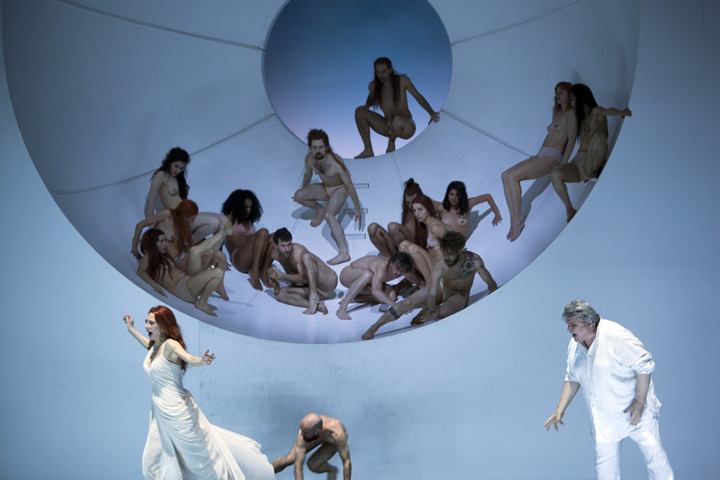

 Need Another Tannhäuser?

As is usually the case with me, when something grabs me - as did the Met's recent Tannhäuser -shouting protests notwithstanding  - I ended up listening to and watching three more Tannhäuseren First, the old Met cast of Cassily, Troyanos, Marton, Weikl,MacCurdy, Levine, next the premiere of the current run, and just now, finished the 2014 Staatsoper Under den Linden, which I'd heard, but never seen. While I was mildly hesitant with the staging after the Venusberg, it not only grew on me, it drew me in a manner more than an evening of traditional Medieval tableau (which I love and am NOT bashing so just STOP). Once I settled in I found the staging, directed by Sasha Waltz, who with Pia Maier Schriever designed it, together with superb costuming by Bernd Skadzig and the tremendous lighting design of  David Fin to be enormously powerful and I was, moved to tears at all the appropriate moments, but also in a few surprising places.  


Waltz, a renowned dancer and choreographer, infused every moment of her Tannhäuser with  dance and movement, at times making it feel almost like a physical manifestation of a moto perpetuo.  The Venusberg crowd (in a variety of costumes once they don actual clothing) wend and work their way into every scene, as observers, pilgrims, Elisabeth's family, and more. Their  gestures in and around the principal characters add depth rather than detract from the telling of this redemption tale. 


Musically, this performance is nearly ideal. As Heinrich/Tannhäuser Peter Seiffert is in his 60's and looks every one of those years, and vocally, at times sounds older than that.  And yet, there is still beauty in the voice when it isn't pushed and remains within a narrow range - mostly the mid-upper. Low notes can growl and higher passages feel pushed and can be both throaty and then switch on a dime, to thin and strain-y. Somehow he makes all of this work for him and the intensity of his Heinrich feels personal. In that vein, the Rome Narrative is rough going, but again, Tannhäuser is a man who's been to hell and back (so to speak) and the interaction between him and Wolfram is great theatre. 


As Wolfram, I honestly can't think of a performance (at least now) as beautifully perfect as nor as emotionally on the nose as As Peter Mattei's turn here. The man is, as ever, a masterful actor and the opening scenes of the third act are, for me, the heart of the opera. His commentary on, then scene with Elisabeth, found me (again) in tears and it all segued into the breathtaking beauty of O du mein holder Abendstern.  Waltz gives Wolfram some odd, dancerly moves to perform and poses to strike, but like elsewhere these do not deter but rather embellish the meaning of the opera's most beautiful aria.  Mattei takes on the dance and the gestures, and, with nothing on stage but Elisabeth's shoes and his shadow, through that gently commanding voice nearly steals the entire evening.


Ann Petersen imbues Elisabeth with angel-like purity, through a voice capable of sounding equal parts girlishly youthful, devout, and passionate.  She is truly ideal as Elisabeth. We don't see her name much here, but I just read an excellent  review of her in a revival of Simon Stone's brilliant Tristan (on video with Nina Stemme and Stuart Skelton), and I'd like to hear more, and how the voice has held up.

While he still sings beautifully, hearing the 2014 René Pape as Landraf is almost jaw dropping. It's a voice lesson in accuracy, conveyance of emotion, a seamless legato line and . . . well, he is simply marvelous. 


The rest of the cast all measure up, but I have to bring up the Venus. Gott in himmel (what an inappropriate phrase for this character!). While I still carry a torch for Troyanos (and Dame Gwyneth) Marina Prudenskaya's Venus is the epitome of schoolboy sexual fantasies.  Mama Mia.  Gorgeous and lithe she also posseses that both cuts and slinks through the siren's call with erotic venom. 

Barenboim leads the Berlin forces - chorus and orchestra in a glowing, dramatically propulsive reading that vibrates even in its quietest passages (i.e., Wolfram's Evening Star) and thrills from first note to last.  I don't know what other platforms it's on, but I do know it's yet another performance keeping me glued to MediciTV.

Labels: , , , , , , , , , ,

Saturday, January 9, 2016

Considering Kundry: Wagner's Most Fascinating Character

Years ago my feathers got ruffled when I read an article arguing Kundry leaves an insignificant impact in Wagner's Parsifal. He stated incorrectly Kundry's only lines are in Act 2 "and even then limited," and suggested it doesn't even matter WHO sings Kundry, and expressed wonder as to why any singer with a major career would take on this unrewarding role.

Of course, Kundry being one of the characters I find the most fascinating in the world of opera, I nearly fell from my chair and responded with my having heard seen and/or heard (live or on recording) Kundry sung by the likes of Maria Callas, Christa Ludwig, Martha Modl, Jessye Norman, Tatiana Troyanos, Angela Denoke, Catherine Malfitano, Waltraut Meier, Renata Scotto, Rita Gorr, Leonie Rysanek, Irene Dalis, Violetta Urmana, Regine Crespin, Linda Watson, Katarina Dalayman, Petra Lang, Eva Randova, Yvonne Minton, Michelle DeYoung, Anne Gjevang, Gillian Knight, Gwyneth Jones. Evidence enough of the role's power to attract a widely diverse roster of celebrated singers.

I can think of few characters more fascinating, more troubling, more perplexing and ultimately more touching, than Wagner's hybrid distillation of several of the Grail myths more interesting females. Wagner seems to have carved this fascinating creature from von Eschenbach, Chretien de Troyes, and God only knows who else. Von Eschenbach describes her as "a woman so talented that she spoke all languages: Latin, Heathen and French . . . familiar with both dialectic and geometry; and she haad also knowledge of astrononomy . . . (her) nickname the sorceress. Her mouth was not restrained for she could say quite enough (and) with it she dampened much joy." That's our gal! In each act Kundry seems not only transformed, but is transforming right before us! What a gift Wagner has given the singer of this role . and what a marvelous challenge!

In Act 1, we're presented with this mysterious, wild woman of dubious character, which in no way prepares us for the seductress we're introduced to in the second act. Even then, we continue to witness her pain and the torture she's endured throughout the entire act.

Many operatic characters have screams written into the score, but, for me, none is more chilling than the moans and screams of Kundry, because we're witnessing the ultimate horror; someone realizing they are still alive, when that is the last thing they want to be.

Kundry's second meeting with Parsifal is one of the most fascinating scenes in all of opera. Beginning with "Parsifal Weile!" what ensues is of such a complex nature that it rattles my mind, this even after spending a lifetime with these characters. Throughout, we see this tortured, conflicted and ultimately cursed woman, helplessly bound to continuing Klingsor's dirty deeds, yet now, touched by this innocent fool, she longs for salvation. When she comes clean revealing her thousand year old secrets, she has in a sense found another victim as we witness Parsifal's own confliction, and at the same time, the beginning of an understanding of his place in the world.

A most wordy guy, Wagner was seldom prone towards repeating a word, a practice more common in operas that precede his own, so when he does so, the effect is of such dramatic significance that we can almost hear the gears turning in his characters’ minds. With fever pitch intensity, we hear Parsifal cry out:

"Amfortas! - -
Die Wunde! - Die Wunde! -
Sie brennt in meinem Herzen.
Oh, Klage! Klage!
Furchtbare Klage!
Aus tiefstem Herzen schreit sie mir auf.
Oh! - Oh! -
Elender!
Jammervollster!
Die Wunde sah ich bluten, -
nun blutet sie in mir! -
Hier - hier!
Nein! Nein! Nicht die Wunde ist es.
Fliesse ihr Blut in Strömen dahin!
Hier! Hier im Herzen der Brand!


All of those repeated words present us with a device that, given the right singer, has the potential to shatter an audience as we witness before our eyes (and ears), the Innocent Fool in a profound epiphany of heartstricken terror, pain, realization, understanding, and most importantly of all, empathy.

Even as a child, I was drawn to, what my mother would call, "sad stories." I still am, and it's no wonder that my favorite operas are (I believe) amongst the saddest stories set to music: Parsifal, Wozzeck, Pelleas et Melisande, Don Carlos . . . (you get the idea). There's an ineffable sadness to Parsifal that may be the cause of why it alienates so many operalovers. That quality of sadness, instead of pretending pain or ugliness away, instead embraces and reveals along with it . . . everything: not merely joy and good times, which we reflect on in happier states, but all. Alles. I’ve spoken with a number of others who like me, easily declare Parsifal to be their favorite (or one of their favorite) operas, and Kundry to be one of their favorite characters. It truly is one of those "love it/hate it" operas."

My favorite line in the entirety of the world of opera is uttered neither by the title character, nor Kundry, but rather Gurnemanz who, during their journey to the Grail Temple responds to Parsifal’s notice having barely trod, yet seems already to have traveled far, utters:

Du siehst, mein Sohn, zum Raum wird hier die Zeit.
(You see, my son, here space becomes time)


For me, this magical bit of metaphysics applies not only to the journey at hand, but to the entirety of the opera itself and the world in which its inhabitants find themselves, most pointedly to Kundry who for nearly a thousand years has restlessly roamed from realm-to-realm.

Though with only one twice repeated word (“Dienen”) to sing in Act 3, I believe Kundry makes as strong an impression in this act - or has the opportunity so to do - as any the other principals. To be effective the singer, even with only four notes, (and, of course, her entrance groan) must be felt from deep down beneath Kundry's skin. While Act II is where she shines vocally, Act III's two scenes are moving for each of the characters of the story(sans Klingsor). The ordinance of humility and Kundry’s baptism perfectly sets the stage for the second Grail Temple scene, with Wagner's sensational Transformation Music. Here transformation is an apt description not only for what we see occurring onstage, (the shifting from outdoor wilderness to indoor temple) but what we ourselves have witnessed of the characters who likewise have themselves transformed. I've always likened this moment to each having passed through the proverbial refiner's fire: The world weary, tortured Kundry finally finds her rest, the once haughty (and mildly intolerant) Gurnemanz is now the epitome of patience and humility, the hopelessly wounded Amfortas is finally healed, the once Innocent Fool has grown with wisdom and assumes his position as the new Grail King. In only his second Grail Temple experience, Parsifal has attained a level of understanding and awareness previously unimaginable, and the final words expressed by the chorus of Knights, children and the other participants in this moving moment of wonder could not be more profound: The redeemer is redeemed.

Many modern audiences (not me) have a problem with many newer productions having Kundry remain a live at the end, but my strongest preference is always to allow her to die. On the opposite end of the stick I know many who despise Wagner's stage direction "Kundry sinks silently to the ground" calling it a Victorian or puritanical "judgment." This train of thought I simply can’t agree with seeing it this way: release is what all Kundry has longed for (far long before we meet her). She's earned it, and Wagner's score, shimmering, shining and filled with the resolution of a long hoped for freedom, provides us with every indication her suffering is now at an end and Kundry is, at long last, finally at peace.

It remains amazing to me how Wagner's music ever matches this bizarre, complex bizzare twist of a tale with equal parts carnality, rage, torment and hope filling it with some of his most beguiling music. Yet, more amazing still is when I'm caught up in it, I often forget I'm even listening to music at all, such is the total effect that I feel almost as though I've entered someone else's reality. Wagner’s final work is so powerful even just writing, thinking, or talking about it can put tears in my eyes and make my blood run just a bit faster.

Enthüllet den Gral! Öffnet den Schrein!

Labels: , , , , , , , , , , ,

Saturday, February 16, 2013

Considering Kundry (Opera's Most Fascinating Character)

Years ago my feathers got ruffled when I read an article arguing Kundry leaves an insignificant impact in Wagner's Parsifal. He stated incorrectly Kundry's only lines are in Act 2 "and even then limited," and suggested it doesn't even matter WHO sings Kundry, and expressed wonder as to why any singer with a major career would take on this unrewarding role.

Of course, Kundry being one of the characters I find the most fascinating in the world of opera, I nearly fell from my chair and responded with my having heard seen and/or heard (live or on recording) Kundry sung by the likes of Maria Callas, Christa Ludwig, Martha Modl, Jessye Norman, Tatiana Troyanos, Angela Denoke, Catherine Malfitano, Waltraut Meier, Renata Scotto, Rita Gorr, Leonie Rysanek, Irene Dalis, Violetta Urmana, Regine Crespin, Linda Watson, Katarina Dalayman, Petra Lang, Eva Randova, Yvonne Minton, Michelle DeYoung, Anne Gjevang, Gillian Knight, Gwyneth Jones. Evidence enough of the role's power to attract a widely diverse roster of celebrated singers.

I can think of few characters more fascinating, more troubling, more perplexing and ultimately more touching, than Wagner's hybrid distillation of several of the Grail myths more interesting females. Wagner seems to have carved this fascinating creature from von Eschenbach, Chretien de Troyes, and God only knows who else. Von Eschenbach describes her as "a woman so talented that she spoke all languages: Latin, Heathen and French . . . familiar with both dialectic and geometry; and she haad also knowledge of astrononomy . . . (her) nickname the sorceress. Her mouth was not restrained for she could say quite enough (and) with it she dampened much joy." That's our gal! In each act Kundry seems not only transformed, but is transforming right before us! What a gift Wagner has given the singer of this role . and what a marvelous challenge!

In Act 1, we're presented with this mysterious, wild woman of dubious character, which in no way prepares us for the seductress we're introduced to in the second act. Even then, we continue to witness her pain and the torture she's endured throughout the entire act.

Many operatic characters have screams written into the score, but, for me, none is more chilling than the moans and screams of Kundry, because we're witnessing the ultimate horror; someone realizing they are still alive, when that is the last thing they want to be.

Kundry's second meeting with Parsifal is one of the most fascinating scenes in all of opera. Beginning with "Parsifal Weile!" what ensues is of such a complex nature that it rattles my mind, this even after spending a lifetime with these characters. Throughout, we see this tortured, conflicted and ultimately cursed woman, helplessly bound to continuing Klingsor's dirty deeds, yet now, touched by this innocent fool, she longs for salvation. When she comes clean revealing her thousand year old secrets, she has in a sense found another victim as we witness Parsifal's own confliction, and at the same time, the beginning of an understanding of his place in the world.

A most wordy guy, Wagner was seldom prone towards repeating a word, a practice more common in operas that precede his own, so when he does so, the effect is of such dramatic significance that we can almost hear the gears turning in his characters’ minds. With fever pitch intensity, we hear Parsifal cry out:

"Amfortas! - -
Die Wunde! - Die Wunde! -
Sie brennt in meinem Herzen.
Oh, Klage! Klage!
Furchtbare Klage!
Aus tiefstem Herzen schreit sie mir auf.
Oh! - Oh! -
Elender!
Jammervollster!
Die Wunde sah ich bluten, -
nun blutet sie in mir! -
Hier - hier!
Nein! Nein! Nicht die Wunde ist es.
Fliesse ihr Blut in Strömen dahin!
Hier! Hier im Herzen der Brand!


All of those repeated words present us with a device that, given the right singer, has the potential to shatter an audience as we witness before our eyes (and ears), the Innocent Fool in a profound epiphany of heartstricken terror, pain, realization, understanding, and most importantly of all, empathy.

Even as a child, I was drawn to, what my mother would call, "sad stories." I still am, and it's no wonder that my favorite operas are (I believe) amongst the saddest stories set to music: Parsifal, Wozzeck, Pelleas et Melisande, Don Carlos . . . (you get the idea). There's an ineffable sadness to Parsifal that may be the cause of why it alienates so many operalovers. That quality of sadness, instead of pretending pain or ugliness away, instead embraces and reveals along with it . . . everything: not merely joy and good times, which we reflect on in happier states, but all. Alles. I’ve spoken with a number of others who like me, easily declare Parsifal to be their favorite (or one of their favorite) operas, and Kundry to be one of their favorite characters. It truly is one of those "love it/hate it" operas."

My favorite line in the entirety of the world of opera is uttered neither by the title character, nor Kundry, but rather Gurnemanz who, during their journey to the Grail Temple responds to Parsifal’s notice having barely trod, yet seems already to have traveled far, utters:

Du siehst, mein Sohn, zum Raum wird hier die Zeit.
(You see, my son, here space becomes time)


For me, this magical bit of metaphysics applies not only to the journey at hand, but to the entirety of the opera itself and the world in which its inhabitants find themselves, most pointedly to Kundry who for nearly a thousand years has restlessly roamed from realm-to-realm.

Though with only one twice repeated word (“Dienen”) to sing in Act 3, I believe Kundry makes as strong an impression in this act - or has the opportunity so to do - as any the other principals. To be effective the singer, even with only four notes, (and, of course, her entrance groan) must be felt from deep down beneath Kundry's skin. While Act II is where she shines vocally, Act III's two scenes are moving for each of the characters of the story(sans Klingsor). The ordinance of humility and Kundry’s baptism perfectly sets the stage for the second Grail Temple scene, with Wagner's sensational Transformation Music. Here transformation is an apt description not only for what we see occurring onstage, (the shifting from outdoor wilderness to indoor temple) but what we ourselves have witnessed of the characters who likewise have themselves transformed. I've always likened this moment to each having passed through the proverbial refiner's fire: The world weary, tortured Kundry finally finds her rest, the once haughty (and mildly intolerant) Gurnemanz is now the epitome of patience and humility, the hopelessly wounded Amfortas is finally healed, the once Innocent Fool has grown with wisdom and assumes his position as the new Grail King. In only his second Grail Temple experience, Parsifal has attained a level of understanding and awareness previously unimaginable, and the final words expressed by the chorus of Knights, children and the other participants in this moving moment of wonder could not be more profound: The redeemer is redeemed.

Many modern audiences (not me) have a problem with many newer productions having Kundry remain a live at the end, but my strongest preference is always to allow her to die. On the opposite end of the stick I know many who despise Wagner's stage direction "Kundry sinks silently to the ground" calling it a Victorian or puritanical "judgment." This train of thought I simply can’t agree with seeing it this way: release is what all Kundry has longed for (far long before we meet her). She's earned it, and Wagner's score, shimmering, shining and filled with the resolution of a long hoped for freedom, provides us with every indication her suffering is now at an end and Kundry is, at long last, finally at peace.

It remains amazing to me how Wagner's music ever matches this bizarre, complex bizzare twist of a tale with equal parts carnality, rage, torment and hope filling it with some of his most beguiling music. Yet, more amazing still is when I'm caught up in it, I often forget I'm even listening to music at all, such is the total effect that I feel almost as though I've entered someone else's reality. Wagner’s final work is so powerful even just writing, thinking, or talking about it can put tears in my eyes and make my blood run just a bit faster.

Enthüllet den Gral! Öffnet den Schrein!

Labels: , , , , , , , , , , , , , , , ,

Monday, July 26, 2010

Jessye Norman: Roots - Album of the Year!


In her new two disc album, Jessye Norman has given us an a gift that is as sure to infuriate as many as it delights. To my mind, this is exactly as it should be. The live album (recorded before an audience at the Berlin Symphonie) is a musical journey, in its way a theatrical work presenting Norman's life as a proud, African American woman of song.

It opens with a rhythmic overture of African drums serving as a sort of "call to order" which doesn't so much end as it does flow into her first number, an a capella rendition of His eye is on the sparrow. Slowly an instrument, a drone, is heard as we move into the spiritual I want two wings as the instruments progress with the singer directly, marvelously, into I couldn't hear nobody pray with the singer and her musicians increasing in intensity through this steady stream of sound. The effect not unlike that of walking down the darkest of halls or paths, lost, blindly, eyes adjusting slowly to the darkness, moving toward a single shaft of light, distant, faint, that, with each step increases in warmth and brilliance. It is a tremendous.

Norman uses her instrument as the best jazz or classical musicians do, with a sound that is usually immediately identifiable, but also willing to do everything and anything within its means to achieve an artistic purpose. Like the great Betty Carter, she is not beyond bending melodies and pitch, lightening the voice to a thin, almost childlike sound, then suddenly opening up and bathing the room in a lush warmth which you never want to end. Some, particularly strictly classical audiences, found this disturbing, and early reviews denounced the album as "painful," "disgusting," and "shameless." Everyone of those critics may be right in not liking what she's done here, but all of them are dead wrong and have failed to understand what this remarkable artist has done here.

The first song to take us there is Duke Ellington's Heaven, where Norman, begins treating it as a jazz standard, playing with the piano, swooping up and down and coloring the notes and text generously with liberties. But, about midway through, through scatting, nonsense syllables, trilled "rs" and drum-like sounds becomes not only the singer, but a player in her own band. The effect brings a terrific sense of fun with Norman covering several octaves both easily and breezily. Only in the bizarre world of music can this be followed - almost seamlessly, by a reprise of Bernstein's Somewhere from West Side Story. Norman's is about as inauthentic a version to Broadway as is possible to imagine, but she wears it earnestly and this little version does exactly what she expected it would do - have the audience hoopin' and hollerin' as she rolls, plows, then busts into My Baby Just Cares for Me." It's almost too much to take in, and I looked in vain for a place to take a breath before coming to the realization: I didn't even want to.

Norman is unrecognizable in a number of the pieces (including the aforementioned "My baby...") but every syllable is uttered with care, precision, just as every note is a wild, swinging celebration of a life's joy, as she calls out her player's names before a solo riff in classic, great jazz lady style.

While Lena Horne's version of Stormy Weather has always been my touchstone for that particular song, Norman takes a new approach, a jazz-infused one, and at some points almost introduces just a hint of Billy Holiday. It's a slower, more sensuous take than anyone is probably used to, but, with her operatic inclinations and unusual instincts infuses the song with a weight that feels natural as it builds towards the final reprise. Thrilling is not an understatement.

Moving on, what this lady does with Weill's Mack the Knife is nothing but sheer brilliance. Norman almost returns the piece to the opera house, giving the opening narrative auf Deutsch, against the small tattoo of a snare drum as she turns the bloody, violent text into a chilling narrative of devilish delight. Each verse grows in intensity, her voice tinged with a bit of violence until the audience erupts in extended cheers as the song is still wrapping up. Oh, Jessye!

It's almost impossible to review this without wanting to comment on every single number (as I've done up until now). Suffice it to say, what Norman does with nearly every song, is claim it as her own. She turns whatever you may have known or felt about a song completely on its ear. Even something as innocuous as All the pretty horses becomes in her hands, something else altogether - a haunting dreamscape with enough colors to convince this listener he has synesthesia.

Then, there's the throaty brutality of God's Gonna Cut You Down which closes the first half, with a dark rawness that gives Johnny Cash a run for his money. When she ends the song it is with a final pronouncement announcing death and it is blood chilling. BUT, Miss Norman isn't done yet, oh, no! She directs, or more appropriately, admonishes her band to "Take me off" as, mic still in hand, she walks off singing "Go tell . . . go tell that back biter, Good God a'mighty's gonna cut you down!" The audience cannot contain itself again and goes absolutely wild, erupting into rhythmic applause and cheering the ovation fierce and almost unending.

Norman opens the second half with Les Chemins de L'amour in a throaty baritone, that under different circumstances might be deemed a bit indulgent, but here . . . it works. There are countless brilliant touches that abound throughout the remainder of the show, such as La Marseillaise morphing into The Star Spangled Banner which serves as the introduction to J'ai Deux Amours.

Jessye closes out her musical journey with Ellington, Bizet, Monk and more before finally ending this breathless journey with When the Saints Go Marching In introduced by a bluesy, twang that propels both the audience and Jessye into a fiesty mood that finishes the concert in as bawdy, loud and rip roarin' a manner that probably hasn't been heard in a house since Judy sang one night at Carnegie Hall.

It is nearly beyond comprehension (but only "nearly) that this is the same woman who for years has transfixed me as Cassandre, terrified me as Judith, thrilled me as Ariadne, made my heart soar with Sieglindes and it only makes this crazy cake all the tastier.

This is as joyous a celebration of a singer as I have ever experienced and I only hope the album sells well and shows those who might not already know, what a force of nature, what an artist and remarkable human being is this Jessye Norman. Few artists I can think of now or of the past, would, after a legendary opera and concert career has ended in classical music, so painstakingly and intricately craft a show of this immediacy and complexity. Now take the show on the road, girl!

Labels: , , , , , , , , ,

Thursday, April 1, 2010

Domingo Becomes The Fat Man


UPSS International/Arts Desk

Domingo Becomes "The Fat Man"
UPSS International/Arts Desk

The latest new role for supertenor Placido Domingo will be playing another supertenor: Luciano Pavarotti. "I'm excited for this opportunity to portray my friend and . . . we can admit it now . . . sometimes rival, the wonderful Luciano Pavarotti," Domingo told a small clutch of television and news reporters gathered outside of the Deutsche Oper Berlin, the company which has commissioned the new opera scheduled to open its 2011-12 season.

Titled "The Fat Man," the new opera is being composed by controversial German composer, Beat Furrer, whose previous opera "Begehren" was an enormous artistic success at the 2003 Festival in Graz where its enormous staging required it to be produced in a converted factory space large enough for its installation.

"Begehren was a controversial retelling of the Orfeo and Euridice myth," explained Furrer, "very static musical language with very little stage movement and with the enormous lighted floors that rose and fell . . . . they were as important as the music. But with my new opera of the Pavarotti things will be different. I will enjoy making the Italian music sounds - or my idea of this sound and working with a man - Domingo - who knew the Pavarotti."

As for portraying his former colleague, Domingo seems to be up to the challenge and approaching it with great humor, "I am a Spaniard singing in German about the life of an Italian opera singer . . . the world of opera is crazy like that! But I'm used to singing in French about Russian Czars and in Italian about French kings and poets and in German about Spanish knights," laughed the still handsome and youthful 69 year old. "So, why not now sing in German about an Italian tenor, right?"

As for what follows "The Fat Man," Domingo laughed again, hinting his portrayal of Pavarotti may be his final operatic role, "After singing 200 different roles, The King of the High C's is a nice exit to the stage, yes?

Maybe.

Labels: , , , , , , , , ,