Friday, January 30, 2026

Amazing "Amazing Adventures of Kavalier & Clay"


This past Saturday, I along with countless others braved the worst winter storm in years to attend the cinema screening of Mason Bates' and Gene Scheer's new opera, The Amazing Adventures of Kavalier & Clay.

I had thoroughly enjoyed the opera's opening night broadcast enormously but, like everyone else I knew, furious at the Met for not scheduling this important new work for an HD treatment. Fortunately for the Met, all seven performances were sold out with tickets were as rare as the proverbial hen's teeth. Seizing the moment, the Met scurried to get cameras in  to record the final performances into the seamlessly edited HD recording  we saw Saturday. They also (wisely) scheduled four more performances during the winter break. Thi is good.

With the daunting task of crafting a libretto for an "average length" opera from Michael Chabon's 650 page Pulitzer Prize winning novel, Mr. Scheer, while commiting some gender re-assignments of several roles, did a remarkable job and delivered a text presenting more than enough of the duo's adventures to project and evoke this sprawling tale of war, comic books, fascism, adventure, sacrifice, freedom, love and - most beautifully - friendship. Everything you need to know is in there.


Armed with this, Mr. Bates' created a wide sprawling score, infused with his now familiar style combining traditional orchestrations with electric, synthesized sound, and the result feels just right.  While I admire and champion many contemporary composers, Bates has been on my radar for 20 years, and I can't think of a composer better equipped to tell this kind of tale. 

(Side note: Many critics and audiences have complained about Bates use of electronics, and how they "don't belong" in "classical music."  One may not like employment of synthesizers, electric guitars, etc., but the fact is electronics have been used in classical music for more than a century, employed by countless composers including Edgar Varèse, Gian Carlo Menotti, Olivier Messiaen, Kaija Saariaho, Philip Glass, John Adams .  . . so precedent has been more than just merely "set.") 

Bates refers to this synthesis of traditional and electronic sound, as symphonic electronica.  As one who has been a fan of (and involved in) the Noise Music scene, I was heartened to hear the incorporation of these strange sounds (along with all the foley work supplied for the radio show-within-an-opera) incorporated into a work, with its myriad style motifs propelling the story through a gloriously unique hybrid of operatic theatre. While I prefer my opera live and in the house, it was especially fun experiencing Kavalier & Clay at a cineplex - bringing world of the movies into the mix. Yes, some have complained specifically about that, but those people are always yammering and whining about something ain't they? (Rhetorical question, but the answer is "yes.")


Bates' style motifs (my name for whatever it may be called)  work brilliantly, switching between elements of jazz, swing, avante garde (the symphony electronica), folksong, Hip Hop rhythms and, when appropriate, grand olde Hollywood epic soundtrack magic .  While Bates is not a minimalist, he comfortably employs the brightness and quicksilver sound of that movement seamlessly into the fabric of his score. Influenced by what has come before him, With nods to (at least to my ears) Ravel, Weill, Bernstein, Wagner, Strauss, Prokofiev, and others Bates manages to create his own original sound world and it is a beautiful, haunting and always captivating one.

Eschewing the modern practice (well from Wagner onward) of adhering to vocal parlando, Bates has created arias, duets, ensembles, choruses that feel like classic standard operatic set pieces - and I love that nod to past traditions.  


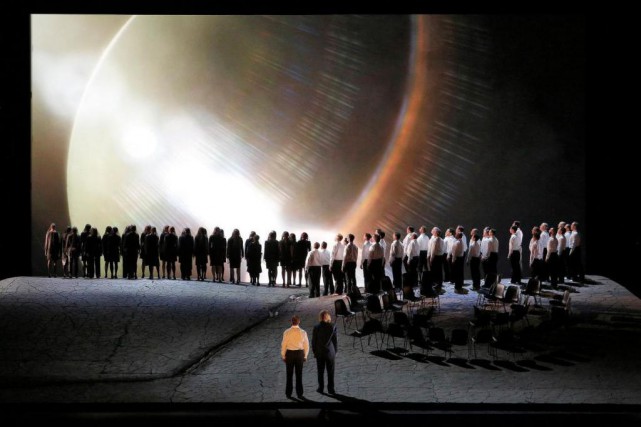
The mindblowing production design from 59 Studio, easily rivals the most impressive physical productions the Met has put upon that great stage. Curtains, dissolves, projections, sets - all move the story - and its audience - from 1939 Prague through Brooklyn, Manhattan's gallery scene, office buildings, skyscrapers, a gay bar, warehouses, the Western frontline of the war, and, just as importantly, the fantasy world of comic books. Bartlett Sher's direction here with a perfect, if not name-recognizable cast, is perhaps the best work I've seen from him to date, and it showed in the way he paced the story's action, as well as the work with that remarkable cast. 

With his warm, resonant baritone, endearingly accented English, and physical presence, Andrzej Filónczyk strikes all the right notes as Joe Kavalier. Bringing the immigrant's sense of wide-eyed wonder, fueled by hopes and dreams of a better life in America. this part of the story felt especially prescient given what's happening to immigrants - and citizens - in these United States of America. We watch the rise and fall of Joe and seeing those dreams crushed through the rise of World War II's fascism, and it is devastating. As an actor, Filónczyk pulls us along through that heartbreak and redemption. It is a tremendous performance. 


The other title role was in equally excellent hands as tenor Miles Mykkanen's displayed all of the savvy, wit, ambition, along wit h the scarred insecurity and fear as the leg braced Sam with a clear, soaring tenor. It was impossible not to love Sam, and everybody did.

Sun-Ly Pierce (a singer I fell in love with in Des Moines Cunning Little Vixen) is Rosa who is very much  the anchor"and conscience of the show. Possessing a beautifully gleaming mezzo with a secure top, Ms. Pierce stole every heart. Her first act aria, Open Your Eyes reveals Rosa's earnest desire to rescue the child victims of the war. It was also the first sign I knew that I'd be in tears at what was yet to come. 


In some fun duel-casting, comic book hero The Escapist was portrayed by by a non-singing dancer, Jerimy Rivera, and "portrayed" by actor, Tracy Bacon who was beautifully sung by baritone Edward Nelson. Nelson, tall, blonde and handsome, Nelson was the epitome of the superhero-type, abundantly confident, openly gay, not quite garrulous but close, he is the opposite of closeted, fearful Sam, which makes their relationship both difficult and touching. The first kiss is not what one expects and was one - of many - moments that felt positively . . . well, cinematic.

As is often the case whenever he's cast, Patrick Carfizzi - in the brilliantly written character role of Sheldon Anapol - nearly steals every scene he's in. As the kindhearted, benevolent boss at Empire Novelty Company, Incorporated. Mr. Carfizzi never fails to impress and get to the heart of every role I've been lucky to see him in - and there have been plenty!

One of the most crucial roles in Kavalier & Clay, is Joe's 14 year old sister, Sarah. Not a big singing role, but whenever she is onstage - singing or not - she is at the heart of this epic story. Soprano Lauren Snouffer was not only believable as the braided teenager, she made me wish Sarah had more to sing.

How moving it was for me to see one of my all-time-favorite singers, Richard Croft, along with Ellie Dehn as Joseph's parents, Solomon and Estelle. Both were enormously moving, and I couldn't help but recall them working together nearly twenty years ago in Satyagraha (can it have been that long ago?)


The balance of the cast showed the careful attention the Met can lavish in bringing a new, challenging work to life.  

 Yannick Nézet-Séguin seemed to be charged by every element, presenting a reading that would be hard pressed to be improved upon, shaping and coordinating the myriad elements of orchestration, sound design, electronics, percussion (right down to the clicking of typewriter keys). I feel (and maybe am alone here) that he shines in this kind of material more than some "traditional" works. Bates score deserved this kind of treatment. 

For me, this is what contemporary opera can be: a great literary source inspiring a poet and then a composer, designers, directors, singers and players to present something that can touch thousands of people with its beauty.

One of the more fascinating things I've taken in about this opera is that audiences (generally) have been so powerfully moved both by this opera and its message, cheering, standing ovations (don't start on me with that) while it seems the majority of critics have either trashed it, or only given mild praise.  

I remember being glued to the premiere broadcast and, even without its visual element - being stunned into silence and moved to tears - as was the entire audience at my cineplex this past Saturday. It made the first review - Joshua Barone for The NY TImes - come as a bit of a shock damning it as "superficial."  I read how Scheer's libretto is cliché-ridden with no "meaning or purpose."  And while he positively cites the drawing projections, he complains about other design elements (e.g., the Clay's apartment). 

He damns Bates' score  as "uninspired . . . obvious . . . harmless . . . nondescript . . . forgettable" bringing up these were the same problems he had with Fire Shut Up In My Bones and Grounded - operas with "toothless scores that ask so l itle of their audiences."  His final paragraph beginning "That's not what opera is," is the final blow.  But he was not alone - the majority of "professional" reviews seemed to go out of their way - in best and most imaginative "I'm going to write a bad review with fun words." Some of the attacks were beyond laughable. One, complaining about the death of one of the characters and how it did not feel "tragic enough."  Or the number of reviews varying the theme of "the melodies are so banal you wonder why they bothered." And on and on they go.  How clever. they all are. 


But none of that matters to me - I - and almost everyone I know - loved the experience, and I've friends who were so moved by this - they went back to Wednesday's encore performance.  I'm thrilled that, despite any bad press - the Met saw the wisdom of bringing the production back during the break for four more performances beginning February 17 that, while not yet sold out, are already selling well.  I wish everyone in the company - and all future audiences - the very best.  I do hope that more positive word-of-mouth reviews will factor in more than the harsh criticisms of those who felt it a waste of time, money, and talent. 

As I end this, I'm reliving the opera's emotionally transcendant final scene, I can't help but think of another opera that affects me with its bittersweet but beautiful message of hope in this often confusing and sometimes dark world  Leoš Janáček's The Cunning Little Vixen.  That's not bad company to keep. 

Viva Kavalier & Clay!

Labels: , , , , , , , , ,

Thursday, June 5, 2025

From A-to-Z: Andrey Zhilikhovsky Has It All

Something happened during the Met's HD  of Il Barbiere di Siviglia I didn't expect. As thrilled as I was with our Rosina and "Lindoro" both given stunning performancs by  Aigul Akhmetshina, and debutant, Jack Swanson it was Andrey Zhilikhovsky who completely captivated me with his wily barber, Figaro. Yes, it is a beautiful voice, but it wasn't that alone - it was the total inhabiting of a Figaro the likes of which I've rarely seen (and there have been some truly great ones in the past).


Zhilikhovsky brought a from the streets/pulled up by the bootstraps"  edgey quality to Figaro that I've neither seen, nor frankly even thought of before. It added something that made Figaro even more likeable - if that's possible. Zhilikhovsky's Figaro was a savvy opportunist, tuned in to absolutely everything and everyone around him. I loved watching him his rubbery mask of a face (and a handsome face at that) as within the literal blink of an eye, he'd switch gears from near disbelief to joy, frustration, on-the-spot "fixes" or a self-admiration of his place as the central cog in a very big machine. It was one of those performances that linger on in memory long after the curtain drops. Much longer. 

The conducting, the cast, - everything about it made this about as sparkling and believable a Barbiere as I've seen in decades. Bravo a tutti! I was pleased to see so many glowing reports and reviews of the show and questions of "who is this guy?" I thought I'd share some info (perhaps redundantly to some) about our Man from Moldova

So, while basking in the glow of Barbiere, I kept thinking to myself that Zhilikhovsky looked and sounded mighty familiar, but couldn't quite place how, or where from. A little digging through my own files and . . . well, it's no bloody wonder: I've seen him in a number of streams, i.e.., London's Royal Opera La Boheme, where his Marcello was one of the two best things in the show (Ailyn Perez' Mimi being the other, with - for ME - superstar Juan Diego Florez, a bit bleaty and dry voiced as Rodolfo); and as the Grown Up Almaviva in Rome's sparkling Graham Vick  staging of La Nozze di Figaro.  There were also more than a few other things that he stood out in.  

Of those,, it was his Prince Andrei in Tcherniakov's electrifying staging of Prokofiev's War and Peace for the Bayerische Staatsoper a couple of years ago that had me raving about the man and his total commitment to the art. It is a little embarrassing to admit I'd forgotten about him since those performances, but . . . maybe it's the name (what's in a name?)  or something else  that blocked my memory. Who knows.  That said, I can, however, guarantee this: having just watched scenes from the Prokofiev, and along with his Figaro, I shan't be forgetting him again. That's a promise.

As any production of Prokofiev's masterpiece is in and of itself a major event, critics from around the globe descened on Munich and to a one uniformly praised the Bayerische production (even the NY Times wrote a rave review as part of a lengthy piece - of course  it was not by Herr Zach Woolfe surprise, surprise) all of them singling out Zhilikhovsky's Prince.

The highest praise . . . has to be reserved for the central singing performances of Moldovan Andrei Zhilikhovsky as Prince Andrei Bolkonsky, Ukrainian Olga Kulchynska as Natasha Rostova, and Armenian Arsen Soghomonyan as Count Pierre Besukhov, all never anything less than impressive.  (Opera Journal - London, March 2023)

The baton is raised, the flutes begin to sing of spring, a man stands up, takes off his scarf, his parka and also begins to sing of spring, and of his love for a girl. It is Prince Andrej Bolkonski, wonderfully sung and played by Andrei Zhilikovsky. He is in love with Natascha Rostowa, played by Olga Kulchynska,and together they are magnificent . . . Andrei is mortally wounded, Natascha witnesses his agony, and they are beautiful and tragic as they say goodbye in their final duet. (L'Ape Musicale - Italy, March 2023)

The baritone's life story reads like a novel of conquering self through tough times, and a spiritedness of never giving in.  Growing up in poverty, and having to hitchhike to and from his lessons for hours each week, Zhilikhovsky studied music early on, continuing to study in college with a concentration not in singing but rather but choral conducting. Whilst in college in Moldova the voice appeared and people took notice. Completing his conducting studies, he was quickly offered an opportunity to study in Russia at the Rimsky-Korsakov Conservatory in St. Petersburg and things exploded from there with a five year engagement at the Bolshoi and then all over the globe throughout Europe, the U.K., the U.S. . . . everywhere.

I get made fun of (and don't mind one bit) that I'm always plastering the internet with photos of operas and singers, but it is my way - along with hearing these singers - to remember the works and artists I fell in love with. I don't always have time to look for and dig up a recording - but an instant 2 second glance at a photo can - for me - conjure up the memory of an entire performance and why it was special. So, to that end I offer in this post a gallery of  Zhilikhovsky in a variety of roles both alone, with other singers and directors, in case anyone else wants to see 'em.  You know you do. 

I will be actively on the lookout now for lots more from Our Man From Moldova.

(Click on images to enlarge)


Labels: , , , , , , ,

Saturday, October 26, 2024

Met Soars with Grounded


I'm in a minority amongst my opera friends. I like and love a lot of works, especially newer operas, that routinely get bad press in the opera groups, criticized by the press.   I often call my own t aste into question, but the older I get the more I realize, I really don't care what anybody else thinks.  It's fun to read their opinions, their criticisms, and (less frequently) their praise, but the bottom line always has to be: what did the piece do for me? Did it touch and move me?  I never - well hardly ever - approach anything with any expectation. Of course I WANT it to be a successful evening, but other than that hope, I go in blind. It's why I'm rarely disappointed and probably why I have more fun at the opera than anyone I know, even if, owing to my present circumstances, the bulk of that enjoyment comes from experiencing those things online, a practice many find abhorrent, but you take what you can get. 

SO, after that preamble, I spent World Opera Day doing something I love best of all: experiencing a new opera:  Jeanine Tesori and George Brant's Grounded.  I listened on radio to the prima, but there were distractions (lots of them) and while I very much liked what I heard and praised the broadcast, I had no idea of the full impact the work would make by seeing it and listening to the score with a dedicated pair of ears.  I was simply blown away by the thing.  Dramatically, musically, theatrically, from the opening moment to the final, chilling silence (destroyed, as usual, by an over enthusiastic Met audience who can't wait to break a  half second of silence with their screaming), I was riveted.

The staging, which I'd read was "bland" . . . "safe" . . . "uninspired," etc.  I found to be none of those things. Kind of electrifying and cinematic actually.  The flow of scenes from one to the next, the use of a multi-tiered set, the projections, the lighting, the excellent  choreographed chorus . . . all of it worked for me.

None of that, however, guarantees a good show, so Tesori's and Brant's work, while given an excellent production - had to show it was worthy of it.  It was.  Tesori's theatrical background shows, and while "too Broadway" was leveled at it by more than one critic, I found very little "Broadway" about it - in the same sense Menotti, Gershwin or Weill wrote music dramas for the non-traditional operatic venues.  Tesori is a gifted composer and her melodies worm their way into the heart, perhaps none so much as the character of Eric's little wordless hum that repeats itself through the opera. Brant's powerful text in the word settings given them by Tesori were better than one often encounters in English language operas. Everything was weighted properly, naturally generally, yet she is unafraid (fearless really) in also allowing words to be elongated for dramatic effect.

As the title character, Jess - we were treated to a never less than stunning achievement from a voice I was mostly unfamiliar with, but who turned me into an instant fanboy: mezzo soprano, Emily D'Angelo. D'Angelo combines a lean almost muscular sound with a gorgeous warmth and refulgence that is unusual.  At times I felt the ghosts of Lorraine Hunt Lieberson and Tatiana Troyanos - and I can't pay a higher compliment than that to any young singer.  D'Angelo, as it happens to turn out, is a formidable, strong actor as well, which the role of Jess not only requires - it demands. The beauty of HD is that we see the faces so well, and every emotion, even the thoughts of Jess, registered on the mezzo's face in a performance that, was Tony Award calibre.

As husband and father of Sam, Ben Bliss turned in one of his best performances to date .  Quite simply Bliss went from being the greatest Don Ottavio I've heard or seen into a loving  practical cowboy card dealer, and one of the sweetest, nicest characters to be written into an opera in . . . . I can't remember when. His aforementioned "tune" and his aria, as well as his scenes with Jess and Sam, the lovely Lucy LoBue, were a tonic, and the perfect counterpoint to the intensity of the war games at hand.

Another discovery for me was the young baritone, Kyle Miller, who, as the Sensor quite frankly, startled the life out of me. A gorgeous baritone sound and terrific comedic timing and acting chops poured out of what Jess described as a "12 year old," added punch to their scenes together.

I've always loved Greer Grimsley, and 30 years since his Met debut (what?) the voice seems to get growlier by the season, and sometimes I must admit I wish I could be hearing someone else in some of his roles, but  his Commander here seemed tailor made for his current voice and, while not a large role, it's an important one and it worked.  Perfectly.

Ellie Dehn as Jess' conscience, Also Jess, worked, brilliantly, even if at first I thought it was just a device to give notes to the central character that were too high for a mezzo.  My bad. This was not overused and actually intensified the "real" Jess' emotions, freeing her up even for other dramatic purposes.

Yannick Nézet-Séguin (who I thought, for a moment was Roberto Alagna when he entered the pit) really did marvelous things with Tesori's score, keeping everything flowing and tightly reigned in, never letting a moment sag. Tesori's orchestration is a huge, gleaming, lyrical thing of beauty, and her sense of groupings for effect was as masterful as any of the greats.  

I loved the dramatic structure of Grounded . . . it felt real at every turn, and it was,a beautiful thing to see something as ugly as war, drone attacks measured out with reason and emotion. Some of the criticisms I read had to do with making it a "gender" thing, how if the role were written for a man it would've been a different and probably less sensitive opera. Why? Stereotype much?  

Throughout the FB Opera groups I've read: "It was horrible"  . . . "An atrocity" ".Death of opera" . . . "what a disgrace" . . . "All the talents of singers, directors, staging crew, lighting. . .wasted on dreary, ugly, silly stuff . . . tragic. . . . laughable . . . Somebody needs to take a giant step back and consider what opera is supposed to do and be" . . . "they opened the season with this crap?" " How the mighty have fallen" . . .

One lady in Met Opera in HD's page was so angered by my opening night positive remarks, she BANNED me from seeing not only her remarks but ANY remarks in her thread (I didn't know that kind of censorship was possible on FB).

I didn't mean to end negatively - but wanted to relate my entire experience with this new work, so that included the bad with the good. 

I disagree with all of the naysayers, and while new works don't often get revived - or even second performances - I hope with some of the operas we've seen lately, and particularly Grounded- that trend comes to an end. If not, there's always La Boheme.

Labels: , , , , , , , , , ,

Tuesday, August 20, 2019

Porgy and Bess: ENO and The Met

Here are a few shots of the upcoming production of Porgy and Bess which originated in London and will be coming soon to the Met.


Labels: , , , ,

Saturday, November 24, 2018

Luciano and Renata's Perfect Boheme


I've had a lot of time over this Thanksgiving holiday being at home and staying warm. A constant friend has been the TV. While attention has been given to Netflix, with "Get Shorty" and Season 3 of "Dare Devil" vying to be my favorite show, a lot of time has also been spent on the worth-every-penny "Met on Demand." In the past few days I've watched "Wagner's Dream"; "The Opera House"; "Giulio Cesare"; "Die Walkure"; and a few others, but nothing surprised me - or lite me up nearly as much - as a production I'd not watched since its re-release a decade or so ago - and an opera I often steer clear out of sheer over familiarity. The opera? "La Boheme." The stars? Luciano Pavarotti and Renata Scotto. While the singing, naturally, goes straight to the heart of the matter, there was something about the entire cast's performance, but notably our Mimi and Rodolfo.

While Scotto famously stated that after seeing herself in this production, she immediately decided she had to lose weight to become more effective actress, I don't think it's true. She can't by any stretch be considered "fat" and her Mimi could not possibly be more dramatic and heartbreaking without crossing over into caricature. Her gestures are large, born of a verismo-esque style that she brought to the many non-verismo operas, which had mostly been her bread and butter. Those larger than life gestures are not in the least unwelcomehere as the diminutive diva accesses the broad scope of emotions Puccini gives his Mimi; there is shyness, there is strength of purpose, there is a little pride, a little anger, a little self pity and a million other things all beating in this girl's enormous heart. Her Act 4 "dumb show" during the interlude, after the other Bohemians leave and Rodolfo's back is turned to her - a noble, arduous attempt to rise from her death bed fails as the music swells with life and, caught in the blankets she is held, earthbound, is a lesson in physical acting that took my breath away. At almost every turn, Scotto is not a star, but a true member of an ensemble, something that seems to happen more these days, but too rarely seen back then. But, she also knows when to turn it on showing us why death scenes were something of a Scotto specialty.

Also part of an ensemble was the Rodolfo of Luciano Pavarotti. Considerably svelter than before (and then he would be shortly thereafter) there is something of the natural comedian about this bear-like tenor and he exhibits a physical grace and energy that was, and would again becom, rare for him. His rush to pick up a dropped item from the floor, his bending to the floor with Mimi, his "dash" across the stage, the faux balletic poses he strikes for the Act Four dance sequence, it all feels natural creating a Rodolfo that is sunnier and less "I'm just a dope in love" than we sometimes saw from him later. And then there's the singing. Ave Maria, the sounds made are the Rodolfo of one's dreams and together, he and Little Renata truly do make music.


The rest of the cast was, more or less, also up to the task, but there was no mistaking whose show this was, even while being about them all, though I'd single out Alan Monk's Schaunard for some touching acting, and being the sort of "framer"of the death scene, and wonderfully captured by the cameras.

Fabrizio Melano directs the cast in this uber-traditional production (on loan from Lyric Opera of Chicago) with no nonsense, and Levine and the Met forces were, even then, in tremendous form and in service of Puccini.

The excitement extends, as it always should, through the curtain calls and cheers, and while everyone milks it for all their worth, no one holds a candle to La Scotto. She enters to a roar from the house and immediately makes a deep curtsy then moves, almost ninja-like toward the stage apron to retrieve a small bouquet, and in so doing kneels, than sits there like she was Judy Garland. Naturally, the ovation intensifies and so does Scotto's beaming, beatific smile. Another lesson from the old days.


Oddly, I think a lot of today's opera's powers-that-be would find this old production with youngish, though still middle-aged singers, to be the antithesis of what they feel opera should be about. I'd disagree and say, at least in this instance, it is everything opera should and can be about.

Labels: , , , , , , ,

Wednesday, February 28, 2018

A Met Parsifal to Remember


I was fortunate to be able to attend the final performance of the long awaited revival of François Girard's production of Wagner's Parsifal at the Metropolitan Opera. Perhaps I should change the word "fortunate" to "blessed." Parsifal is my favorite opera, I've heard and seen it many times, in a number of productions and I have no hesitation in stating Girard's is, hands down, the most perfect, emotionally gripping productions in my experience so far. Everything about it spoke to me in a way that was as much spiritual as it was "theatre." And what gripping theatre it was. Mr. Girard was, of course aided by Wagner's masterpiece, so a lot of the work was already laid out for him. This does nothing to lessen his accomplishment, but, in tandem, Wagner and Girard worked magic on a level that is rare in any opera house, and the Met does itself proud by the production of this union.


I have watched this production many times in its HD and video format (shout out to Met on Demand, worth its weight in gold) but nothing could quite have prepared me for the effect it had - nor the spell it wove on me - experiencing it in the house. Girard may have updated this to another era, possibly even the future, but he filled it with symbolism, gestures and experiences that felt as ancient as the first humans to walk upright. He explored Wagner's text more thoroughly than any traditional production I've experienced, including our relationship to animals and nature. The stating was complex in what it asked of its participants, far more so than could be gleaned from video; the constant movement, gesticulations, bowing, hand and arm gestures were dazzling, and mysteriously moving in their effect. They were not just "show," but filled with purpose, a history that, even if one could only guess and still not understand (as was my case) added to the sense of awe and wonderment Wagner built in to his libretto and score. There was at times, especially when viewed from the balcony and higher levels, the look of a heavily choreographed musical, not in a cheap, or frilly way, but just beautiful, the concentric circles of the Knights, for example had a "June Taylor Dancers" quality about it that surprised me yet fit perfectly to the staging and story.

The constant changing of backgrounds, shifting with the mood and color of the music was never less than breathtaking, and, while some I know complained about them, I felt only enhanced and heightened what was happening in the pit and onstage.

Musically, things could hardly have been improved upon. Maestro Yannick Nézet-Séguin led the Met orchestra and chorus in a masterful way that belies his experience, the participants responding completely to everything he asked of them. The cast was about as fine an ensemble of singers as has even taken part in a Parsifal, going back to the beginning of anyone alive's memory.

Foremost in that cast was the first voice we hear, Gurnemanz, here in the person of Rene Pape. There have been other beautifully sung Gurnemanz - Salminen, Hines, Moll and Siepi spring to mind - but for me, no singer has approached the text as delicately and as meaningfully as Pape has, particularly in this run. Some say Pape is not a particularly good actor, but I will say, as Gurnemanz, I can't recall a singer getting as "into the skin" of this character as this man has. Every gesture, facial expression, tear and note was of a piece, creating a Gurnemanz of enormous emotional and spiritual wisdom and depth. As opposed to his first Gurnemanz - a true figure of authority - here was a man of great humility and complete service to his order. His phrasing throughout was as delicate and purposeful as a lieder singer. Moments were caressed and uttered with an almost otherworldly beauty, and phrases such as:

"Nun freut sich alle Kreatur
auf des Erlösers holder Spur,
will sein Gebet ihm weihen."

are burned forever into my memory. It was that kind of performance.

Peter Mattei was a surprise the first time he approached Amfortas, a surprise in the very best sense, indeed. With a timbre lighter than we are normally used to hearing in the role, this was a youthful King whose suffering made one pity him in the most honorable sense. Mattei, with that beautiful voice, was capable of making us not only sympathetic to Amfortas, he went so far as to break out hearts and share in that pain. It was nothing short of remarkable. His restoration at the opera's denouement made us feel that the title character's own painful journey, was worth the trip, both to the opera house, and Monsalvat itself.

In most performance I have always felt Klingsor was never as deliciously malevolent as Wagner painted him. All that changes in the performance of Evgeny Nikitin. Here was juicy, brutal, unhinged menace, booming of voice and owning his place in the dark realm. There were subtle touches unseen (by me) before, for example, in his short prelude, Nikitin's Klingsor is not only ringing his hands and painting himself with blood, but he mimics some of the gestures of the grail ceremony we'd witnessed in the first act, most notably the kissing of the fingers which previously was passed from brother-to-brother, yet Klinsor has no one to pass this onto. There was a sort of pain, then anger on his face as his hands reached out to . . . no one. The moment was simultaneously telling, touching and chilling.


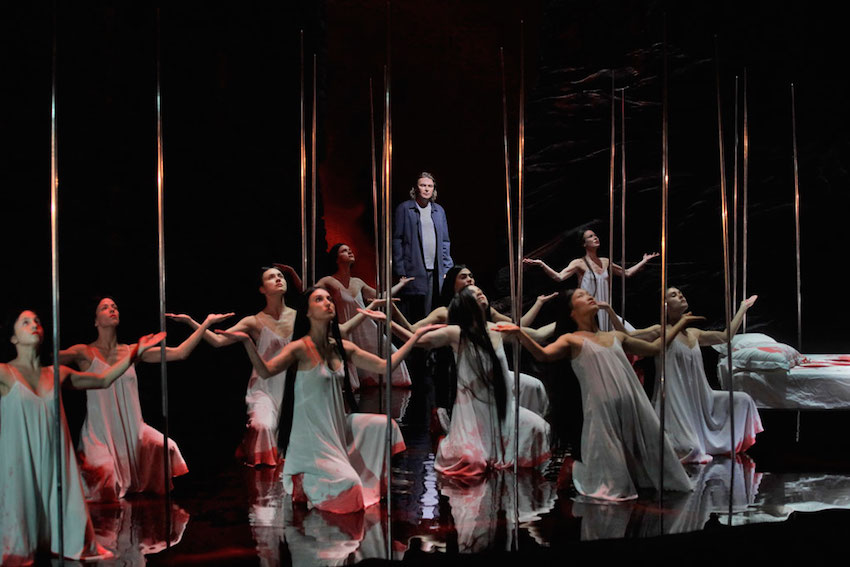
He was matched in his movements in the brilliantly choreographed movements of the Blumenmädchen who moved as one and made for as spectacular a stage picture as one could hope for. The singing by these "girls" was sensuous and had a youthful femininity that seemed fresh and erotic - both welcome elements. These were not middle aged women in flowing caftans trying to lure a pudgy tenor dressed as a boy, but physically alluring, manipulative menaces using their wiles. It was, in a word; hot.

Evelyn Herlitzius, who made her company debut in this run, presented us with richly drawn, emotionally gripping
Kundry. Bolder and perhaps more wild than many before her both vocally and dramatically she "felt" like Kundry. There was not the beauty of tone of, say, Crespin (who compared in that department?) or Troyanos, and top notes were on pitch, though often lunged at, the effect was special and one just believed this was Kundry.

In the title role we were treated to a much lighter sounding Parsifal than anyone can probably recall . . . certainly in my memory there has been no tenor who made this same effect. The "boyish" timbre of his voice bothered some, but me, not at all. While the voice has a "thin" quality to it, Vogt projects it masterfully, and made me believe every moment. I'd heard criticisms that Parsifal should sound "older" in the final act, but I personally don't buy into that. Most of us have had the same voice quality since we were young, and, as a friend told me (paraphrasing someone), "your voice is your voice, you can't pick up another one up at the corner store" adding, "especially during a second intermission."

As one always hopes for every opera, particularly Parsifal, the audience was about as well behaved as could be, coughing was at a minimum (usually only when dust seemed to blast out of the air conditioning system), no applause before the music was finished, everyone seemed hushed and caught up in the moment. Indeed, at the ovation, everything that had been held in check was given ample opportunity to explode, and that's the correct word for what happened when the curtain rose for bow time. Every singer received sustained applause and cheers, the chorus was roared at as was the incoming Music Director, who, after working so hard for so long, could not contain himself, running to every corner of the stage, hugging and shaking hands with a youthful exuberance that bodes well for the company's future. All things came together in a way that was uniquely special, and I received what I always want from a Parsifal: everything in the world.

Photos by Ken Howard taken from multiple internet sources

Labels: , , , , , , , , ,

Tuesday, February 6, 2018

Parsifal at The Met: Revival Redemption at Monsalvat


I had some difficulty tuning in last night and, there were several glitches on Sirius including an infuriating “This is a test of the Emergency Broadcast System . . . “ a few minutes into one of Gurnemanz’s 3rd act monologues and worse – Sirius dropping out during Parsifal’s final line and receiving the “content not available” message before Mahler began playing from another Sirius channel. Even these, however couldn’t (fully) spoil the effect that was being made over the air, and, based on good evidence, emanating from the house itself.

Yannick Nézet-Séguin led what can only be described as an extraordinary reading of an extraordinary score and his love for this score was made palpable in its execution. Moments, like some of those orchestral interludes during Gurnemanz’s monologues that change its tone which many others either gloss or languish over, here crackled with life, a vibrancy in the strings that was electric. The first transformation scene went about as beautifully as Knappertsbusch, with a similar sense of moving forward and at Gurnemanz’s response (my favorite line from any opera) to Parsifal’s observation:

"Du siehst, mein Sohn,
zum Raum wird hier die Zeit!"


We were all along for that journey. Here was shape and form, expansive where it needed to be, then firm . . . taut with a momentum like some great galactic force pulling each of us, inexorably, into its core. I was, as I always want to be by Parsifal, overwhelmed and transported.


That same care and detail, without being over precious was to be heard also in the Good Friday music, every measure part of the journey.

In the title role Klaus Florian Vogt will not likely be to the liking of some (most?) of our listers here. My first encounter with him – about ten years ago – found me perplexed . . . the tone that, I thought, of a countertenor. After a few years I’ve come to love his interpretations of both Parsifal and Lohengrin. Vogt began his musical career as a horn player with the Philharmoniker Hamburg and played in the pit for Parsifal. There is a purity of tone – almost treble like – in his singing that I feel works wonderfully in this role paired against both Frau Herlitzius and Herr Pape
brought an interesting aural tapestry, all the richer for its inclusion of light.

Making her company debut, Evelyn Herlitzius offered a wonderfully drawn Kundry. Bolder than many, more wild than some in her delivery. When she wanted sleep, you just know that no one in the world has ever been more exhausted than this lady. She took interesting liberties with her laugh at Klingsor – beginning it earlier and lasting longer and less “measured” than one is generally accustomed to. She was sensational and different than my other favorite Kundries who offered more plush to their sound (think Ludwig, Troyanos, et. al.) and more in the Modl and Meier vein. Whatever she did, it all boiled down to making me believe she really was Wagner's most fascinating character.

Of Klingsor, all one can say of Evgeny Nikitin is that he sings the role as though born to it. Too often for my taste has Klingsor had a wiry sound, more “Merlin the Magician” not enough menace. Not so Nikitin who roars through the part like a beautiful, sexy howling beast. There was evil, snarling beautifully through and, for some folks who like the darker side, there is a sinister, sensuality in the terror he offers with no apology. Brilliant.

His Blumenmädchen sounded sexier than usual, girly and wild (“Girls Gone Wild,” I remarked to friends last night on FB). They definitely didn’t sound like middle-aged matrons in caftans beckoning a hefty tenor in boy’s clothing. There was definite “snap” going on in their sound which somehow managed to be both luscious and lean. Delightful.

When Peter Mattei first took on Amfortas everyone (including me) thought why? Well, he showed us all why when this production first appeared here, and, as though we could possibly forget, reminded us again last night. The elegiac quality of his suffering is exquisitely portrayed, the sound, focused, unforced, open with a raw beauty so exposed it almost feels “raw.”

Rene Pape has, from the beginning, been one of the most beautifully sung, sonorous Gurnemanz in my experience. He belongs up there with the best interpreters of the role. While at this stage of the game a singer could just offer what he knows would “sell” – Pape goes beyond this. One can hear some age in his voice, softening the old knight’s sternness, and, if at all possible, deepening the intensity, whilst balancing it with gentleness. Nowhere was this more evident than in the Good Friday music, where he evokes nature itself and spins out such tenderness in:

"Nun freut sich alle Kreatur
auf des Erlösers holder Spur,
will sein Gebet ihm weihen
."

Just his mere utterance of “Kreatur” is a model of exquisite word painting.

Everything about this performance lifted my heart up last night, made me glad to be alive right now regardless of what else is happening in this crazy world. For six hours last night we had the opportunity to be lost in the time space continuum on our way to Monsalvat.

I can hardly wait to experience this live in a few weeks – and that, friends, is an understatement.

Photo Credits: Ken Howard/Metropolitan Opera

Labels: , , , , , , , , , , , , ,